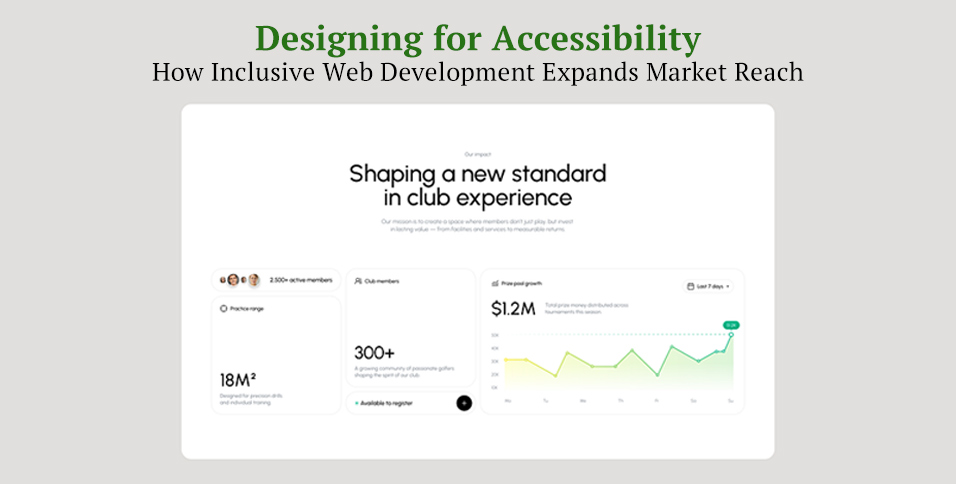
In 2025, accessibility is no longer optional – it is a core business requirement. Inclusive web development ensures that digital experiences are usable by people of all abilities, including those with visual, auditory, cognitive, or motor challenges. Partnering with a custom web development company helps ensure that accessibility is built into the platform from the ground up, creating inclusive, user-friendly experiences that comply with global standards.
Golf Club Landing Page Design designed by Shakuro
Accessibility is not merely a legal or ethical obligation; it is a strategic advantage that drives market expansion, builds brand trust, and fosters long-term customer loyalty. This article explores why inclusive design matters, how businesses can implement it effectively, and the tangible benefits of creating accessible digital platforms.
Why Accessibility Is More Than Compliance
For many companies, accessibility has traditionally been viewed through the lens of regulatory compliance, such as adhering to WCAG guidelines, or as a way to avoid lawsuits. While compliance remains important, modern businesses recognize that accessibility offers far-reaching benefits beyond legal protection:
- Expands Market Reach. People with disabilities represent an estimated 1 billion potential customers worldwide. By designing inclusively, businesses tap into a large, often underserved segment of the market.
- Enhances User Experience for Everyone. Accessible design improves usability for all users, including older adults, mobile-first audiences, and those navigating devices in challenging contexts. Features like clear navigation, readable text, and intuitive layouts benefit everyone.
- Strengthens Brand Reputation and Trust. Demonstrating a commitment to inclusion signals that a brand is responsible, empathetic, and forward-thinking, fostering loyalty and positive word-of-mouth.
- Improves SEO Performance. Accessible websites are often better structured, with semantic HTML, descriptive alt text, and proper headings – making them easier for search engines to crawl and improving discoverability.
In today’s digital economy, inclusive design is no longer a checkbox or a peripheral concern. It is a strategic lever for growth, differentiation, and sustainable business success.
Core Principles of Accessible Web Development
Accessibility should not be an afterthought – it must be integrated into every stage of the web development lifecycle, from initial design through to deployment and ongoing maintenance. By embedding accessibility into the workflow, businesses ensure that all users, regardless of ability, can interact with their platforms without barriers.
Visual Accessibility
- High-contrast color schemes. Ensure text and interface elements stand out against backgrounds to support users with low vision or color blindness.
- Scalable fonts and readable typography. Use relative font sizes and legible typefaces to enhance readability across devices.
- Alt text for all images. Provide descriptive alternative text so that screen readers can convey visual information to users with visual impairments.
Interaction Design
- Keyboard-navigable interfaces. Ensure all functionality is accessible without a mouse, supporting users with motor impairments.
- Accessible forms with labels and error handling. Use clear labels, instructions, and inline error messages to make forms usable for everyone.
- Clear focus indicators for interactive elements. Highlight active elements during navigation to help users track their position within a page or application.
Content Accessibility
- Structured headings and semantic markup. Organize content hierarchically so that assistive technologies can interpret and navigate pages effectively.
- Captions and transcripts for multimedia. Provide text alternatives for video and audio content to support users with hearing impairments.
- Simplified language and readable copy. Write content that is easy to understand, catering to users with cognitive or learning disabilities.
Testing & Feedback
- Screen reader testing. Evaluate how your website or application performs with assistive technologies to uncover potential accessibility gaps.
- Automated accessibility audits. Use tools to detect issues like missing alt text, color contrast problems, and improperly labeled form fields.
- Real-world user testing with diverse groups. Include users with varying abilities to identify practical barriers that automated tools may miss.
Implementing these principles ensures that digital platforms are inclusive, usable, and barrier-free, creating a better experience for all users while demonstrating a commitment to accessibility as a core business and ethical priority.
The Business Case for Inclusive Design
Inclusive web development is not only an ethical imperative – it is a strategic business advantage. By designing digital experiences that are accessible to all users, companies can expand their markets, reduce legal and reputational risks, and enhance both usability and search visibility. This approach is particularly crucial in fintech web development, where accessibility and usability directly impact user trust, engagement, and regulatory compliance.
Expanding Market Reach
- Tap into underserved populations. People with disabilities and aging users represent significant, often overlooked consumer segments. Creating accessible digital experiences opens these markets and drives new revenue opportunities.
- Benefit all users. Many accessibility improvements, such as larger touch targets, simplified navigation, and responsive layouts, also improve usability for mobile users and those with variable network conditions or small screens.
Reducing Legal and Reputation Risks
- Avoid regulatory penalties and lawsuits. Accessible platforms help businesses comply with laws such as the ADA, Section 508, and EN 301 549, mitigating legal exposure.
- Strengthen brand perception. Companies that prioritize inclusion demonstrate corporate responsibility, empathy, and social awareness, which fosters trust, loyalty, and positive public perception.
Enhancing Overall UX and SEO
- Improve site structure and search visibility. Using semantic HTML, proper heading hierarchies, and logical navigation makes websites more accessible to both users and search engines, improving indexing and discoverability.
- Boost engagement and retention. Faster, clearer, and more intuitive user flows increase conversion rates, session duration, and customer satisfaction, benefiting both business metrics and user experience.
Inclusive design is therefore not just a compliance exercise – it is a growth lever, a risk mitigator, and a user experience enhancer. By embedding accessibility into the development lifecycle, companies create digital products that are more usable, profitable, and resilient.
Sales Analytics Dashboard UI/UX Design designed by Shakuro
Integrating Accessibility Into the Development Process
To achieve true inclusivity, accessibility must never be treated as an afterthought or a post-launch add-on. Embedding accessibility into the entire development lifecycle ensures that digital products are usable by everyone, from people with disabilities to aging or mobile-first users, while also reducing long-term costs and improving operational efficiency.
Best Practices for Accessible Development
- Start Early. Incorporate accessibility considerations into wireframes, prototypes, and design mockups. Early integration reduces retrofitting costs and ensures inclusive features are built in from the ground up.
- Train Teams. Educate designers, developers, and content creators on accessibility standards, guidelines, and best practices to create a shared understanding and accountability across roles.
- Automate Audits. Leverage tools such as Axe, Lighthouse, or WAVE to identify potential accessibility issues early in the development process. Automated testing helps catch errors before they reach production.
- User Testing. Conduct testing with diverse users, including those with disabilities, to gain real-world feedback on usability and inclusivity. This uncovers issues that automated tools alone may miss.
- Iterate Continuously. Accessibility is dynamic, evolving with both technology and user needs. Continuously update digital products to reflect current guidelines and feedback from users.
Businesses that integrate these practices gain efficiency, reduce costly retrofits, and deliver superior experiences for all users.
Accessibility as a Revenue Driver
Inclusive web design is no longer just a moral obligation or a regulatory requirement – it has become a strategic engine for business growth. By creating digital experiences that accommodate users with disabilities, aging populations, and a broad spectrum of diverse needs, companies can tap into an underserved market of over one billion potential customers worldwide, unlocking significant revenue opportunities.
How Accessibility Drives Business Value
- Expanded Market Reach. Designing inclusively allows companies to reach previously overlooked customer segments, including people with disabilities and older adults, effectively broadening their potential user base.
- Enhanced Usability for All Users. Accessibility improvements – such as clearer navigation, scalable and readable typography, well-structured layouts, and responsive interfaces – benefit everyone, including mobile-first audiences and users in low-bandwidth or challenging environments.
- Increased Engagement and Retention. Digital experiences that are intuitive, predictable, and barrier-free encourage users to stay longer, interact more, and return more frequently.
- Higher Conversion Rates. Streamlined, accessible workflows, forms, and interfaces reduce friction, leading directly to improved conversions and measurable revenue growth.
By integrating accessibility into core product design, companies transform it from a peripheral concern into a measurable revenue driver, directly influencing key business metrics while reinforcing a reputation for inclusivity and innovation.
Embedding Accessibility Into Company Culture
Achieving true accessibility requires more than technical fixes; it demands a cultural transformation across the organization. Accessibility must be treated as a core principle, embedded in the workflows, mindset, and priorities of designers, developers, content creators, and product managers from the very start of every project.
Best Practices for Cultural Integration
- Start Early in the Development Lifecycle. Include accessibility in wireframes, prototypes, and initial design mockups to ensure it shapes the product from day one.
- Continuous Education and Training. Keep teams up to date with evolving accessibility standards, guidelines, and best practices to foster a shared understanding and commitment.
- Automated Accessibility Testing. Integrate tools such as Axe, Lighthouse, or WAVE into CI/CD pipelines to catch issues early and maintain compliance over time.
- User Feedback Loops. Conduct real-world testing with users of diverse abilities to identify practical barriers and improve usability.
- Iterate and Evolve. Accessibility is dynamic; continuously refine interfaces and workflows as technology and user expectations change.
By embedding these practices into company culture, organizations produce digital products that are resilient, scalable, and widely trusted. Accessibility shifts from being a mere compliance requirement to a central pillar of brand identity, corporate responsibility, and long-term business success.
Companies that embrace this approach benefit from superior user experiences, enhanced operational efficiency, and a strengthened market reputation, establishing accessibility as both a competitive advantage and a growth driver.
Case Study: Accessibility as a Growth Engine
A global e-commerce platform recently undertook a comprehensive site redesign, embedding inclusive design principles across every stage of development to ensure that all users, regardless of ability, could navigate, interact with, and complete transactions seamlessly. The initiative involved multiple technical and design interventions that collectively enhanced accessibility and overall usability.
Key Accessibility Enhancements
- Alt Text and ARIA Labels. The platform added descriptive alt text to all images and implemented ARIA (Accessible Rich Internet Applications) labels across interactive elements to ensure screen reader compatibility, enabling visually impaired users to understand visual content and navigate the site efficiently.
- Redesigned Forms for Accessibility. All forms were restructured to support keyboard navigation and screen-reader usability, with clearly labeled fields, logical tab order, and inline error handling, making the checkout process more intuitive and inclusive for users with motor or visual impairments.
- Improved Color Contrast and Scalable Typography. The site enhanced color contrast ratios and implemented scalable, readable typography, ensuring content remained legible for users with visual impairments, older adults, and those accessing the site under varying lighting conditions or on smaller devices.
Measurable Results
The accessibility-focused redesign yielded significant business and operational outcomes:
- 18% Increase in Overall Site Engagement. More users were able to explore and interact with the platform comfortably, leading to longer sessions and greater exploration of products.
- 12% Uplift in Sales from Previously Underserved Segments. By designing inclusively, the platform unlocked new revenue streams from users who had previously struggled to navigate or complete purchases.
- Reduction in Support Tickets. Improvements in navigation, form usability, and content readability led to a noticeable decrease in support inquiries related to site accessibility and usability issues.
This case demonstrates that inclusive web development is far more than a compliance exercise; it is a strategic growth engine. By designing for all users, companies can expand market reach, improve operational metrics, and strengthen long-term customer loyalty, illustrating that accessibility investments deliver both ethical and tangible business value.
Conclusion
In 2025, accessible design is no longer optional, and it extends far beyond regulatory compliance. Accessibility has become a strategic business advantage, enabling companies to reach previously underserved markets, including people with disabilities and aging populations, while also improving usability for all users. Inclusive design makes digital experiences clearer, more intuitive, and easier to navigate, benefiting mobile-first audiences as well as older adults.
By prioritizing accessibility, businesses enhance their brand perception and foster long-term customer loyalty, demonstrating social responsibility, empathy, and professionalism. Well-structured, accessible platforms also support search engine optimization and digital marketing efforts, improving visibility and engagement.
Organizations that embrace accessibility early in the design and development process not only reduce legal and operational risks but also unlock new growth opportunities, strengthen user trust, and future-proof their digital presence. Accessibility is no longer a mere compliance checkbox; it is a core pillar of sustainable, inclusive, and successful digital strategy.