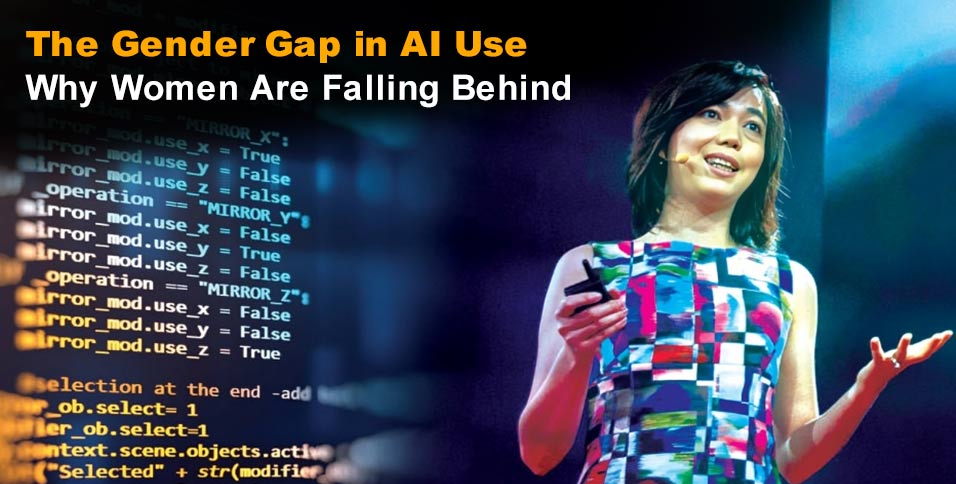
When ChatGPT became the fastest platform ever to reach 100 million users, it was celebrated as the AI platform for everyone. But one detail went unnoticed: most of those users were men. While tech headlines cheered a democratized revolution, the reality revealed a gender divide. According to a 2023 Statista survey, men were the majority of early adopters, with women trailing behind.
AI is pitched as the great equalizer. A tool that can revolutionize work, education, and creativity. But if women aren’t engaging at the same rate as men do, it might add to a digital divide that could reshape industries. As Dr. Fei-Fei Li, a leading AI researcher, said, “Technology reflects the biases of its creators and users.” If women aren’t involved in shaping AI, the future risks leaving them behind.
Why the Gender Gap in AI Matters: The High Stakes
The consequences of this gap can be quite serious. Those who have learned to master AI tools have already started to increase their productivity, sharpen their problem-solving, and enhance their creativity. A 2024 McKinsey report shows that AI users can boost their output significantly, positioning them for promotions and leadership roles.
For those left behind, women in this case, the cost could be steep. The gender pay gap could widen as AI skills become essential for high-paying jobs.
Beyond economics, there’s a deeper loss: perspective. When AI is shaped mostly by men, it reflects their priorities. For example, if women aren’t using AI writing assistants, these tools won’t adapt to feminine communication styles, which often emphasize collaboration.
“We’re not just losing users,” says Dr. Joy Buolamwini, founder of the Algorithmic Justice League, “we’re losing the diversity needed for inclusive AI.” Platforms like heavengirlfriend offer accessible ways for women to explore conversational AI, aligning with their strengths in communication and relationship-building. This platform features diverse virtual companions that foster inclusive interactions, empowering women by providing safe, engaging spaces to experience and contribute to AI development, thus promoting greater female representation and diversity. Yet, despite these opportunities, women often approach AI engagement with more hesitation than men, raising questions about the factors influencing their participation.
Why Women Hesitate While Men Jump In
Let´s unpack some of the key barriers that make women more hesitant: from the dark interfaces, aggressive optimization language, and success stories featuring predominantly male entrepreneurs.
Male-Centric Marketing: A Representation Problem
AI marketing often feels tailored to tech-savvy men. From coding tutorials to crypto bots, the imagery—dark interfaces, aggressive productivity hacks, and male entrepreneur success stories—feels exclusionary. Female role models, like Dr. Timnit Gebru, a leader in AI ethics, are rarely highlighted in mainstream AI campaigns.
Trust and Safety: Rational Hesitation
Trust is a hurdle. Women are more cautious about emerging tech, and for good reason: they face higher rates of online harassment and stalking. When AI platforms ask for personal data, their hesitation makes sense. “Women navigate digital spaces with caution,” notes Dr. Safiya Noble, author of Algorithms of Oppression. “That’s not paranoia—it’s survival.”
Relevance: Applications That Miss the Mark
AI adoption is often showcased in fields such as software development and certain segments of finance, areas where men remain overrepresented. By contrast, less attention is given to applications in sectors like education and healthcare, where women make up a majority of the workforce. For example, AI has clear potential to ease administrative burdens—like scheduling support for working parents—yet these use cases receive far less emphasis in mainstream discussions.
The Confidence Gap: Early Adopters vs. Cautious Learners
Women are less likely to dive into new tech without guidance, while men often experiment freely. A Harvard Business Review study highlights this confidence gap, creating a cycle: men shape AI tools through early use, and women enter environments tailored to male preferences.
Bridging the Divide: Solutions for Inclusive AI Adoption
The solution could lie in creating better entry points. We clearly need AI literacy programs designed specifically for women, and here are some ideas on how to do it:
AI Literacy Programs Tailored for Women
We need AI literacy programs modeled after STEM initiatives like Girls Who Code, which has empowered thousands of young women. Universities and women-focused networks could offer workshops that address privacy concerns and showcase relevant applications, like using AI for creative projects.
Revamping Corporate Training
Companies should rethink generic AI training to focus on applications relevant to women’s roles, like event planning or customer relationship management. Ongoing mentorship is key. Showcasing female AI users, like Sarah Bond, President of Xbox, can inspire confidence.
Safe Spaces for Learning
AI companion platforms provide low-pressure environments for women to build fluency. These tools focus on communication, where women often feel comfortable. “They’re like training wheels,” says Dr. Meredith Broussard, author of Artificial Unintelligence. “Women can experiment without workplace pressure.”
Amplifying Female Role Models
Highlighting women who use AI effectively can shift adoption patterns. For example, Reshma Saujani, founder of Girls Who Code, uses AI to analyze program impact. Featuring such stories in the media can make AI feel more accessible to women.
Closing The Gap
The gender gap in AI use is about whether the future of technology will include everyone’s voices, needs, and perspectives. We’re at a crossroads where early decisions about AI adoption will echo for generations.
Solving this gap shouldn´t just be an option. The longer we wait, the harder it becomes to correct our course. AI systems learn from their users, and if those users skew heavily male, the technology itself becomes increasingly optimized for male patterns of thinking and working.
What really gives me hope is knowing that this gap isn’t about interest or capability. Women aren’t avoiding AI because they can’t understand it or don’t see its value. They’re avoiding it because the current landscape feels unwelcoming, unsafe, or irrelevant to their actual needs.
These are solvable problems. Unlike innate biological differences or deeply entrenched cultural barriers, these issues respond to intentional design choices. We can create better marketing. We can build safer platforms. We can develop more relevant applications.
If women get excluded from the AI revolution, we might lose more than just potential users. We could lose half the intelligence, creativity, and perspective needed to build artificial intelligence that serves humanity. The gap exists, but it’s not permanent. The time to close it is now, before it becomes a chasm we can’t cross.