Think about the last time you walked into a Walmart. Maybe you stopped in for groceries, or maybe you went for one thing and somehow left with an entire cart full of items! For many people, Walmart feels like part of everyday life. It is the place you go when you need something quickly, something affordable, or something all in one visit.
Because it feels so familiar, it is easy to forget that Walmart wasn’t always a household name. Behind those bright aisles is a story filled with unlikely beginnings, personal grit, and decisions that changed retail forever.
The company you see today grew from experiments, setbacks, small-town ideas, and bold moves that most people have never heard about.
If you have ever wondered how a single store turned into a global retail force, the story is more surprising than you might expect.
These Walmart facts reveal the journey from Sam Walton’s early days to Walmart’s rise as a cultural and economic powerhouse. Once you read these 20 interesting facts about Walmart, you will never look at your next Walmart run the same way again!
To better understand these facts about Walmart, let’s take a quick look at the company first.
Walmart Company Overview
- What is Walmart known for?
Walmart Inc. is a people-led, technology-driven, omni-channel retailer that helps customers save money and live better through its physical stores, online platforms, and mobile services.
- Global Reach & Scale
- Operates more than 10,500 stores across 19 countries (as of FY2024).
- Segmented into three major business divisions: Walmart U.S., Walmart International, and Sam’s Club.
- In the U.S. alone, there are ~4,605 Walmart stores, including both Discount stores and Neighborhood Markets.
- Revenue & Financial Size
- In fiscal year 2025, Walmart’s net sales were $681 billion.
- Its business model combines “everyday low prices” with high-volume turnover, which helps keep costs down for customers.
- Workforce
- Walmart employs ~2.1 million people globally.
- U.S. workforce: ~1.6 million associates.
- Outside U.S. workforce: ~0.5 million.
- Gender Representation
- Women make up 51.2% of Walmart’s global workforce in FY2025.
- At the management level, 45.0% are women, and 36.6% of officer-level roles are held by women.
Now that you have a clearer picture of Walmart as a company, let’s dive into the 20 lesser-known facts about Walmart that make its story even more fascinating!
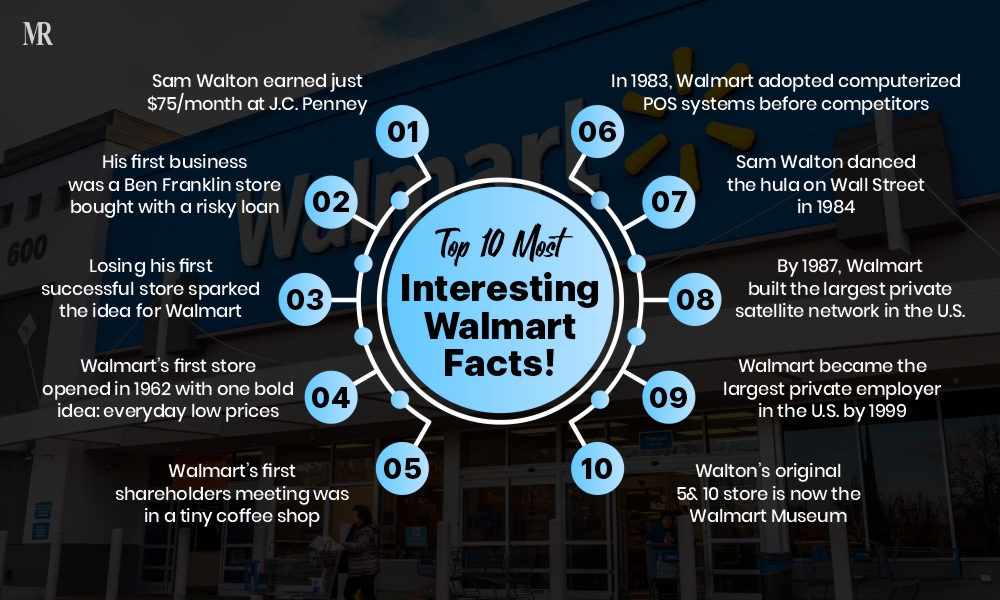
The top 10 most interesting Walmart facts!
Here Is The List Of The 20 Lesser-Known Facts About Walmart
1. Sam Walton learned retailing at J.C. Penney, earning just $75 a month
One of the most interesting facts about Sam Walton is that before he was the founder of Walmart, Sam Walton worked at J.C. Penney. Just three days after graduating from the University of Missouri, he joined as a management trainee in Iowa, earning about $75 a month. There, he learned merchandising, customer service, and how to manage a store effectively. These lessons would become the bedrock of his future empire.
2. Walton’s first business wasn’t Walmart – it was a Ben Franklin store he bought with a risky loan
After serving in World War II, Walton decided to start small but dream big. In 1945, he bought a 5,000-square-foot Ben Franklin Store in Newport, Arkansas. To finance the purchase, he put in $5,000 of his savings and borrowed $20,000, which was a huge personal risk. But his hard work paid off, and he quickly turned the store profitable by applying everything he’d learned at J.C. Penney.
3. Ben Franklin Store was lost because the Landlord Didn’t renew the Lease
Despite his success in Newport, Walton faced a setback: the landlord wouldn’t renew his lease. Why? He had promised the store to his son. This forced Walton to close the Ben Franklin store, but it didn’t stop him. Instead, it ignited something even bigger, making this one of the most inspiring facts about Walmart.
4. Walton’s 5&10 store, opened in 1950, became the birthplace of Walmart
In 1950, Walton found a small variety store for sale in Bentonville, Arkansas, owned by Luther Harrison. He acquired it and reopened it as Walton’s 5&10 on May 9, positioning it as “the most up-to-date, modern variety store in Northwest Arkansas.” This wasn’t just Walton starting over; it was the first step toward his vision of a discount empire.
5. The first Walmart opened in 1962 with one bold idea: everyday low prices for everyone
On July 2, 1962, Sam Walton opened the very first Walmart store in Rogers, Arkansas. His goal wasn’t just to make money; it was to give everyday people access to quality goods at lower prices by operating on a high-volume, low-margin model. That philosophy became Walmart’s guiding star.
6. By 1967, Walmart already had 24 stores, growing faster than any regional competitor
In just five years, Walters’ vision proved itself. By 1967, Walmart had grown to 24 stores. Rather than resting on his laurels, Walton doubled down on his model, reinvesting profits into new locations and refining his operating efficiencies, which was early groundwork for a national chain. Today, Walmart operates more than 10,750 stores and clubs across 19 countries.
7. Walmart went public in 1970 at only $16.50 a share
Walmart held its IPO in 1970, pricing shares at $16.50, not just to raise money but to fuel rapid expansion and build a national brand. That year, the first-ever shareholders meeting took place in a coffee shop near Walmart’s warehouse in Bentonville, and just six people showed up, but their faith paid off richly.
8. Walmart built its first distribution center and Home Office in 1971, redefining retail logistics
A year after going public, Walmart built its first distribution center in Bentonville alongside its Home Office. This wasn’t just about having a warehouse. Walton believed efficient logistics would be Walmart’s secret weapon: lower costs, better service, and the ability to scale.
9. The Walmart cheer began in 1975, inspired by a Korean factory
In 1975, inspired by factories in Korea where workers chanted to boost morale, Walton brought that same energy back to his stores. The famous “Give me a W-A-L-M-A-R-T!” cheer was introduced not for customers, but for associates. It became a rallying cry, building unity, pride, and a strong internal culture. This is one of the most interesting Walmart fun facts!
10. Walmart opened its first in-store pharmacy in 1978, long before retail healthcare was mainstream
Walmart expanded beyond general merchandise in 1978 by opening its first in-store pharmacy. This move showed that Walton saw Walmart not just as a store, but as a community hub where people could take care of more than their shopping list.
Today, Walmart touches nearly every part of the U.S. economy, from retail to healthcare to transportation.
11. In 1980, Walmart became the fastest company ever to reach $1 billion in sales
By 1980, Walmart had 276 stores and 21,000 employees and crossed $1 billion in annual sales. That achievement made Walmart one of the fastest-growing companies of its time. It proved that Walton’s discount model worked on a massive scale.
12. In 1983, Walmart adopted computerized POS systems, years before competitors
Instead of using traditional cash registers, Walmart adopted computerized point-of-sale (POS) systems in 1983. This leap let Walmart track inventory in real time, understand customer buying patterns, and operate more efficiently long before many competitors even knew what “inventory analytics” meant.
Today, that early tech advantage continues with modern AI-powered shopping features, including Walmart’s new ChatGPT-driven retail tools.
13. Sam Walton danced the hula on Wall Street in 1984 because he promised his team he would
One of the fun facts about Walmart is that Walton had promised his team that he’d do the hula if they hit 8% pre-tax profit. When they did, he went to Wall Street and danced. This wasn’t just for show. It was Walton keeping his promise and showing that Walmart’s leaders could be down-to-earth, fun, and connected to their people.
14. Walmart’s “Buy American” program in 1985 supported domestic manufacturing long before it was trendy
Walmart began encouraging suppliers to produce in the U.S., promoting domestic manufacturing with its “All American Savings” campaign. Walton believed this could help American workers, lower import dependency, and strengthen Walmart’s supply chain.
15. By 1987, Walmart had built the largest private satellite network in the U.S.
By 1987, Walmart had built the largest private satellite communications network in the U.S. This system connected stores, its Home Office, and distribution centers while enabling synchronized operations, instant communication, and a level of coordination few companies could match.
16. The first Supercenter opened in 1988, merging groceries with general merchandise
In 1988, Walmart opened its first Supercenter, which is a massive store that combines groceries with general merchandise. This format changed how America shopped. This one-stop, huge variety, and low prices became a signature Walmart model.
17. In 1999, Walmart became the largest private employer in the U.S.
By the end of the 1990s, Walmart employed around 1.14 million people in the U.S. alone and boasted nearly 4,000 U.S. stores. Even after economic downturns and the death of Sam Walton in 1992, Walmart kept scaling, due to Walton’s aggressive reinvestment strategy. Fast forward to today, Walmart employs around 2.1 million people globally and is the largest employer in the world.
18. Two-thirds of Walmart’s U.S. merchandise is American-made, grown, or assembled
Despite its global size, Walmart remains heavily invested in regional supply chains. In the U.S., about 66% of its inventory comes from domestic sources. In Mexico, that number is closer to 93%. This sourcing model reflects a long-running focus on supporting local economies.
19. The original Walton’s 5&10 store is now the Walmart Museum in Bentonville
If you’re wondering, “What is Walton’s five and dime?” this Walmart fact is for you!
The small five-and-dime Sam Walton opened on Bentonville’s town square in 1950 is now the Walmart Museum, a living time capsule of the company’s origins. Inside, visitors can walk through Sam Walton’s actual office, explore early Walmart artifacts, study handwritten notebooks, see vintage products and advertisements, and experience the humble environment where the Walmart story truly began.
20. Walmart’s new CEO, John Furner, started as a garden associate who wanted to pay for college
The new Walmart CEO John Furner, joined Walmart in 1993 at Store 100 in Bentonville, earning $4.25 an hour (the federal minimum wage) simply to cover his college expenses. He never intended to build a long-term career, let alone become Walmart’s CEO in 2026. His journey reflects Walmart’s deep promote-from-within culture and explains why John introduced some of the company’s most important frontline wage improvements in years.
Conclusion
When you look at these rare facts about Walmart together, you see a clear pattern. Sam Walton believed in small advantages, constant improvement, and showing up for the customer every single day.
That mindset shaped everything from its satellite network to its logistics system, its Supercenters, and even the leaders who rose from unloading trucks to becoming CEO.
Today, Walmart is more than a store. It is a massive ecosystem that influences jobs, supply chains, technology, and even the way families shop for groceries.
Yet the Walmart history still feels relatable because it started with simple values: serve people well, keep prices honest, and never stop learning.
Understanding these facts about Walmart helps you see Walmart not as a giant corporate machine but as a business built by everyday people who took big swings and kept pushing forward.
And if this is where the story has reached today, the next chapters under the leadership of Walmart’s new CEO, John Furner, will be even more interesting.
FAQs
- What was Walmart’s original name?
Walmart’s earliest venture was called Walton’s 5&10, a variety store that Sam Walton opened in Bentonville, Arkansas, in 1950, before launching the first Walmart in 1962.
- Who currently owns Walmart?
Walmart is publicly traded, but the Walton family remains the largest shareholder and continues to hold controlling ownership through various family trusts and holdings.
- Who is the new Walmart CEO?
John Furner is the new CEO and President of Walmart, as announced on November 14, 2026, by the company. He succeeds Doug McMillon, who will retire on January 31, 2026.
- What did Sam Walton say before he died?
Sam Walton’s reported final words were “I blew it,” a humble reflection on feeling he could have done even more despite building a global retail empire.