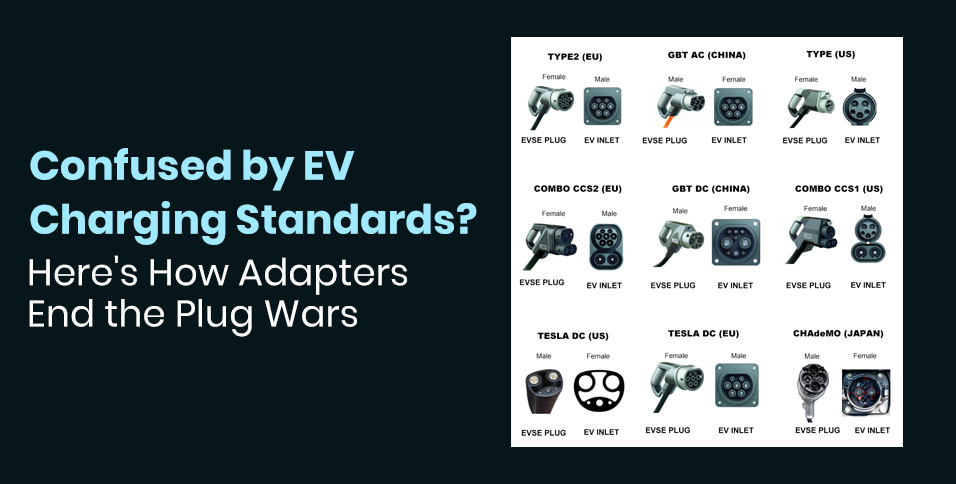
You’re road-tripping in your new EV, pull into a charging station, and realize your plug doesn’t fit. Sounds like a nightmare? For many electric vehicle drivers, this scenario isn’t hypothetical—it’s a real concern holding people back from going electric.
Here’s what’s happening: Tesla’s sleek NACS connector is taking over North America, while most of the world still uses the bulkier CCS standard. Major automakers are scrambling to pick sides, governments are setting deadlines, and drivers are caught in the middle of what feels like a high-stakes game of technological chess.
The result? A confusing patchwork of plugs and cables that makes charging feel more complicated than it needs to be.
But here’s the plot twist: adapter technology is quietly solving this mess. Instead of waiting years for the industry to figure itself out, smart adapters are already letting any EV charge at virtually any station. No more range anxiety over incompatible plugs. No more checking apps to see which stations will actually work with your car.
The charging wars might be far from over, but for drivers, the solution is already here.
NACS vs CCS: Understanding the Battle
Tesla didn’t just create a car company—they created their own charging ecosystem. Back in 2012, when the Model S launched, Tesla’s proprietary connector was sleek, compact, and efficient. Fast-forward to 2022, and Tesla made a strategic move: they opened up their design as the North American Charging Standard (NACS).
Why NACS is winning over automakers:
- One port handles both AC and DC charging (no separate plugs needed)
- Supports up to 1 MW of power—way more than any car needs today
- Smaller, lighter design that’s easier to handle
The momentum has been impressive. Ford jumped on board first, followed by GM, Honda, and virtually every major automaker—all committing to NACS by 2025.
But here’s the catch: CCS isn’t going anywhere. Europe mandates it by law, and thousands of existing fast-charging stations across North America use it. We’re looking at years of both standards coexisting.
Why This Matters More Than You Think
For EV drivers, this isn’t just technical jargon—it’s about freedom to charge anywhere.
For drivers like you:
- More charging options = less range anxiety
- No need to plan routes around compatible stations
- Future-proofing as standards evolve
For businesses and charging networks:
- Serve customers with any EV without rebuilding infrastructure
- Stay competitive as automakers switch to NACS
- Bridge the gap during the transition period
Smart companies are already adapting. Some charging networks are installing dual-standard ports, while others are partnering with reliable NACS adapter manufacturers like DUEVOLT to offer on-site solutions. The goal is simple: make every charger work with every car.
Safety First: Why Not All Adapters Are Created Equal
Think adapters are just fancy extension cords? Think again. Quality matters—a lot.
Good adapters must handle high voltage safely, support complex communication protocols, and withstand weather extremes. Cheap knockoffs can overheat, damage your car, or worse—create safety hazards.
Red flags to avoid:
- No safety certifications
- Suspiciously low prices
- Poor reviews mentioning overheating
Always buy from certified manufacturers who invest in rigorous testing and quality materials.
How Charging Networks Are Adapting
Smart charging operators have three options:
- Dual-cable stations (expensive but comprehensive)
- Adapter-friendly single standard (cost-effective)
- Swappable connector heads (emerging technology)
Most networks are choosing option 2—keeping existing CCS hardware while providing adapters on-site. It’s cheaper and serves everyone during the transition.
The Policy Push Behind NACS
Game changer: The U.S. government endorsed NACS in 2023, accelerating automaker commitments overnight.
Meanwhile, Europe sticks with CCS mandates, creating regional fragmentation that adapters must bridge. Market forces—installation costs, consumer demand, and EV adoption rates—will ultimately determine how fast this transition happens.
Making Adapters User-Friendly
The biggest barrier isn’t technical—it’s fear of the unknown.
Charging networks are solving this with clear signage, video tutorials, and staff training. When drivers understand the simple “plug and play” process, adapter anxiety disappears.
What’s Next: Smart Adapters and Beyond
The future looks like the smartphone industry—remember when every phone had a different charger? Soon we might see:
- Smart adapters with app connectivity
- Modular charging systems
- Wireless charging (skipping plugs entirely)
Until then, companies prioritizing safety and customer support will win the transition period.
Bottom Line
NACS vs CCS doesn’t have to stress you out. While the industry sorts itself out, quality adapters let you charge anywhere, anytime. The key is choosing certified products and supporting infrastructure that works for everyone—today and tomorrow.
The charging wars are real, but the solution is already in your hands.