The European commercial construction sector is evolving rapidly, driven by stricter sustainability regulations, technological innovation, and rising demand for energy-efficient buildings. Developers and contractors must adapt to stay competitive in a market increasingly shaped by green building standards and smart technologies.
This article explores the key trends transforming the industry, from solar integration for high-power operations to modular construction and AI-driven automation. These advancements are reducing environmental impact and redefining efficiency and cost-effectiveness in commercial projects across Europe.
1. Sustainable and Green Building Practices
The push toward carbon neutrality is reshaping European commercial construction, with sustainable design and eco-friendly materials becoming industry standards rather than optional extras. Developers are increasingly turning to low-impact materials like cross-laminated timber (CLT) and recycled steel, which reduce embodied carbon while maintaining structural integrity.
Meanwhile, energy-efficient building techniques, such as passive design principles, high-performance insulation, and green roofs, are minimizing operational emissions. Certifications like BREEAM and LEED are further accelerating this shift, as investors and tenants prioritize buildings with verified sustainability credentials.
2. Solar Panel Integration for Energy Efficiency
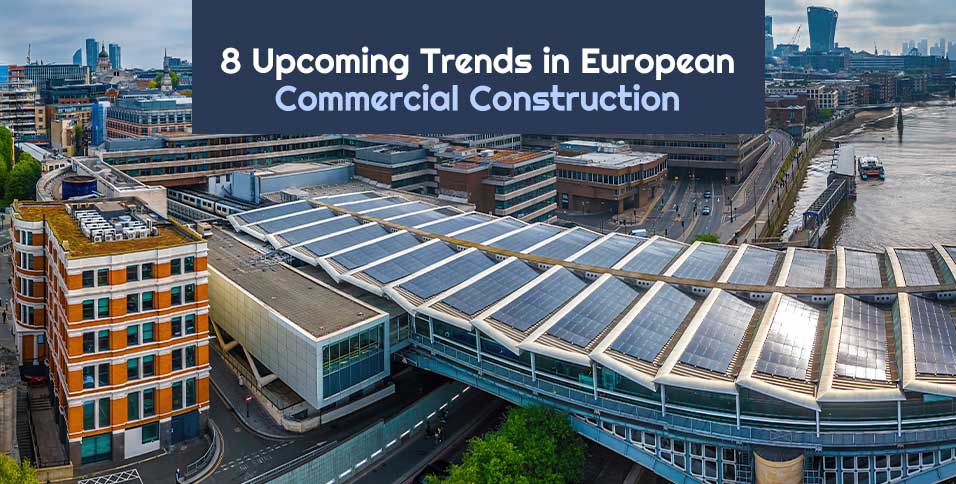
As energy demands surge across European commercial facilities, solar power has transitioned from a supplemental feature to a core component of building design. The construction sector is responding by integrating photovoltaic systems as fundamental architectural elements. Building-integrated photovoltaics (BIPV) are replacing conventional facades and glazing, turning entire structures into power generators while maintaining aesthetic appeal.
Solar panels for businesses help offset carbon emissions and save money on energy bills. With industrial electricity prices fluctuating dramatically, on-site generation provides both cost stability and compliance with tightening EU emissions regulations. Modern warehouses and manufacturing plants are particularly adopting solar at scale, where vast roof spaces can host systems capable of powering energy-hungry automation and HVAC systems.
Commercial projects increasingly pair panels with battery systems and smart energy management software, enabling facilities to maximize self-consumption of renewable power. In Germany and the Netherlands, we’re already seeing solar-powered industrial parks achieve near-zero operational emissions, setting a benchmark for the continent.
3. Smart Buildings and Internet of Things (IoT)
Europe’s commercial construction landscape is undergoing a quiet revolution as buildings evolve from passive structures to intelligent, responsive environments. At the heart of this transformation lies the integration of IoT technologies, creating ecosystems where every system communicates and adapts in real time.
Modern commercial spaces now employ networks of sensors that continuously monitor and adjust environmental conditions, from temperature and lighting to air quality and energy usage. These systems learn occupancy patterns and automatically optimize building operations, significantly reducing energy waste while maintaining ideal working conditions.
The business advantages of this technological shift are becoming increasingly apparent. Properties equipped with advanced building management systems demonstrate measurable improvements in operational costs and tenant satisfaction.
4. Modular and Prefabricated Construction
The European commercial construction sector is witnessing a paradigm shift as modular techniques move from niche alternative to mainstream solution. This approach, where up to 90% of a building is factory-manufactured before arriving on-site, is rewriting traditional project timelines and quality standards. It is suitable for commercial projects with repetitive elements, such as office complexes, hotel chains, or healthcare facilities.
Beyond speed and quality, modular construction significantly reduces material waste and on-site disruption, offering clear advantages for urban regeneration projects where minimizing neighborhood impact is crucial. The technique also enables innovative hybrid approaches, where prefabricated components integrate with traditional construction for complex architectural designs.
5. Rethinking Construction Waste
The European commercial construction sector is undergoing a fundamental shift in how it views materials, with circular economy models replacing traditional linear “take-make-dispose” approaches. This philosophy treats every building component as part of an ongoing lifecycle, where materials are carefully selected for their potential reuse and buildings are designed for eventual disassembly rather than demolition.
Leading projects now incorporate material passports or digital records detailing the composition and potential future applications of every structural element. This enables future recovery of high-value materials like steel beams, glass panels, and even concrete aggregates. Advanced sorting technologies at demolition sites can now separate and clean materials to near-virgin quality, feeding them back into new construction projects.
6. Robotics and Automation
The clatter of traditional construction sites across Europe is giving way to a new symphony of whirring drones, robotic arms, and autonomous vehicles. Robotics is solving critical challenges from labor shortages to precision demands in increasingly complex construction projects.
On modern sites, autonomous machinery handles everything from bricklaying to rebar tying with millimeter accuracy, while drones conduct daily progress scans that feed into Building Information Modeling (BIM) systems. This digital-physical integration allows project managers to identify potential issues before they become costly delays.
Three-dimensional (3D) printing technology has moved beyond prototypes to create structural components and even entire building modules on-demand, reducing both material waste and lead time. The human workforce is evolving alongside these technologies, with operators upskilling to manage robotic systems rather than perform manual tasks.
7. Future-Proofing Commercial Buildings
Forward-looking projects now incorporate flood-resistant foundations, passive cooling systems, and redundant power infrastructure as standard features. Architects are rethinking building orientations and facades to optimize natural climate regulation, reducing reliance on energy-intensive mechanical systems.
The most innovative designs feature adaptable floorplates that can easily reconfigure for changing uses, ensuring long-term relevance as business needs evolve. This approach extends beyond physical structures to encompass digital resilience. New constructions increasingly embed the infrastructure for 5G connectivity, IoT expansion, and future energy systems, avoiding costly retrofits down the line.
8. Digital Twins for Construction Management
Europe’s commercial construction sector is embracing digital twin technology, creating dynamic virtual replicas of physical buildings that transform how projects are designed, constructed, and operated. These living digital models continuously sync with their real-world counterparts through IoT sensors, enabling unprecedented levels of control and optimization throughout a building’s lifecycle.
During construction, digital twins allow teams to simulate different scenarios, detecting potential clashes or inefficiencies before they manifest on-site. This virtual testing ground has proven particularly valuable for complex commercial projects, where even minor errors can lead to significant cost overruns. Once operational, the technology provides facility managers with real-time insights into energy flows, space utilization, and equipment performance.
Bottom Line
Europe’s commercial construction sector is embracing sustainability and innovation. Solar integration, smart buildings, and modular techniques boost efficiency, while robotics and digital twins enhance precision, and resilient designs future-proof assets. These trends prove that eco-conscious construction drives profitability. As regulations tighten, forward-thinking developers will lead the market, building smarter, greener, and more adaptable spaces for tomorrow.