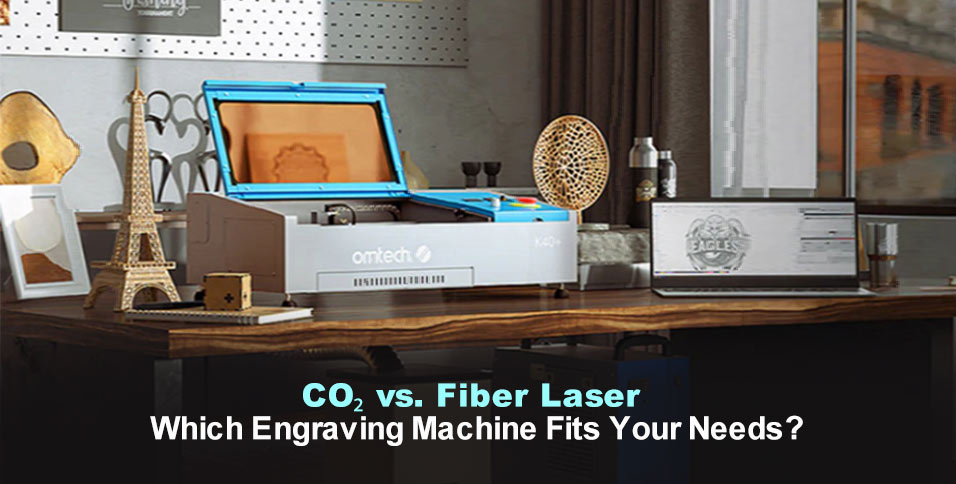
Laser engraving has transformed how makers, small businesses, and manufacturers personalize products. From custom wooden signs to precision metal markings, laser technology brings creativity and efficiency together. But before you dive in, there’s one major question: Should you choose a CO₂ laser or a fiber laser? Both offer incredible performance—but in very different ways. This guide breaks down how each type works, what materials they handle, and which one fits your unique needs.
How CO₂ and Fiber Lasers Work
Let’s start with the basics.
A CO₂ laser engraver generates light by exciting a mixture of gases (mostly carbon dioxide) inside a glass tube. This light is then reflected through mirrors and focused into a powerful beam. The wavelength is ideal for engraving and cutting organic materials like wood, leather, and acrylic.
A fiber laser, on the other hand, uses a completely different technology. It sends light through fiber-optic cables infused with rare-earth elements such as ytterbium, producing an ultra-focused, high-energy beam. This shorter wavelength makes fiber lasers ideal for metals and certain hard plastics.
Material Compatibility: What You Can Engrave
Your material list is often the biggest deciding factor.
CO₂ Lasers can engrave and cut:
· Wood
· Acrylic
· Leather
· Glass
· Paper
· Rubber
They’re the go-to for signage, crafts, and creative projects.
Fiber Lasers, meanwhile, shine with:
· Stainless steel
· Aluminum
· Brass
· Titanium
· Some plastics (like ABS or polycarbonate)
If you’re working with metal parts, jewelry, or industrial components, fiber is the clear winner.
Engraving Quality and Precision
When it comes to engraving detail, both laser types deliver—but in different ways.
CO₂ lasers excel at surface engraving and cutting. They create smooth, clean results on wood, acrylic, and other organic materials.
Fiber lasers are built for high-precision marking. They produce crisp, permanent designs on metal surfaces—perfect for barcodes, serial numbers, or intricate patterns that require ultra-fine detail.
If you want artistic depth and smooth finishes, go with CO₂. If you need permanent, high-contrast marks, fiber is your best bet.
Speed, Maintenance, and Lifespan
Here’s where performance meets practicality.
Speed: Fiber lasers typically engrave faster than CO₂ models due to their higher energy efficiency and shorter wavelength.
Maintenance: CO₂ lasers require some routine care—like cleaning mirrors, lenses, and occasionally replacing the laser tube. Fiber lasers, with fewer moving parts, are virtually maintenance-free.
Lifespan: A CO₂ tube usually lasts around 10,000–20,000 hours, while a fiber laser source can run for up to 100,000 hours. That’s a big difference if you’re running a high-production setup.
Cost and Investment Value
Budget is always part of the equation.
CO₂ lasers have a lower entry cost, making them great for beginners, schools, and small creative businesses. They also offer versatility across materials.
Fiber lasers come with a higher upfront investment—but lower long-term maintenance costs and a significantly longer lifespan. If you’re engraving metals frequently or running a production line, that long-term value quickly pays off.
Think of it this way: CO₂ lasers are your all-around workshop tool; fiber lasers are your specialized powerhouse.
Best Use Cases
Still unsure which laser engraving machine fits your work? Here’s a quick breakdown.
Choose a CO₂ Laser If You:
· Work mostly with wood, acrylic, leather, or glass.
· Run a craft shop, maker studio, or educational program.
· Need a laser that can both engrave and cut.
· Want a balance between cost and versatility.
Choose a Fiber Laser If You:
· Engrave primarily on metals or coated surfaces.
· Need deep, permanent, or serial markings for business use.
· Prioritize speed, precision, and durability.
· Operate an industrial or manufacturing-focused business.
For both paths, OMTech offers reliable, high-performance CO₂ and fiber laser machines built to fit every level of expertise. Whether you’re a DIY crafter or a metal fabricator, OMTech’s lineup helps you bring your projects to life with professional results.
How to Decide: Key Questions to Ask Yourself
Before making your choice, ask:
· What materials do I work with most often?
· Do I need to cut as well as engrave?
· What’s my budget, both upfront and long-term?
· How much production volume do I expect?
Answering these honestly will point you to the right technology for your goals.
Conclusion
Both CO₂ and fiber lasers have their strengths. A CO₂ laser gives you flexibility and creative freedom across many materials, while a fiber laser delivers unmatched precision and power on metals. Choosing the right one comes down to your materials, goals, and how you plan to grow.