Chronic pain is like an invisible prison. It creates a confined space within a person, isolating them from their own lives, their work, and their families. It’s an unwanted roommate that never leaves, a silent static that drains color from the world. For one-sixth of the global population, and the 50 million Americans who navigate this pain every year, the quest for relief can be a desperate and often devastating journey. The field of pain management is a landscape of complex, costly, and invasive options, a place where true, accessible solutions have felt just out of reach.
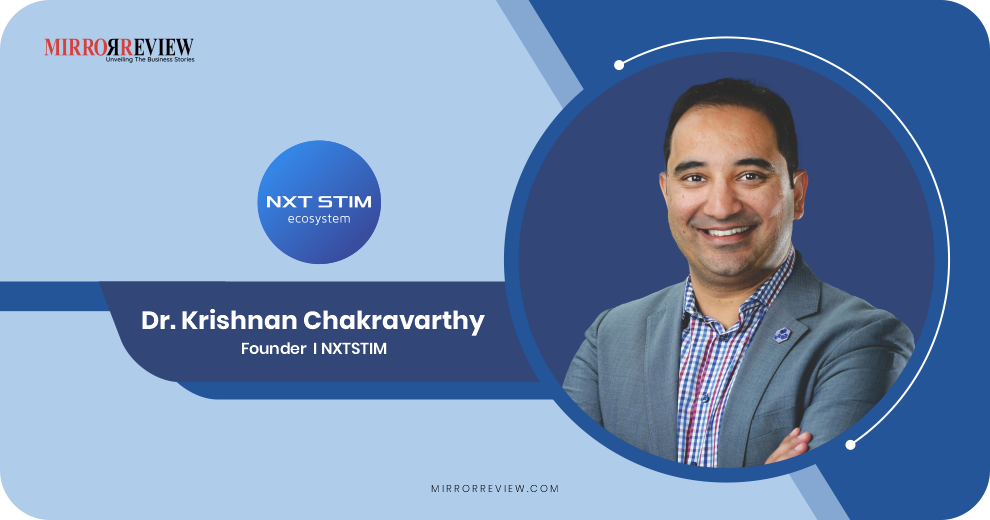
Into this landscape steps Dr. Krishnan Chakravarthy. He is not simply visiting this landscape; he is redefining it.
To meet Dr. Chakravarthy is to meet a man of quiet intensity, a humble polymath who defies easy categorization. He is a physician treating patients at the VA hospital, a scientist running his own institute, and an engineer with a strong background in nanotechnology. Additionally, he is an affiliate professor at UC San Diego in both Anesthesiology and Nanoengineering, and the founder of multiple biotechnology startups. With over a hundred published works and lectures at more than 400 international venues, he has been recognized as a “World Expert” in the top 0.1% of pain management scholars.
However, these accolades are not the main focus. In Dr. Chakravarthy’s view, they are simply tools for his true mission. At his core, he is a translator. His life’s work is centered on translating the most advanced science from the “bench to the bedside” to address three critical issues in pain management: access, community, and cost. He is not just building a product; he is creating a new, more human, and accessible ecosystem of care.
The Forging of a Translator
The seeds of this mission were planted during Dr. Chakravarthy’s time in the medical scientist training program at SUNY Buffalo School of Medicine and Biomedical Sciences. He describes the experience as “life-altering.” It was there that he worked under his mentor, Distinguished Professor Paul Knight, MD, PhD, who instilled in him the core value of “translational science,” the idea that research is not meant to live in a journal but to be brought to the patient. This philosophy became his true north.
During his graduate studies, he worked at the Centers for Disease Control and Prevention, where he developed vaccine delivery tools using nanotechnology. He was learning how to create solutions at a microscopic level. However, a defining moment came not from a lab but from a business plan competition in the final year of his graduate school, translating his research work into a company, where his team, NanoAxis, won the competition. “It truly changed the way I thought about translating research and science into commercial value,” Dr. Chakravarthy recalls. The spark was lit. He saw that a good idea, structured correctly, could scale its impact from one person to millions.
This new lens focused his path. Dr. Chakravarthy pursued his residency at the prestigious Johns Hopkins Hospital and his interventional pain management fellowship at Harvard’s Massachusetts General Hospital. His passion, he says, “has been my passion since… over a decade ago.” He was drawn to pain management and neuromodulation precisely because of their potential scope. This was not a niche problem. This was a problem that “affects a large majority of the human population.” He had found his mountain.
Diagnosing the System: Access, Community, Cost
As a “World Expert” climbing this mountain, Dr. Chakravarthy saw a frustrating reality. The existing solutions, while powerful, were not reaching the people who needed them most. “Today, on average, we provide close to 150,000 patients with implantable and neurostimulation devices every year at a staggering cost of over $100,000 to private and large health systems,” he explains. “However, 1/6 of the human population has some form of chronic pain and most of these therapies are restricted to the developing world.” The math did not add up, highlighting a major health care disparity. The gap between the 150,000 served yearly and the 50 million Americans suffering was not a gap; it was a chasm.
At the end of 2020, he founded NXTStim to address this chasm head-on. “We had to come up with a novel, revolutionary way to provide the best in class therapy that is non-invasive, low-cost, and simple to deploy for patients,” he states, “while creating a community and ecosystem around those patients.”
This is the “why” of NXTStim. It is not just about a new device; it is about a new delivery model for healthcare. The company is pioneering a platform that uses digital health and artificial intelligence to manage and treat pain. The goal is to fundamentally break down the barriers of cost and access, creating a sustainable, scalable solution for a global problem. To put it into context, the system costs $150 compared to $150,000, a complete paradigm shift in thinking about neuromodulation therapy.
Building an Ecosystem of Solutions
If you look at Dr. Chakravarthy’s career, you see a common thread. As he puts it, “The common thread is the focus on innovation… in either better patient care, better patient safety, and/or novel innovation that enhances the care delivery model.” He is not just building one company; he is patiently building an entire entrepreneurial ecosystem for the pain management space.
- Solaris Research Institute (SRI): This global contract research organization (CRO) addresses a foundational problem. “We recognize that standardization of data is so critical in our specialty,” Dr. Chakravarthy notes. Payers and providers need “consistent outcomes.” Solaris is building the infrastructure, using AI and software tools, to ensure that pain and spine research is built on a reliable, standardized foundation.
- Douleur Therapeutics: This venture is developing a novel non-opiate therapeutic for acute and postoperative pain. The “why” is clear: to create safer, more effective alternatives that can help combat the opioid crisis.
- Accufix Medical: This company was born from a direct clinical need. “Trial lead migration is a critical issue” in spinal cord stimulation, he explains. So, he developed a customized lead anchoring tool to fix it. It is a perfect example of his “bench to bedside” philosophy: see a problem, build a solution, improve patient care.
This “physician partner” approach has made Dr. Chakravarthy an international thought leader. He has been involved in “pioneering several first clinical cases” in the United States.
In July 2021, at UC San Diego Health, Dr. Chakravarthy was part of the first commercial implant of the Reactiv-8 restorative stimulation device for back pain. He also partnered with Medtronic to advance their Inceptiv closed-loop system, which he likens to “a thermostat or automated cruise control.”
The system “measures neural activity… and determines the optimal therapy to put it back into the spinal cord based on the feedback.” His first patient, one with diabetic peripheral neuropathy, “did very well.” These are not just technical achievements; they are “landmark moments… that help advance more therapy options for our patients.”
The Humility of True Leadership
Dr. Chakravarthy’s influence extends beyond his own companies; he is currently the President of the American Society of Pain and Neuroscience (ASPN), the largest multidisciplinary pain society in the world. He sees the specialty at a “critical time” and societies like ASPN as “true leaders in helping to bridge that gap and to continue to be the voice” for all pain specialists. It is an act of leadership and stewardship for the entire field.
This stewardship begins with his own team. “The team is simply the most critical element in a successful venture,” he states unequivocally. He seeks out “highly qualified engineers, scientists, and clinicians who really are effective partners and believe in the ‘why’ in the mission. His entire leadership philosophy is built on this foundation of humble, personal responsibility. “Don’t ask someone to do something you can’t do yourself,” Dr. Chakravarthy says.
“Hard work, determination, perseverance, resilience, team building… are necessary ingredients on what success requires… but even that is not enough if you are not willing to do everything no matter how simplistic, or how complex the job is. Failure cannot exist is a must philosophy for every successful entrepreneur.”
The Crucible in the Garage
NXTSTIM, Dr. Chakravarthy jokes, followed the classic startup story of “starting in a garage.” However, the story almost ended there. He recalls a time when certain decisions led to the near collapse of the business within a year of launch due to bad design flaws in the product line, leaving them without any capital reserves.
At one point, the company was reduced to just two employees on the verge of bankruptcy. This was a moment of profound doubt for him. “It was during this time that I thought, ‘Maybe it’s time to close shop,’” Dr. Chakravarthy admits, questioning whether he had made the right decisions.
But the “why,” the mission, was stronger than his doubts. He recalls, “If there was ever a test of self-resilience and who I was at my core it was at that moment. I knew that to come back would require the willingness to go to any lengths to bring the company back. What happened next was a dedication and commitment from me to say I will not give up and I was willing to do every role in the company, from sales to administrative work, to get it back on track to what it is today. Sacrifice, work life balance everything was set aside for one singular goal.”
This is the man behind the title of “World Expert.” He is someone with over 100 publications who was willing to do secretarial work, janitorial work, and administrative work, and make sales calls to save his mission. “I have no regrets,” Dr. Chakravarthy says. “Passion, perseverance, and the incredible human willingness to survive in the trenches came from this experience.”
This embodies his leadership philosophy: “Being humble enough to acknowledge that you are an intricate part of the entire ecosystem, and that no job is not important when it comes to reaching the end goal. Leaders are forged at the brink.”
The True Measure: A Veteran’s Story
Today, that perseverance is paying off in the way that matters most to him. The AI-driven digital health platform he envisioned is now a reality, and the data is validating the mission. “What we’ve observed in our 24 month data with over 2000 patients,” Dr. Chakravarthy reports, “AI digital platforms are meeting the same kind of relative long-term outcomes that we see in controlled randomized controlled trials with implantable technologies that are way more costly, harder for patients to access, and nonexistent in developing worlds where insurances don’t exist.”
He has proven that a “low-cost solution” can deliver. He has proven that the “access” and “cost” problem is solvable.
But the true metric of success, for him, is not in the data. It is in the human story. “I think what makes the most impact is hearing from patients directly,” Dr. Chakravarthy says. He tells the story of a recent testimonial from a veteran patient who used the NXTSTIM EcoAITM therapy product and platform.
“What was amazing… was how impactful EcoAITM was in reducing his pain, and how his day-to-day life had been radically altered. It wasn’t just an improvement in pain, but it was improving function, quality of life, his relationship with his loved ones. It was the ability to get around and do things that were meaningful, and to be alive and feeling as a human being.”
This is the point. This is the “why.” “It’s not the financials,” Dr. Chakravarthy insists. “Yes this is a business and you have to keep a profitable business, but at the end of the day, real satisfaction for me… is seeing that vision… benefiting somebody that you have never met or spoken to, and having such an incredible impact in his/her life.”
The Global Ecosystem
Dr. Chakravarthy’s “bigger vision” is to take this veteran’s story and many others and multiply it, “helping pain patients globally at a scale that has never been achieved.” His goal is to provide a cost-effective, accessible solution that can “intertwine patients to their care provider,” creating a global ecosystem of care even in developing countries.
It is a monumental task, one that requires a deep integration of work and life. He admits the concept of “work-life balance” is difficult. “The best types of jobs are the ones that are your passion,” Dr. Chakravarthy says. “To me the projects that I pick up, including my work or my passion, are my hobbies.” But this passion is framed by a grounded perspective.
“That being said, hanging out with my kids, playing pickleball… really do make a more fulfilling life. We must all understand that in the end that our loved ones come first. And from there we need to build to what we want to get to.”
This is the essence of Dr. Krishnan Chakravarthy. He is a physician-scientist who started with a passion for translational science, who built a portfolio of companies to fix a broken system, who humbly did whatever he needed to keep his vision alive, and who measures his success not in dollars, but in a veteran’s or patients’ ability to live a “meaningful” life. He is a man who truly understands that the heart of medicine, the heart of technology, and the heart of his business is, and must always be, people.
Quotes