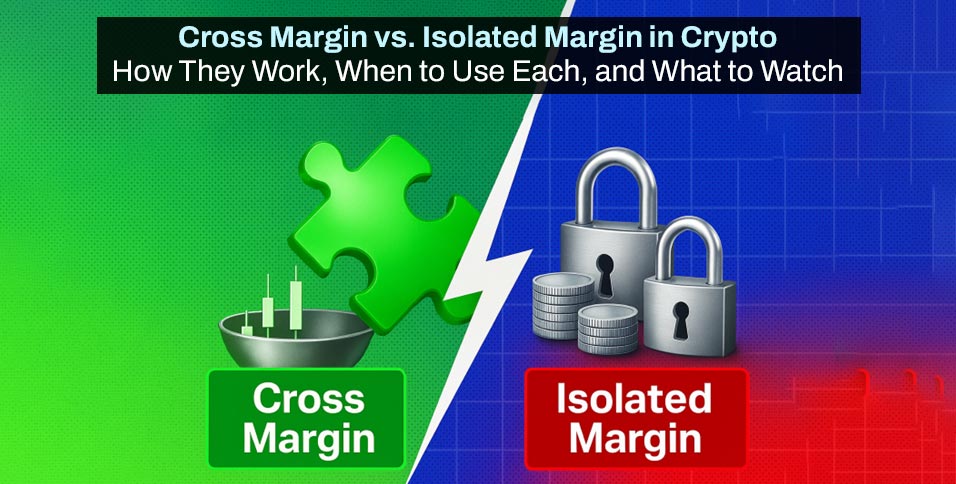
Margin unlocks bigger opportunities—and bigger drawdowns. The way you allocate margin fundamentally changes how your account absorbs market swings. In crypto derivatives, two modes dominate: cross margin and isolated margin. One shares collateral across positions for more breathing room; the other ring-fences risk per trade.
This guide explains both approaches, their advantages and trade-offs, and how trading platforms implement them so traders can align risk with strategy.
Key Takeaways
- Cross margin: best for experienced traders running multiple, possibly hedged positions; it reduces immediate liquidation risk but exposes the entire account equity to a large losing trade.
- Isolated margin: ideal for beginners and speculative plays; losses are capped to the funds set for that single position, but liquidation can arrive sooner if the market moves fast.
Cross Margin Explained
Definition. In cross margin, your total available equity backs all open positions. If one position draws down, it can be supported by unrealized gains or unused margin from others.
Mechanics. Suppose your account equity is 2,000 USDT.
- You’re long BTC (uses 600 USDT initial margin) and short ETH (uses 400 USDT).
- BTC dips and approaches its maintenance level. Because you’re on cross margin, funds from the remaining equity can automatically shore up the BTC position, delaying liquidation—especially if the ETH short is in profit.
Why traders use it.
- More runway during volatility and fewer surprise liquidations when a portfolio is diversified or hedged.
- Operational simplicity: no manual top-ups per position while you manage a book of trades.
Core risk.
- Since collateral is shared, one runaway loser can consume the entire balance. Cross margin mitigates “sudden” liquidation on a single leg but amplifies account-level exposure if the market turns broadly against you.
Fast fact: In cross margin, liquidation is less likely to be triggered by one move—but when it is, the impact can extend to the whole account.
Isolated Margin Explained
Definition. In isolated margin, each position has its own collateral bucket. You choose how much to allocate; that allocation is the maximum at risk for that trade.
Mechanics. With 2,000 USDT equity:
- You open an isolated altcoin long with 300 USDT margin.
- If price hits that trade’s liquidation threshold, only the 300 USDT is lost. Your other 1,700 USDT and any other positions remain untouched.
Why traders use it.
- Tighter, more transparent risk per idea. Great for learning, testing new systems, or trading highly volatile instruments without jeopardizing the entire account.
Core trade-off.
- Because collateral is not shared, isolated positions can liquidate earlier in whipsaw markets unless you manually add margin or adjust leverage.
Side-by-Side: Cross vs. Isolated
| Dimension | Cross Margin | Isolated Margin |
| Collateral source | Shared from total account equity | Ring-fenced per position |
| Liquidation dynamics | Later liquidation, portfolio can “bail out” weak legs | Earlier liquidation if the single bucket empties |
| Portfolio effects | Great for multi-leg, hedged, or correlated strategies | Best for experiments, high-volatility bets, and strict loss caps |
| Operational load | Fewer top-ups; account covers needs automatically | More monitoring; manual top-ups when needed |
| Worst-case risk | One bad outlier can drain the whole account | Loss capped to the position’s allocation |
When to Use Each Mode
Choose Cross Margin If…
- You run multiple correlated or hedged positions (e.g., long BTC, short ETH) and want profits on one leg to offset drawdowns on another.
- You operate swing or multi-day strategies where short-term volatility shouldn’t automatically knock you out.
- You prefer capital efficiency, letting the account allocate support to where it’s most needed.
Be mindful of: concentration risk. Ensure no single idea can spiral into a portfolio-wide event.
Choose Isolated Margin If…
- You’re executing speculative or event-driven trades (new listings, thin altcoins, high beta pairs) and want a hard loss ceiling.
- You’re learning or testing a new system and want to protect the rest of the account.
- You want position-level discipline: each idea stands (or falls) on its own funding.
Be mindful of: upkeep. Without shared collateral, you may need to add margin or resize quickly in moving markets.
Practical Risk Guidelines (Applies to Both Modes)
- Know your liquidation math.
Track initial vs. maintenance margin and monitor liquidation prices before entering. If you can’t tolerate the liquidation level, change size or leverage first—don’t rely on hope later. - Use stop-loss and take-profit orders.
Pre-commit to exits. Stops keep losses contained; TPs bank gains without second-guessing. - Avoid over-leverage.
High leverage narrows the buffer to liquidation. A position sized at 1–2% account risk is usually more durable than an oversized “all-in” bet. - Diversify exposure by thesis, not ticker count.
Ten positions all tied to one macro theme are not diversified. Mix timeframes, instruments, and catalysts. - Plan top-ups intentionally.
- Cross margin: define a portfolio-level max drawdown (e.g., 15–20%).
- Isolated: define per-trade adds (e.g., “one add at −30% with new stop here”) or refuse adds entirely.
- Cross margin: define a portfolio-level max drawdown (e.g., 15–20%).
- Review slippage and execution.
In fast markets, order type and venue quality affect realized P&L as much as your thesis.
How Trading Platforms Implement Margin Modes
Most reputable crypto-derivatives venues implement cross and isolated margin in broadly similar ways. The specifics—execution model, collateral options, leverage logic, product range, and how easily you can switch modes—shape the day-to-day risk experience for traders.
As one practical example, XBTFX implements the following features to support both cross and isolated margin:
Straight-Through Processing (STP) execution.
Orders route directly to liquidity venues, helping reduce intervention risk and align fills with real market conditions—crucial when margins and liquidation levels are tight.
Crypto-denominated accounts.
Funding and collateral in crypto streamline deposits/withdrawals and keep P&L aligned with the asset class you trade.
Dynamic leverage.
Leverage scales with position size and instrument, allowing higher leverage on smaller, tactical ideas and more conservative settings on larger exposures. This logic complements both cross and isolated approaches:
- On cross, it optimizes capital usage across a portfolio.
- On isolated, it helps test higher-beta ideas while keeping the downside contained to the position’s bucket.
Broad crypto CFD lineup.
From majors (BTC/USD, ETH/USD) to a wide slate of altcoins, the product set supports both portfolio construction (cross) and contained experimentation (isolated).
Seamless switching.
Traders can move between modes quickly—for instance, running a cross-margin core portfolio while opening an isolated, event-driven trade in a volatile altcoin.
Note: Nothing here is investment advice. Margin trading is high risk and can result in the loss of all capital allocated—especially under extreme volatility or illiquidity.
Conclusion
Cross margin and isolated margin are two different answers to the same question: how much account equity should any one idea be allowed to risk?
- Cross offers flexibility and capital efficiency for portfolio thinkers.
- Isolated enforces strict loss caps for idea-by-idea risk.
With execution, dynamic leverage, and mode flexibility, XBTFX enables both paths. The edge comes from matching the mode to the market and your method—before you press “open.” To see how these concepts work on a live venue—including execution model, dynamic leverage, and one-click mode switching—explore the XBTFX platform by opening a free demo account.
FAQ
What is cross margin in crypto derivatives?
A mode where all available account equity backs all open positions, reducing immediate liquidation risk but exposing the account to portfolio-level drawdowns.
What is isolated margin?
A mode where each position has its own margin allocation. If that position is liquidated, losses are confined to that allocation; other funds remain intact.
Which is riskier?
Neither is inherently “safer.” Cross can avoid premature liquidations but can endanger the whole account if one trade runs away. Isolated caps loss per idea but can liquidate earlier in fast markets unless topped up.
What is a margin call?
A broker alert that your margin level fell below requirements. You must add funds, reduce exposure, or risk forced liquidation.