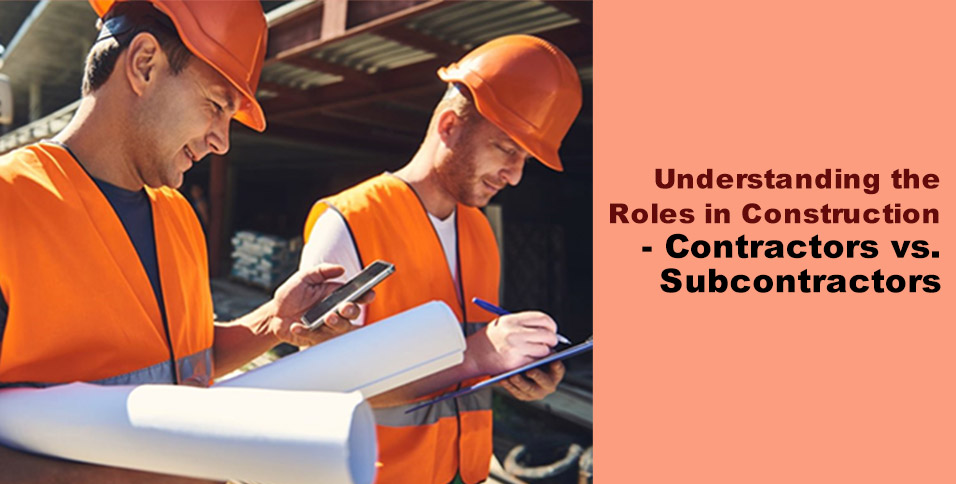
Construction industry is one of the most dynamic and most important sectors in the world economy. Whether in the form of skyscrapers in big cities or residential houses in suburban areas, constructions projects define how we live, work and relate to our environment.
The people behind these projects are the ones who actually make them happen and are the contractors of the buildings/project, the subcontractors, architect, engineers, and skilled manpower.
The concept of a contractor might be well-known to a large number of individuals, but what roles and duties are associated with each of the professions working in the construction site, and how do they differ, is not always obvious.
In this case, it is important to know the difference between contractors and subcontractors among others as a way of knowing how the projects are to be organized and completed efficiently. This precision is particularly necessary to property owners, developers, and any individual who intends to launch a construction project.
The Job of a Building Contractor
The key person involved in leading and carrying out a construction project is a building contractor, commonly known as the general contractor. They have their obligations way before any ground is broken. They can be engaged in the process of reviewing architectural plans, cost estimation, sourcing of materials, and employing of workers.
When the project begins the contractor organizes all the phases so that the work should possess the time schedule, financial and quality aspect of the project. They also ensure that they fulfill the safety regulations and observe the local building codes.
The building contractor is the most common contact of the client or property owner in most of the cases. They deal with architects, engineers, suppliers and the many tradespeople involved on the project. In case there are any unforeseen obstacles-delays due to weather, shortages of supplies, etc., or any modification in the design etc. it is the contractor who readjusts the schedule and resources to make sure that everything goes according to the schedule.
A Contractor Vs. A Subcontractor
Although the contractor is in charge of the entire project, he or she does not usually carry out all the work. Rather, they seek professional services of experts who are called subcontractors. Here the distinction between contractors and subcontractors comes out a lot.
The contractor can be compared to the team manager of a sports team, who dictates the playing strategy and makes all the players be aiming at the same destination. The individual players are the subcontractors and each one has a specialty in some field like plumbing, electrical work, roofing, carpentry etc.
The subcontractors are normally employed to perform certain sections of the project that need specialized skills. To cite an example, when constructing a house, a general contractor may hire plumbing subcontractor to put in the pipes, an electrical subcontractor to wire the house, and a masonry subcontractor to construct the chimney.
Subcontractors do not communicate directly with the client as compared to the contractors. They answer to the contractor whose responsibility is to monitor their work and make sure that this work is incorporated into the bigger picture of the project. Such breakdown of roles enables high efficiency and control of the quality because the subcontractors can concentrate on the specific task only.
Reasons Why Clients Should Care About This Difference
Those in charge of property development or ownership would do well to familiarize themselves with the distinction between contractors and subcontractors. Even though a subcontractor performed the plumbing work, it is still the contractor’s obligation to fix any problems that develop during construction. The customer saves time and effort because the contractor takes care of coordinating with all the necessary parties. Read more here.
Contracts and payment systems are also affected. In most cases, after a client signs a deal with a contractor, the contractor will pay the subcontractors. The client saves time and money thanks to this agreement, and the contractor is still held responsible for the end result.
A Construction Project’s Process
Contractors and subcontractors work together throughout the many stages of a typical construction project. Starting with planning and design is the pre-construction phase. Here, the contractor may work with design professionals to assess plans, assess practicality, and set a price.
The contractor finds suppliers, negotiates prices, and chooses subcontractors all throughout procurement. Read more here https://www.wikihow.life/Select-a-Construction-Subcontractor. If you want your project to go off without a hitch or be beset by delays, the selection procedure is crucial. Picking dependable subcontractors with expertise is key.
The contractor is responsible for making sure that all subcontractors start and finish their jobs on time once construction starts. For example, the electrical and plumbing crews can’t begin their work until the subcontractor working on the framing is finished. Scheduling tasks meticulously keeps the project on track and free of obstacles.
In the latter stage of a construction project, known as “post-construction,” the contractor is responsible for supervising inspections, getting any outstanding work done, and then delivering the final product to the customer.
Challenges in Contractor-Subcontractor Relationships
The relationship between contractors and subcontractors can be intricate, despite the fact that they both labor toward the same objective. Disputes might arise as a result of misunderstandings, vague contracts, or problems in scheduling.
Scope creep, in which subcontractors are requested to perform more work than initially agreed upon without corresponding changes to time or compensation, is a typical problem. Because of this, tensions may rise and the end result may suffer.
Skilled contractors avoid these problems by keeping everyone informed at all times, providing comprehensive contracts, and setting clear deadlines. It is essential to communicate well. To keep everyone on the same page and handle issues before they get out of hand, have progress meetings weekly or daily.
Why Insurance and Licensing Are Crucial
Before working on a construction project, contractors and subcontractors alike must ensure they comply with all applicable laws. Liability insurance and a license are requirements in several areas. Employees and customers alike are safeguarded by these regulations.
Contractors and subcontractors must prove their competence and compliance with industry norms in order to obtain the necessary licenses to carry out their work. Meanwhile, insurance safeguards one’s financial well-being in the event of mishaps, destruction of property, or other unanticipated incidents.
When clients choose specialists that are licensed and insured, they lessen their risk. Being sure that the contractors working on their house or business are adhering to strict guidelines for professionalism is reassuring.