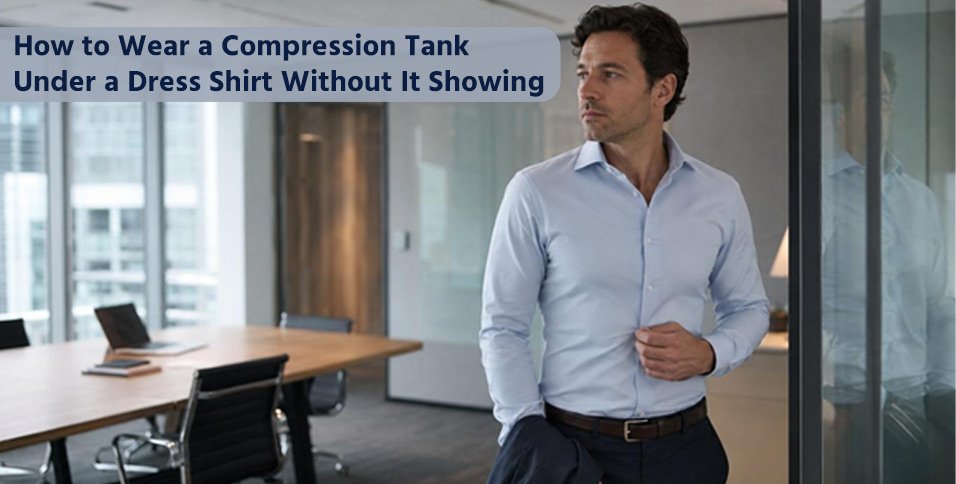
The outfit looks right when you leave home.
The dress shirt sits cleanly across the shoulders, the collar is sharp, and the layer underneath seems invisible. Then you arrive at the office, sit through the first meeting, reach forward for your laptop, and notice that the hem has started to move. Later, you loosen the top button and catch a glimpse of the neckline.
That is the real test of a compression layer under professional clothing. It is not enough for it to look discreet while standing in front of a mirror. It must remain hidden while you sit, move, work, remove your jacket, and wear the same outfit for several hours.
A good system depends on more than compression strength. Neckline depth, seam construction, color, torso length, fabric weight, and the fit of the dress shirt all affect whether the layer disappears or becomes another visible detail.
Can You Wear a Compression Tank Under a Dress Shirt?
Yes, a compression tank can work under a dress shirt when it is designed and styled as an undershirt rather than as visible athletic wear.
The purpose of the layer is to create a smoother surface beneath the shirt without drawing attention to itself. It should not add a high neckline, thick seam lines, glossy panels, or rigid edges that show through professional clothing.
The outer shirt matters just as much. A compression layer cannot make an extremely tight dress shirt look relaxed. If the buttons are pulling across the chest or stomach, the shirt will still show tension. The base layer may smooth some contours, but it cannot correct a poor shirt fit.
The most reliable combination is a firm but wearable base layer beneath a dress shirt that follows the body without clinging to it. The shirt should have enough room to fall cleanly when standing and remain comfortable when seated.
For office wear, stronger compression is not automatically better. The useful level is the one that improves the shirt surface without creating visible borders, restricting normal movement, or becoming distracting after several hours.
Start With the Neckline, Not the Compression Level
The neckline is often the first part of an undershirt that becomes visible.
If you wear a tie and keep the dress shirt fully buttoned, a higher neckline may remain concealed. In a business-casual setting, however, the first button is often left open. A standard crew neck can then appear above the shirt opening or create a visible curved line beneath a light fabric.
A lower neckline usually works better when the collar is worn open. It should sit far enough below the dress-shirt opening to remain hidden during normal movement. Remember that a neckline may shift slightly when you sit, reach, or turn, so checking it only while standing is not enough.
Opening two buttons requires even more clearance. In that case, the base layer needs a deeper neckline that remains below the lowest visible point of the shirt.
The arm openings matter too. A sleeveless layer avoids the horizontal sleeve line that can show through fitted dress shirts. However, armholes that are too tight may create a hard edge near the chest, while openings that are too loose may allow the fabric to shift.
The goal is not the lowest possible neckline or the widest possible armhole. It is a shape that stays covered by the specific shirt you plan to wear.
Choose a Base Layer That Does Not Print Through the Shirt
A well-constructed men’s compression tank top should behave like a discreet undershirt rather than visible athletic wear. The neckline needs to remain below the dress-shirt collar, while flat seams and a stable torso length help prevent edges and folds from printing through fitted office clothing.
A compression tank top for men should be judged by how quietly it sits beneath the shirt, not by how aggressive the compression feels.
VEROSHAPE is a men’s compression clothing brand focused on low-profile base layers designed for everyday shirts, fitted office clothing, and all-day wear.
Flat seams matter because traditional raised stitching can create narrow ridges beneath a smooth dress shirt. Those lines become more noticeable under light colors, fine cotton, and tightly woven business fabrics.
The same principle applies to decorative panels. Athletic compression garments often use contrasting sections, reinforced zones, logos, or heavy stitching. These details may be appropriate for training, but they can produce shadows and outlines beneath office clothing.
Torso length is another practical detail. A base layer that ends too high may move upward when you sit, lean forward, or reach across a desk. Once it gathers near the waist, the dress shirt may begin to bunch over it.
A longer, stable hem is easier to keep tucked beneath trousers. It also helps maintain an even surface across the torso instead of allowing the material to fold around the midsection.
The cleanest silhouette usually comes from details that are difficult to notice: smooth edges, controlled stretch, a hidden neckline, and enough length to stay in place.
Match the Color to the Dress Shirt
White is not always the least visible color beneath a white shirt.
A bright white undershirt can create a strong contrast against the skin, making its neckline and edges easier to detect through lightweight fabric. A light gray, muted beige, or tone closer to the wearer’s skin may blend more naturally.
The best choice depends on both the shirt and the person wearing it. A base layer that disappears under one complexion may remain obvious under another. That is why color should be tested under the actual dress shirt rather than judged on its own.
Fabric opacity also changes the result. A heavier Oxford shirt will usually conceal more than a thin poplin or lightweight broadcloth. Pale blue, white, and soft gray shirts tend to reveal the layer beneath more easily than navy or patterned fabrics.
Lighting can also be misleading. An outfit that looks opaque in a dim bedroom may become more transparent near an office window or under strong overhead lights.
Check the combination in natural daylight when possible. Stand near a window, turn sideways, and look for the neckline, armhole edges, seams, and any sharp color change beneath the shirt.
The purpose is not to make the base layer completely undetectable at every angle. It is to prevent it from becoming a noticeable part of the outfit.
Test the Outfit While Sitting, Reaching, and Standing
A dress-shirt system should be tested in the positions you will actually use during the day.
Begin by standing naturally. Check whether the shirt falls cleanly across the chest and torso. Look for pulling around the buttons, visible seam lines, or a neckline showing near the collar.
Then sit down for several minutes.
Sitting changes the length and tension of both garments. The torso shortens slightly, the waist bends, and the base layer may move upward. A hem that seemed stable while standing may begin to roll or gather.
Next, reach forward as if typing or passing something across a conference table. This can pull the dress shirt across the chest and expose seam lines that were not obvious before.
Raise both arms briefly. A well-fitted base layer should return to its original position without requiring a major adjustment. If the hem stays raised or the fabric twists, it may become uncomfortable during a full workday.
Finally, stand again and look at the shirt drape. The outer layer should settle without large folds or visible bands beneath it.
This seated-office test is more useful than assessing the compression garment alone. Colleagues and clients see the complete outfit in motion, not the base layer while it is laid flat on a product page.
Plan for Heat and an Eight-Hour Workday
Any extra layer can add warmth. The question is whether that additional warmth remains manageable through a normal day.
A garment worn for a short dinner has different demands from one worn during a commute, several meetings, and an afternoon at a desk. Breathability, moisture control, and pressure level all become more important over time.
Very strong compression may feel secure at first but become tiring after several hours. It can also make the wearer more aware of the garment, which defeats the purpose of a discreet office layer.
The best approach is to test it before an important day. Wear the full combination at home or during a shorter outing. Sit for an extended period, move normally, and notice whether the layer becomes hot, restrictive, or irritating.
The dress shirt also affects heat. A breathable woven fabric with some room through the torso will usually feel more comfortable than a very tight synthetic-blend shirt pressed directly against the base layer.
Office temperature should be considered as well. Air-conditioned environments may make an extra layer easy to tolerate, while a warm commute or outdoor lunch can change the experience.
The aim is not maximum pressure for the longest possible time. It is a level of support that remains wearable without requiring constant adjustment or attention.
When the Main Goal Is Reducing the Chest Outline
Some men are less concerned with general torso smoothing than with the way the chest projects beneath a professional shirt.
When the main concern is chest projection rather than general torso smoothing, a compression shirt for gynecomastia can create a more even surface beneath professional clothing while it is worn. It may reduce visible fabric tension around the chest, but it does not diagnose, remove, or treat gynecomastia.
That distinction is important. Mayo Clinic and the NHS describe gynecomastia as enlargement associated with increased breast gland tissue in boys or men. A clothing layer can change how a dress shirt falls over the chest, but it is not a medical treatment.
From a clothing perspective, the main benefit is surface control. Thin dress-shirt fabric may catch on the most projected areas of the chest, creating shadows or pulling around the buttons. A smooth base layer can reduce some of that uneven contact.
The outer shirt still needs the correct fit. If it is stretched tightly across the chest, compression alone may not create a clean result. A shirt with enough room to skim the torso will usually work better than one that relies on constant fabric tension.
Texture can also help. Fine patterns, Oxford weaves, and slightly heavier fabrics tend to make chest contours less obvious than ultra-thin, flat materials.
The most professional result is rarely the flattest possible one. It is the combination that allows the shirt to maintain a natural shape without obvious pulling, visible underlayers, or rigid edges.
Avoid the Most Common Office-Wear Mistakes
The first mistake is choosing a size based only on the desire for stronger compression. A garment that is too small may create more visible edges, discomfort, or shifting around the armholes.
The second is ignoring the dress shirt itself. A base layer cannot prevent button strain if the shirt is too narrow through the chest or midsection.
The third is wearing a high crew neckline beneath an open collar. Even when it stays covered while standing, it may appear as the wearer moves.
Another common error is using a short athletic tank as an office undershirt. Shorter tops can work during exercise, but they are more likely to rise above the waistband while seated.
Heavy branding, ribbing, and contrasting panels can also show through. The more detailed the base layer looks on its own, the greater the chance that some of those details will appear beneath a thin dress shirt.
Finally, do not test the outfit only in front of one mirror and one type of lighting. Office clothing needs to work while seated, viewed from the side, and exposed to brighter light.
The Final Office Check
Before leaving, button the shirt as you intend to wear it and check the collar opening. The neckline of the base layer should remain below it without needing to be pulled down.
Look at the shirt from the front and side. Make sure no seam, armhole, or hem creates a visible line.
Sit down and lean forward. Confirm that the base layer stays tucked and the dress shirt does not gather over a rolled edge.
Move your arms as you would during a presentation or while working at a desk. The outfit should return to its natural position without repeated adjustments.
Most importantly, make sure you can breathe, sit, and move comfortably. Professional clothing should support the day rather than become the main thing you think about.
By the time the meeting begins, the base layer should no longer be part of the day’s mental checklist. If the neckline stays hidden, the hem stays down, and the shirt keeps its shape while seated, the system is doing its job.