The compliance race keeps accelerating. New frameworks and boards still expect spotless audit reports. In Accenture’s 2022 Compliance Risk Study, 95 percent of leaders said they’re actively building a company-wide “culture of compliance,” a clear admission that spreadsheets can’t keep up.
Regulators are turning up the heat, too. Since late 2023, the U.S. SEC has required public companies to disclose any material cybersecurity incident within four business days, forcing security and legal teams to prove—almost in real time—that their controls work. Unsurprisingly, demand for always-on compliance software is surging: analysts project the global compliance-management market will reach about $60.49 billion in 2025, up 14.5 percent from 2024, according to The Business Research Company.
This guide compares 9 leading compliance-automation tools, explains our scoring criteria, and offers a buyer’s checklist so security and compliance leaders—especially in SMB and mid-market tech firms—can shortlist the right fit with confidence. Expect concise analysis, transparent sourcing, and practical next steps.
How we scored the 5 platforms
Buying compliance software shouldn’t feel like roulette, so we applied a five-point rubric grounded in everyday GRC hurdles:
- Multi-framework reach – Every tool had to support at least two heavyweight standards (for example, SOC 2 plus ISO 27001 or HIPAA) to avoid duplicate work when new mandates arrive.
- Evidence-first automation – We looked for continuous control monitoring, automated evidence capture, and a catalog of 40 or more native integrations that prove the platform can pull data from cloud, IAM, HR, and ticketing systems without manual exports.
- Speed to “audit-ready” – Products reporting an average onboarding window under eight weeks earned extra credit; delayed go-lives are a deal-breaker for teams facing customer deadlines.
- Pricing transparency – Vendors that publish starting prices or offer a free trial or demo ranked higher, while opaque call-for-quote models lost points.
- Customer trust and upkeep – We required a 4.0/5 or better average rating on G2 or Capterra and confirmation that the vendor has already rolled out ISO 27001:2022 mappings, which every certified company must adopt by October 31, 2025, according to hvassallo.com.
Applying this rubric distilled hundreds of options into a balanced dozen. These platforms combine breadth, automation depth, and candid pricing, so stretched security and compliance leads can move fast without guesswork.
At a glance comparison table
The matrix below surfaces the factors readers tell us matter most: supported frameworks, depth of continuous automation, native integration count (a proxy for manual effort saved), typical time to reach “audit-ready,” and how transparent each vendor is about pricing.
| Tool | Core Frameworks | Continuous Automation Highlights | Native Integrations* | Avg. Onboarding** | Pricing Transparency |
| Vanta | SOC 2, ISO 27001, HIPAA, GDPR | Real-time control monitoring, auto-evidence | 75+ | 2–4 weeks | Starts at $10k/yr tiered |
| Hyperproof | SOC 2, ISO 27001, NIST CSF, GDPR | Workflow automation, risk mapping | 60+ | 4–6 weeks | Tiered plans |
| Scrut | SOC 2, ISO 27001, PCI, GDPR, CCPA | Risk-first monitoring, cross-mapping | 70+ | 4–6 weeks | Quote only |
| OneTrust | SOC 2, ISO 27001 plus privacy suites | Policy generator, data mapping | 150+ | 6–10 weeks | Modular license |
| AuditBoard | SOX, SOC 2, ITGC | Automated testing, workpapers | 50+ | 6–10 weeks | Enterprise quote |
*Integration counts are rounded totals of officially supported connectors published by each vendor as of August 2025.
**“Onboarding” reflects the median customer go-live reported in vendor case studies and G2 reviews; your mileage may vary..
1. Vanta: continuous compliance for growth-focused teams
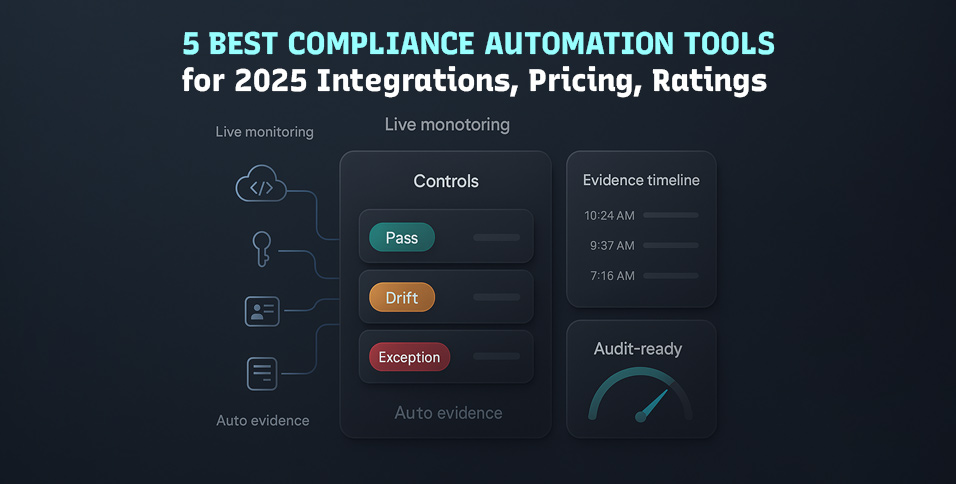
Automated compliance leader Vanta popularized always-on SOC 2 automation and now supports ISO 27001, HIPAA, GDPR, and 35-plus other frameworks. Connect AWS, GitHub, Okta, and 375+ pre-built integrations to start collecting evidence within minutes. A live dashboard stays green while controls hold and turns amber the moment drift appears, letting teams fix issues long before auditors log in.
Implementation is guided yet flexible. Pre-written policies drop into your wiki, and real-time Slack or email alerts remind engineers to patch vulnerabilities or revoke access right away. Customer reviews on G2 rate Vanta 4.6/5 across 1,800+ reviews.
Pricing: Vanta scales by employee count, framework scope, and add-on modules. Independent benchmarks from Smartsuite place starter SOC 2 packages around $7,500–$11,500 per year for small teams, while mid-market bundles with two frameworks often land in the $20,000–$30,000 range. The vendor does not offer a permanent free tier, but the sales team provides a hands-on demo that doubles as a mini readiness assessment.
Best fit: Fast-growing SaaS companies that need SOC 2 now and ISO 27001 soon.
Not ideal for: Large enterprises that already run a mature, highly customized GRC stack and require deep workflow tailoring.
2. Hyperproof: flexible compliance ops aligned to risk
Hyperproof treats compliance as an ongoing operations program rather than an annual scramble. Its unified control library maps to 118+ frameworks (SOC 2, ISO 27001, NIST CSF, GDPR, even custom checklists) and can be reused across business units, so one strengthened control satisfies multiple boxes at once.
Beyond technical scans, Hyperproof adds project-management DNA: tasks sit on a Kanban board, due dates sync to Jira or Asana, and every control links to a live risk register. Executives see how a red risk translates into a remediation plan with supporting audit evidence.
You’ll invest more upfront, configuring controls and 70+ native integrations, but the payoff is flexibility. When ISO annexes change or NIS2 rules land, you tweak mappings once and the entire program updates.
Pricing: Tiered SaaS subscription—Essentials (core compliance), Professional (adds risk and vendor), Enterprise (full suite). Recent G2 reviews show an average 4.7/5 across about 250 ratings, citing transparent onboarding and responsive support. A free sandbox lets teams test workflows before purchasing.
Best fit: Companies graduating from “just get SOC 2 done” to a holistic GRC program that aligns compliance with enterprise risk appetite.
Not ideal for: Seed-stage startups seeking instant automation with minimal configuration effort.
3. Scrut Automation: risk-first compliance in a single pane
Scrut flips the usual checklist model. It starts with a live risk register and auto-maps mitigating controls to SOC 2, ISO 27001, PCI DSS, GDPR, CCPA, HIPAA, and 25+ additional frameworks. Every mitigation step links to a specific citation, so engineers understand why a task matters.
Connect cloud accounts and code repositories, and Scrut’s engine begins 24/7 continuous compliance monitoring. One piece of evidence can satisfy multiple clauses because the platform cross-maps artifacts across standards, a feature customers say cuts duplicate work by roughly 40 percent.
Control owners receive plain-English tasks in Slack or email, while executives view a single scorecard that rolls risk and compliance into one number. Under the hood, Scrut offers numerous native integrations and promises “audit-ready” status in six to eight weeks for a first SOC 2, according to aggregated G2 review data.
G2 users rate Scrut 4.9/5 across about 1,100 reviews, praising its risk alignment and responsive support.
Pricing: Custom quotes. Recent deals reviewed on G2 indicate Scrut typically lands 10 to 15 percent below Vanta for comparable seat counts. A guided sandbox trial is available on request.
Best fit: Growth-stage tech firms ready to move beyond checkbox audits and embed risk management into daily engineering.
Not ideal for: Micro-startups needing only a quick SOC 2 badge without broader risk context.
4. OneTrust: enterprise-grade privacy and compliance under one roof
OneTrust is the heavyweight of this lineup. Beyond powering millions of cookie banners, it offers a broad Trust Intelligence Platform that automates ISO 27001, SOC 2, GDPR, CCPA, vendor risk, AI governance, and more for a large global customer base.
Breadth is the headline: privacy, third-party risk, data-subject requests, ESG, and AI governance all funnel into one dashboard so executives see a unified posture instead of a patchwork of point tools. The trade-off is complexity. Deployments typically require a dedicated admin plus professional-services support, and rollouts average three to six months for mid-market enterprises.
Pricing: Modular and enterprise focused. Public G2 disclosures place core privacy and GRC bundles in the $90,000–$250,000 annual range, depending on users and modules. Trials are rare, but live demos are available. OneTrust Tech Risk & Compliance holds an average 4.3/5 rating across about 1,400 G2 reviews, with high marks for policy depth and automation but lower scores for ease of setup.
Best fit: Large organisations juggling security and privacy mandates across multiple regions that need one extensible platform.
Not ideal for: Lean startups seeking a quick SOC 2 badge and transparent SaaS pricing.
5. AuditBoard: audit management meets continuous compliance
AuditBoard emerged from the internal-audit trenches, so it speaks SOX natively. The platform now covers SOC 2, ISO 27001, ITGC, and operational risk, yet its core DNA remains automated control testing and evidence management.
Connect ERP, HR, and ticketing systems, and AuditBoard schedules control tests on the cadence you set. At each deadline it pulls fresh logs, files them into workpapers, and queues any exceptions for remediation. Every step is time-stamped, creating the granular audit trail regulators expect.
Large teams report cutting manual work by 30–40 percent after go-live. AuditBoard holds an average 4.7/5 rating from about 1,900 G2 reviews, with high marks for SOX workflow depth and reporting power.
Pricing and rollout: Enterprise subscription. Public procurement records show annual costs of $120,000–$300,000, depending on modules and users, plus optional professional-services packages that add eight to twelve weeks for implementation. A sandbox proof-of-concept is available on request.
Compliance-automation buyer’s checklist: 3 data-backed steps to a confident shortlist
A structured, evidence-based approach prevents shiny-feature fatigue and keeps vendor conversations crisp.
- Define your scope and deadlines. List every framework you must hit in the next 18 months and note any fixed audit dates. If you need only SOC 2, sprint tools such as Vanta shine. If ISO 27001, HIPAA, or NIS2 loom, short-list platforms like Hyperproof or LogicGate that map one control to many standards.
- Inventory your integration gap. Compliance automation only works if the right systems are connected. Vanta lays out the flow clearly: connect your cloud, identity, and HR systems and the software automates audit evidence collection while running hourly checks, so drift gets flagged without screenshot scrambles. Now list the cloud, CI/CD, HR, and ticketing apps that actually hold evidence at your company. Every native connector you lack turns into manual work later. Vanta’s 300-plus connectors can save dozens of hours per audit; gaps may force you to script or upload files yourself.
- Model the three-year cost of ownership. Request pricing that includes additional frameworks, users, and support uplifts. Tools that look affordable upfront can climb 30–50 percent once you add vendor-risk or privacy modules. Capture those scenarios early and compare apples to apples. If ISO 27001 is on your roadmap, this breakdown of multi-site certification costs and tactics can help you model realistic TCO and identify savings levers early.
Documenting these five items converts gut feel into a defensible shortlist your CFO can approve and sets realistic expectations for the team that will run the platform every day.
Conclusion: When to upgrade from a point solution to a full GRC platform
Point solutions excel when the mandate is narrow. If customers need only a SOC 2 report, a focused tool can get you audit-ready in four to six weeks and costs forty to sixty percent less than a full GRC suite.
Complexity balloons once new checklists arrive—privacy, vendor risk, SOX, or NIS2. At that point teams often juggle three portals, duplicate evidence, and produce multiple “sources of truth” for leadership. Industry analysis suggests that organizations using multiple unconnected compliance tools spend significantly more time on evidence collection.
A unified GRC platform reverses that fragmentation:
- One control, many frameworks. Map a single policy to SOC 2, ISO 27001, and GDPR simultaneously.
- One dashboard for remediation. Control owners see every open issue in one Kanban board.
- One export for auditors. Generate a cross-framework evidence pack instead of assembling three.
The trade-off is lift. Deployments average eight to sixteen weeks and require an internal owner who can drive change, along with a larger budget.
Quick test:
- You manage two or more frameworks or
- You have hired, or plan to hire, a dedicated compliance lead.
If either is true, start evaluating full GRC platforms or modular suites that let you add risk, vendor, or privacy workflows without ripping out your existing SOC 2 foundation.