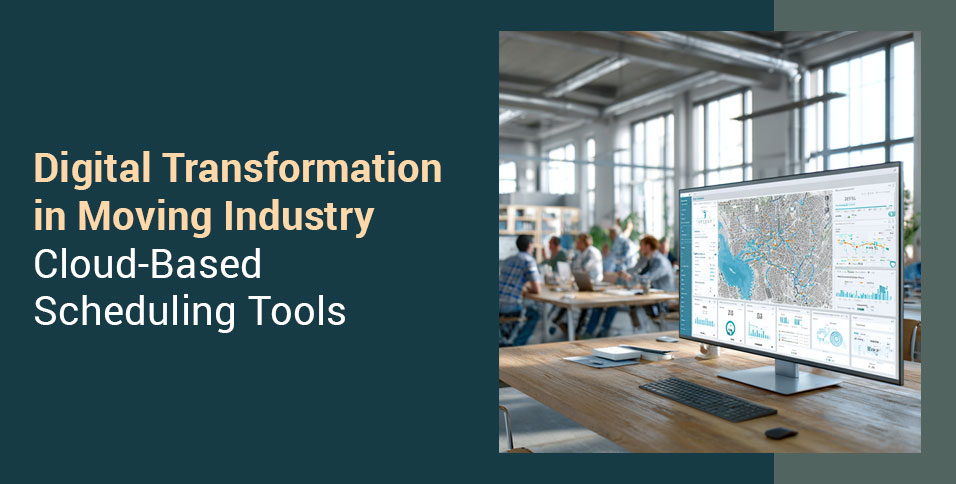
The entrepreneurial journey in logistics requires more than trucks and muscle. Today’s most successful commercial movers and business relocation specialists are discovering that cloud-based scheduling systems separate industry leaders from companies still drowning in spreadsheets and paper manifests. Think of traditional moving operations like trying to conduct an orchestra without sheet music: everyone might know their instruments, but coordinating complex symphonies becomes nearly impossible. Modern moving services with cloud technology transform chaotic logistics into precision operations where every truck, team member, and client receives real-time coordination that would make military strategists envious.
The statistics tell a compelling story about this transformation. Cloud adoption in supply chain management is expected to reach $71.93 billion by 2030, with 70% of logistics enterprises actively adopting digital strategies. Meanwhile, coordinating corporate relocations through advanced office management demonstrates how forward-thinking moving company entrepreneurs leverage technology not as an expense but as a competitive weapon. The entrepreneurs building tomorrow’s moving empires understand that cloud computing is shaping the future of logistics by enabling real-time visibility, predictive analytics, and collaborative coordination that traditional systems simply cannot match.
The Entrepreneurial Case for Cloud-Based Scheduling
Consider the moving company owner who built their business through hard work and customer relationships. For years, they managed schedules using desk calendars, sticky notes, and phone calls to dispatch teams. The system worked until it didn’t. Growth brought complexity, and suddenly coordinating 15 simultaneous moves across a metropolitan area while managing truck maintenance, employee availability, and client communications became overwhelming. This scenario plays out constantly in growing moving companies, creating a ceiling that limits entrepreneurial ambitions.
Cloud-based scheduling systems eliminate this ceiling by transforming operations from reactive chaos into proactive strategy. Instead of discovering scheduling conflicts when crews show up to the same address, the system flags overlaps before they create problems. Rather than calling each team member to find available movers, the platform displays real-time availability across the entire workforce. This shift from firefighting to strategic planning represents the difference between business owners who remain trapped in daily operations versus entrepreneurs who scale their companies into regional powerhouses.
The financial implications extend beyond obvious efficiency gains. Moving companies operating on cloud platforms report revenue increases of 25 to 40% within the first year, not from raising prices but from maximizing resource utilization. Every truck that sits idle represents lost revenue. Every hour that skilled movers spend waiting for assignments instead of completing jobs burns profitability. Cloud scheduling optimizes these resources with precision that manual systems cannot achieve, converting wasted capacity into billable hours while simultaneously improving customer satisfaction through more reliable service delivery.
Real-Time Visibility Creates Competitive Advantages
Entrepreneurs in the moving industry increasingly recognize that information asymmetry kills businesses. When company owners cannot see what’s happening across their operations in real-time, they’re flying blind through storms. Cloud-based scheduling provides that visibility, creating dashboards that display every aspect of operations: which crews are running ahead or behind schedule, which trucks require maintenance, which clients called with concerns, and which territories show the highest demand.
This visibility transforms decision-making from guesswork into data-driven strategy. Imagine a moving company owner noticing through their dashboard that crews consistently finish apartment moves 30 minutes faster than estimated while running over on house relocations. This insight enables pricing adjustments, crew specialization, and marketing strategies that compound competitive advantages. Traditional systems hide these patterns in scattered paperwork and anecdotal observations, while cloud platforms surface actionable intelligence automatically.
The competitive moat widens when customer-facing applications connect to backend scheduling systems. Clients who receive automatic updates about crew arrival times, real-time location tracking, and instant communication channels experience service quality that feels premium regardless of pricing. These technology-enabled experiences create customer loyalty that protects market share when competitors try undercutting on price. Smart entrepreneurs recognize that competing on service quality rather than cost creates sustainable businesses that actually increase in value over time.
Scalability and Growth Without Proportional Overhead
The traditional moving business model requires linear scaling where growth demands proportional increases in administrative staff. A company handling 50 moves monthly might operate with one dispatcher and an office manager. Doubling to 100 moves typically requires doubling administrative support, creating overhead that erodes profitability. Cloud-based scheduling breaks this pattern, enabling exponential growth with minimal administrative expansion.
Entrepreneurs building technology-enabled moving companies discover they can coordinate 200 or 300 monthly moves with administrative teams barely larger than competitors handling 50 moves using traditional methods. The automation handles routine scheduling, dispatching, and coordination tasks that previously consumed human hours. This efficiency advantage creates profit margins that enable aggressive market expansion, better employee compensation, and investment in equipment that further widens competitive gaps.
The scalability extends geographically in ways that traditional operations struggle to achieve. Moving companies using cloud platforms can expand into new territories without establishing physical branch offices. Regional crews connect to central scheduling systems, maintaining operational consistency and resource visibility regardless of location. Entrepreneurs who might have been limited to single-city operations suddenly find themselves building regional or national businesses without the overhead structures that traditionally made such expansion prohibitively expensive.
Data-Driven Decision Making Replaces Gut Instinct
Experience and intuition built successful moving companies for generations, but modern markets reward entrepreneurs who combine industry wisdom with analytical rigor. Cloud-based scheduling systems generate operational data that reveals patterns invisible to even the most experienced business owners. Which crew combinations complete jobs most efficiently? What times of day create the most scheduling complications? Which service packages generate the highest margins? These questions receive quantitative answers rather than speculative responses.
The analytics capabilities enable strategic planning that transforms moving companies from reactive service providers into proactive market leaders. Seasonal demand patterns become predictable, allowing entrepreneurs to optimize fleet size, adjust staffing levels, and launch marketing campaigns with precise timing. Pricing strategies move from copying competitors to analyzing actual cost structures and demand elasticity, creating sustainable profitability rather than participating in race-to-bottom pricing wars.
Perhaps most valuable, data visibility creates accountability that elevates entire organizations. When every team member can see performance metrics comparing their efficiency and customer satisfaction scores to colleagues, healthy competition emerges naturally. Entrepreneurs who create cultures around continuous improvement find that cloud platforms provide the measurement systems that make excellence visible and achievable rather than abstract and aspirational.
Integration Ecosystems Multiply Value
The most transformative aspect of cloud-based scheduling systems isn’t standalone functionality but integration capabilities that connect moving operations to broader business ecosystems. Modern platforms integrate with accounting software, customer relationship management systems, marketing automation tools, and payment processing platforms, creating unified business operations where information flows seamlessly between functions.
This integration eliminates the redundant data entry that plagues traditional operations. Customer information entered once populates scheduling systems, invoicing platforms, and follow-up marketing campaigns automatically. The time savings accumulate quickly, but the real value lies in eliminating errors and creating seamless customer experiences. Clients who receive accurate invoices immediately after moves, followed by personalized satisfaction surveys and strategic re-engagement campaigns, experience service quality that builds referral engines and repeat business.
Entrepreneurs who master these integration ecosystems create sustainable competitive advantages that competitors cannot easily replicate. The network effects compound: more integrations create smoother operations, which improve customer satisfaction, which generates more referrals, which provide data that enables better strategic decisions. Companies operating in these virtuous cycles pull away from competitors still managing disconnected systems and manual processes.
The Investment Decision and ROI Reality
Moving company owners considering cloud-based scheduling systems face investment decisions that require balancing costs against potential returns. Monthly subscription fees, implementation expenses, and training investments create real outlays that impact cash flow. However, entrepreneurs who view technology spending as strategic investment rather than operational expense typically discover ROI that justifies adoption within months rather than years.
The financial analysis should account for both hard savings and opportunity costs. Hard savings come from reduced administrative staffing needs, fewer scheduling errors that create costly rework, optimized fuel consumption through better route planning, and improved equipment utilization that delays capital expenditures. These tangible benefits typically cover implementation costs within 6 to 12 months for companies handling even modest monthly move volumes.
Opportunity benefits prove harder to quantify but often exceed hard savings significantly. The capacity to handle more moves without proportional overhead growth, the competitive advantages from superior customer experience, and the strategic insights that enable market positioning all contribute to business value that shows up in revenue growth rather than cost reduction. Entrepreneurs focused on building valuable enterprises rather than just profitable operations recognize that technology investments create assets that increase business sale prices and attract better acquisition opportunities.
Implementation Strategies for Growing Companies
The path from traditional operations to cloud-enabled scheduling requires more than purchasing software licenses. Successful implementations begin with process documentation that maps current workflows, identifies pain points, and establishes clear goals for improvement. Entrepreneurs who skip this groundwork often struggle with adoption because they’re automating dysfunctional processes rather than optimizing operations before digitization.
Change management becomes critical for companies where employees have operated certain ways for years or decades. The most effective implementations combine top-down commitment with bottom-up involvement, ensuring that dispatchers, crew leaders, and customer service representatives participate in system selection and configuration. When staff members feel ownership over new tools rather than having technology imposed upon them, adoption rates increase dramatically while resistance decreases proportionally.
Training investments separate successful implementations from expensive failures. Moving company entrepreneurs should budget not just for initial onboarding but for ongoing education as platforms evolve and new features launch. The companies that extract maximum value from cloud-based scheduling treat technology proficiency as core competency worthy of continuous development rather than one-time training that never receives refreshers or updates.
Security, Reliability, and Trust Considerations
Entrepreneurs entrusting critical business operations to cloud platforms rightfully question security, reliability, and data ownership. The concerns carry weight given that scheduling systems become operational nervous systems where outages or breaches could paralyze businesses. However, modern cloud platforms typically provide security and reliability that exceed what most moving companies could achieve with on-premises systems.
Enterprise-grade cloud providers invest millions in redundancy, backup systems, and security protocols that small businesses cannot justify independently. Their economic models depend on reliability, creating aligned incentives where platform providers succeed by keeping client operations running smoothly. The service level agreements typically guarantee uptime that exceeds 99.9%, representing reliability that manual systems never achieved despite their perceived security.
Data ownership and portability require clear contractual understanding. Entrepreneurs should ensure that platforms provide export capabilities that prevent vendor lock-in while maintaining ownership of customer data, operational history, and business intelligence. The goal isn’t necessarily avoiding commitment to good platforms but ensuring that growth doesn’t create dependencies that limit strategic flexibility or create vulnerability to predatory pricing.
Future-Proofing Through Continuous Innovation
The moving industry stands at a technological inflection point where the next decade will separate companies that embrace digital transformation from those that resist change. Entrepreneurs building technology-enabled operations today position themselves to adopt artificial intelligence, machine learning, and predictive analytics capabilities that promise even greater competitive advantages tomorrow.
Cloud platforms evolve constantly, delivering new features and capabilities that benefit subscribers automatically. Companies locked into legacy systems or manual operations miss these innovations, creating widening gaps between technology leaders and laggards. The smart entrepreneurs recognize that adopting cloud-based scheduling isn’t a destination but a journey toward continuous improvement and competitive evolution.
The vision extends beyond operational efficiency to fundamental business model transformation. Moving companies leveraging cloud platforms increasingly offer value-added services that generate recurring revenue, build customer lifetime value, and create businesses that command premium valuations. These entrepreneurs aren’t just running moving companies; they’re building technology-enabled service platforms that happen to specialize in relocation logistics.
The moving industry’s digital transformation creates opportunities for entrepreneurs who recognize that logistics excellence increasingly depends on information management rather than just physical capability. Cloud-based scheduling systems provide the foundation for building scalable, data-driven, customer-centric businesses that thrive in modern markets. The entrepreneurs who master these tools won’t just survive industry evolution; they’ll lead it, building valuable enterprises that define tomorrow’s standards while competitors struggle with yesterday’s methods.