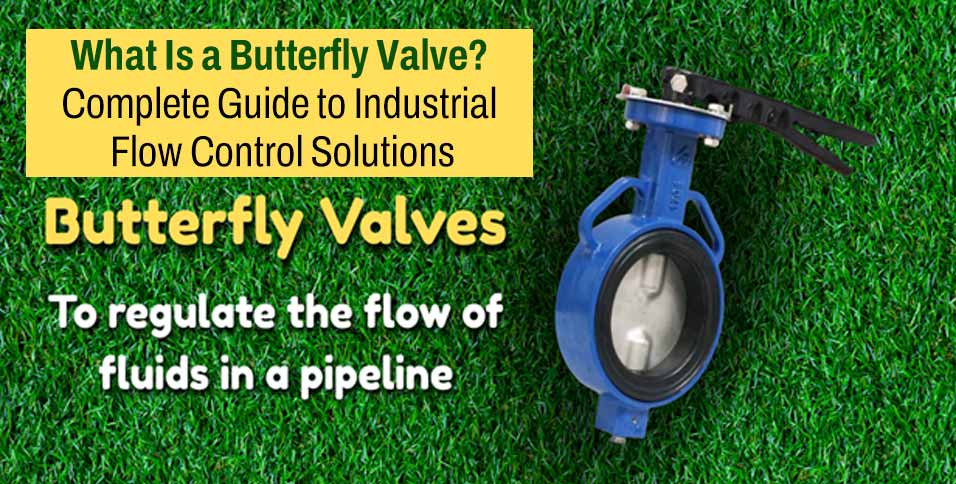
Butterfly valves might appear simple and small; however, they play an essential function in ensuring effective and secure industrial processes. These valves control the flow of gases and liquids through treatment plants to the chemicals used within processing facilities, while ensuring exact flow control and stability of the system. Their slim design, fast quarter-turn operation, and flexibility make them extremely reliable in different industries.
This guide will explain the functions of butterfly valves, examine the various kinds they come with, outline the most important components, examine the various industrial application scenarios, and give important maintenance tips to ensure optimal performance and long-term reliability.
What Are Butterfly Valves?
The butterfly valve may be termed a quarter-turn mechanism that controls the arrangement of gas or liquid flow. The principal component is a rotating disc that is mounted on the shaft. Rotating the disc 90 degrees stops the flow completely or permits it to flow. Partially rotating provides the finest flow control. This makes these valves perfect to be used in applications for industries that demand high-quality and efficient operation.
Parts of a Butterfly Valve
The most important components are:
- Shaft – connects the disc to the actuator or handle.
- Seat – Creates a secure seal to avoid leaks.
- Actuator or Handle – The actuator or handle is the control that either manually or automatically controls the rotation of the disc.
The valve is light, durable, and cheap in design, thus suitable for most industries.
How Butterfly Valves Work
If the disc spins, it either restricts flow or opens it up. Even partial rotation is able to regulate the flow rate precisely due to the precision of engineering. This guarantees little leakage, seamless operation, and excellent performance under high pressure or demand.
Butterfly Valve Varieties: Choosing the Right Type
Butterfly valves are of several types to suit the needs of the industries. Selecting the appropriate type will guarantee effective operation, security, and reliability in the long term:
- Electric Butterfly Valves: These are electric-driven valves that are offered with close control to automated systems. Suitable in cases of the need to operate remotely and control the flow with a specific accuracy.
- Explosion-Proof Butterfly Valves: These valves are designed to provide service under conditions of high risk of explosions to prevent sparks and provide safe operation under conditions of flammable gases or dust. Ideal in chemical plants, oil refineries, and other high-risk industries.
- Pneumatic Butterfly Valves: Pneumatic butterfly valves are controlled using compressed air and are used to control flow fast and reliably. Usually applied in process industries, water treatment, and industrial automation systems.
- Sanitary Butterfly Valves: These valves are constructed of hygienic and corrosion-resistant material, which is perfect for food, beverage, and pharmaceutical use. They eliminate contamination and preserve the quality of products.
- Triple Offset Butterfly Valves: These are high-pressure and high-temperature valves that are designed to perform under extreme conditions and are leak-free. Applicable in power plants, oil and gas, and chemical processing.
How Are Butterfly Valves Built and Used in Industries?
Developed to provide accuracy in the flow control as well as the accuracy of valves, butterflies offer security, efficacy, and reliability in various fields.
1. Materials and Specifications
These Butterfly valves are of carbon steel, stainless steel, as well as PVC, which are appropriate to the required temperature, pressure, and fluid nature. The appropriate specifications guarantee the durability, safety, and good regulation of flow. The valve is made of the right material that will be used to decrease the cost of maintenance and prolong the life of the valve.
2. Electric and Pneumatic Actuators
Actuators automate valve operations for rapid and precise control, while reducing manual effort. Electric actuators permit programmable adjustments, and pneumatic actuators are perfect for fast industrial processes. They also allow integration with modern automated monitoring systems that are automated.
3. Industrial Applications
Butterfly valves are utilized in the water process, HVAC, oil & gas, as well as the food industry. They provide a steady flow, provide safety, and enhance the efficiency of operations across different systems. They are essential in low-pressure and high-pressure applications.
Advantages of Butterfly Valves
Advantages:
- Lightweight and small dimensions: Easy to install and space-wise takes up low dimensions.
- Fast Quarter: Turn Operation enables rapid opening and closing to ensure effective control of flow.
- Multi-functional: It is suitable for gases, liquids, chemical slurries, and corrosive materials.
- Energy efficient: Turbulent fluid flow with low pressure drop.
- Cost-efficient: Suitable when pipelines are of large diameter. Minimizes the total system costs.
Choosing the Appropriate Butterfly Valve
When deciding on a valve, think about:
- System Temperature and Pressure
- Type of fluid and corrosion
- Automation requirements (electric and pneumatic actuators)
- Expectations regarding durability and maintenance
The efficiency, performance, and security are found in the value of consulting professionals.
Best Practices of installation and maintenance
Proper installation and maintenance will guarantee the duration, performance, and security of butterfly valves. Remember to take the following procedures:
1. Inspect for Debris or Damage
Inspect the body, disc and seat of your valve before installation of the valve, checking them before installation. Even minor particles may create leakages or damage the seal and impair the work of valves.
2. Align Flanges Correctly
Ensure that the flanges are placed on the same side. Misalignment may lead to stress on the body of the valve, which may result in leakages or prevent the movement of the disc.
3. Torque Bolts Gradually
Secure bolts by using a crisscross pattern with the torque wrench. This will prevent uneven stress or warping. To preserve the valve’s seat and guarantee a suitable seal, do not overtighten.
4. Actuate the Valve Regularly
It is recommended to rotate the disc regularly, particularly in low-flow systems. Regularly actuating prevents seizing or sticking, and ensures that the valve will remain in a state of reactivity whenever it is needed.
Conclusion
Butterfly valves might appear to be small; however, their function in industrial processes is huge. They offer precise flow control and increase energy efficiency, and ensure system security across chemical, water treatment, HVAC, Food processing industry. Durability, reliability, and low maintenance will be guaranteed by the right choice of material. High-performance valves are capable of minimizing the cost of operation and maximizing the performance of the system. Select the best butterfly valves today and observe how efficient, secure, safe, and productive the engineered industrial sector will be.
Get your systems upgraded now! To ensure effective, accurate, and reliable industry-wide flow controls, study high-performance butterfly valves.
FQAs
What does a butterfly valve do? How is the way it works?
It consists of a disc which is mounted on a shaft and revolves; by 90 degrees, blockage of the flow is ensured, which, by partial rotation, is 90 degrees control of the flow.
Is it possible to operate butterfly valves?
Yes. The pneumatic and electric actuators can provide controlled, automated, and precise control. They decrease manual effort and are able to integrate with monitoring systems to increase efficiency.