
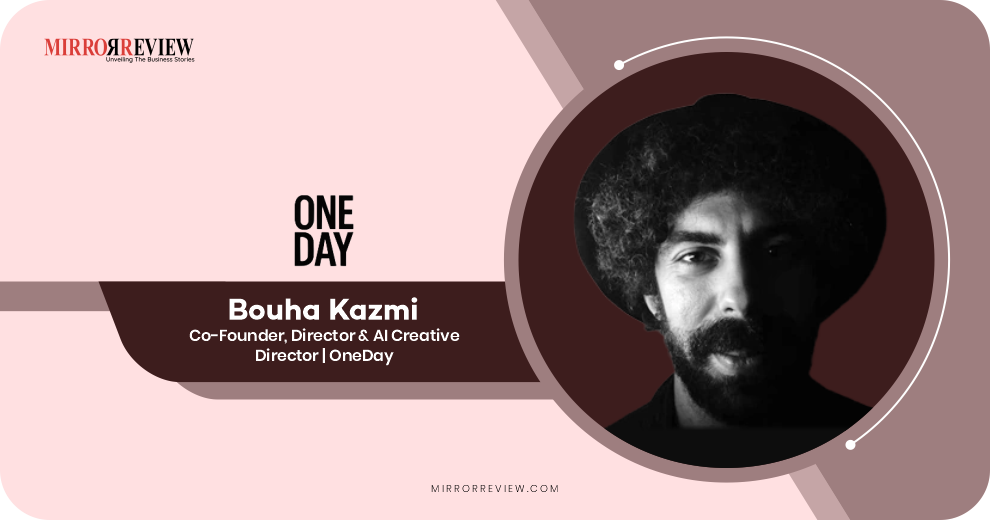
There is a moment, somewhere in the evolution of any creative field, when someone decides that the tools themselves deserve to be rethought. Not just used better, but fundamentally reconceived. That moment, in the world of cinematic storytelling, belongs to people like Bouha Kazmi.
Bouha is the Co-Founder, Director, and AI Creative Director at OneDay (oneday.xyz), a generative AI entertainment studio whose central project is the redefinition of how visually compelling cinematic content, within advertising and within film itself, is conceived, crafted, and produced. This is not incremental work. It is the kind of work that changes the vocabulary of an entire industry.
“At the heart of our work is a new paradigm for creative collaboration,” Bouha describes, and he means that phrase literally. OneDay was not built to do what studios have always done but to do it more efficiently. It was built to discover something new about what is possible when human imagination and advanced generative tools are brought into genuine, working partnership.
A Career of Awards and Achievement
Before Bouha was rewriting the language of cinema, he was becoming fluent in it. His career spans directing across music videos, commercial work, and short films, building over time a body of work that has earned recognition across some of the industry’s most competitive platforms.
He has received nominations and awards from the Shots Awards and leading global festivals. He has been recognized at the MTV VMAs and at the BRIT Awards. And he has been honored twice with the Young Director Award at Cannes Lions, which stands among the most coveted recognitions available to a director working in the commercial space. Earning it once is an achievement. Earning it twice is a statement about a particular, sustained level of creative vision.
These are not peripheral credentials. They represent a filmmaker who, before turning his attention to generative AI, had already demonstrated the ability to produce work of the highest cinematic standard across multiple formats and for the most demanding stages the industry offers.
Building OneDay: The Studio and Its Architecture
OneDay is the institutional expression of what Bouha and his co-founders have been building. The studio describes itself as a GenAI entertainment studio, but that description sells the complexity of the enterprise somewhat short.
What Bouha has co-developed at OneDay is not simply the capacity to use AI tools in a production workflow. He has co-developed the studio’s creative frameworks and visual methodologies, establishing an AI production pipeline and architecture that supports efficient, imaginative, and scalable generative filmmaking. This is infrastructure for an entirely new way of making cinematic work.
The system he has helped build integrates creative direction, narrative design, and advanced generative production practices into a coherent whole, one that is both rigorous enough to be scalable and flexible enough to remain genuinely creative. The result is a studio that can do something most production companies cannot: produce cinematic content that is emotionally anchored and culturally meaningful, at a scale and with an efficiency that purely traditional methods cannot match.
The Films, the Franchise, and the Press
At OneDay, Bouha has co-written, co-directed, and AI-creative directed multiple original short films within a new IP franchise. These are not demonstration reels or technology showcases. They are films, made with the full weight of Bouha’s directorial experience and creative vision, that happen to use generative AI as a fundamental part of their production. The distinction matters. The technology is in service of the story, not the other way around.
The work has attracted the attention of some of the most serious editorial outlets in the world. One Day’s films have been featured in The Guardian, The New York Times, BBC News, and Variety. These are publications that cover cultural significance, not just novelty. The fact that OneDay’s work has landed in all four of them suggests that what Bouha and his collaborators are making is being recognized as something more than a technological experiment. It is being recognized as cinema.
The Philosophy Behind the Paradigm
What makes Bouha’s approach at OneDay distinct is not simply the use of generative AI in filmmaking. Many studios, laboratories, and individuals are doing that. What makes OneDay distinct is the philosophical framework within which the technology operates.
Bouha describes the studio’s goal as producing storytelling that is “cinematic, emotionally anchored, and culturally meaningful.” Those three qualifiers are doing a great deal of work. Cinematic is a question of form. Emotionally anchored is a question of human truth. Culturally meaningful is a question of resonance. Together, they define a standard for AI-generated content that is far more demanding than mere visual impressiveness.
The fusing of human imagination with advanced generative tools, as Bouha frames it, is not a compromise between the human and the technological. It is a new form of creative collaboration, one in which each side contributes what the other cannot provide on its own. Human imagination supplies the emotional intelligence, the cultural instinct, the understanding of why a story matters. Generative tools supply scale, speed, and visual possibilities that no traditional production pipeline can match.
The Storyteller at the Frontier
There is something fitting about the fact that a filmmaker who has been recognized twice at Cannes Lions, and whose work has appeared at the MTV VMAs and the BRIT Awards, is now doing some of the most forward-looking work in the industry. It suggests that the frontier of creativity is not a destination reached only by the technically minded. It is reached, as it has always been reached, by storytellers who are willing to follow their curiosity wherever it leads.
In 2026, Bouha Kazmi and OneDay are leading that search, building the frameworks, the methodologies, and the production architecture that will shape how the next generation of cinematic content is made. For an industry still working out what generative AI means for the art of filmmaking, the work coming out of OneDay offers something more than a demonstration. It offers a direction.
Read more: Creative Visionaries of 2026: The Storytellers and Industry Leaders to Watch


