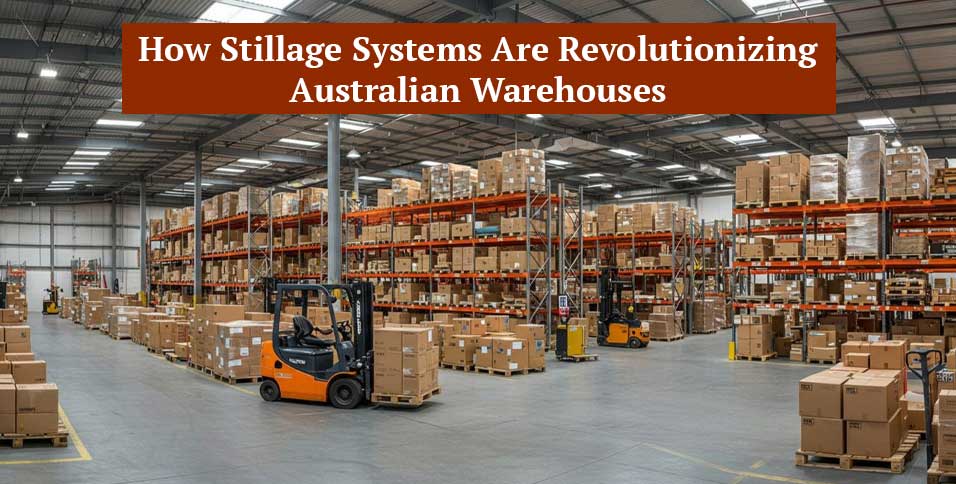
Take a look at any of the top-performing warehouses today and you will see something different from what you would have seen in a warehouse a decade ago. It may not always be immediately apparent, sometimes it is the flow of activity, the ability to access the product, or simply the amount of product that fits into the same area. What is behind this trend? There is increasing use of modular storage solutions that do more than just store products.
Australian companies are also rethinking their warehouse operations as the pressures on the supply chain continue to escalate. With rising costs of property, labor shortages, and growing demands from customers for faster delivery times, the warehouse has become more than a passive storage location, it has become an active competitive tool. But it takes more than good intentions to make this happen, it takes infrastructure that can keep up.
The Warehouse’s Evolving Role in Supply Chains
The warehouse has evolved significantly. Supply chains are a series of interrelated processes: procurement, production, distribution, and delivery. The warehouse is a strategic point in this chain. It is where the flow of goods changes from supplier to customer, where accuracy of pick affects the level of service, and where space utilization affects profitability.
As stated by the Australian Logistics Council logistics costs contribute about 9-10% of the GDP, and warehousing is a major component of these costs. If warehouses are not performing well due to inefficient designs, storage, and workflows, it affects the whole supply chain. But if they are optimized, they can be drivers of operational leverage.
This is understood by modern supply chain thinking. Warehouses are no longer just storage facilities. They are now fulfillment centers, cross-docking facilities, and inventory buffers that can absorb demand variability. This new function demands storage systems that provide flexibility, scalability, and velocity, in addition to capacity.
Challenges Facing Australian Warehouses
The Australian warehousing companies are confronted with a unique challenge influenced by geographical, market, and regulatory factors.
Space constraints are becoming more pressing
The level of vacancies in industrial properties in major metropolitan areas has reduced significantly. According to CBRE, the national level of vacancies in industrial properties has fallen to record lows in recent years, thereby increasing rents. Enterprises cannot just rent more space; they have to wring more productivity out of the space they occupy.
Compliance with safety regulations is mandatory
Safe Work Australia’s guidelines specify the need for correct stacking, loading, and access procedures. Failure to comply is not only a legal issue but also a reputation risk. However, conventional storage systems, especially ad-hoc stacking or makeshift racking, often fail to meet the best practice guidelines.
Scalability is no longer a choice
Peak volumes, promotional spikes, and changing SKU profiles mean that warehouses need to adjust rapidly. Scalability is difficult for fixed infrastructure to handle. Solutions that work well for steady-state operations often break down under variable loads, leaving companies with expensive workarounds or service outages.
The pressure to contain costs never lets up
Labour is the biggest operating cost in a typical warehouse. Data from the Australian Bureau of Statistics indicates that wage growth has been outstripping productivity growth in the transport and warehousing industries. Each inefficiency, whether it is travel time, double handling, or difficult access, directly contributes to increased labour costs.
These are not isolated issues. They add up. The constraints of space lead to inefficient use of space. Inefficient use of space leads to increased handling times. Increased handling times lead to increased costs and safety concerns. The only way to break this cycle is to think about storage in a completely different way.
How Stillage Systems Address Core Operational Challenges
A stillage system provides a modular and stackable storage solution that is adaptable and efficient. This is in contrast to fixed racking or floor storage, where a stillage system provides a flexible infrastructure that can adapt to changing operational requirements.
The efficiency of space usage is improved
The use of vertical space by stackable designs means that storage capacity can be enhanced without the need for fixed installation, which is important in the metro environment where every square meter of space is valuable.
Material handling becomes safer and more systematic
Purpose-built stillages ensure that there are defined load parameters, stable stacking properties, and access points. This helps to minimize the risks associated with manual handling and makes the workflow in the warehouse clearer. When products have a defined place and handling procedure, the rate of accidents reduces.
The flexibility grows with demand
Modular solutions can be dynamically adjusted as changes occur in the inventory profiles. Items for seasonal sales, promotions, or new SKUs can be handled without having to change the infrastructure. This flexibility is not possible in traditional systems.
Product protection improves the quality of inventory
Effective containment helps minimize damage when storing and transporting the merchandise. This is especially important for sectors that handle expensive or fragile items. Product damage translates to lost investment, which can be avoided with proper storage solutions.
Strategic Benefits: Why This Matters Beyond the Warehouse Floor
The importance of good storage infrastructure goes beyond the operational statistics. It defines strategic capabilities.
Operational efficiency adds up over time
Faster put-away, faster picking, shorter distances to travel—these small gains add up. A warehouse handling thousands of transactions a day translates small gains into big productivity improvements. This happens without incurring proportional costs, which makes it a true productivity gain.
Labour productivity is a response to better systems
When employees have easy access to inventory, know where things go, and understand the processes they are supposed to follow, productivity will increase. It’s not about working harder; it’s about removing obstacles that hinder good people. Better storage systems eliminate obstacles that slow good people down.
Return on investment becomes tangible.
Although initial investment in quality storage infrastructure involves capital allocation, the return mechanisms are clear: fewer damages, fewer labor hours per unit handled, lower rental unit requirements, and improved safety records. Progressive companies view these systems not as expenses but as profit-protection investments with tangible returns.
Scalability enables growth without interruption
Perhaps most importantly, modular storage infrastructure allows businesses to scale their operations in line with demand. This means that businesses can capitalize on growth opportunities without the time and expense of facility expansion. It is the difference between growing with and growing without infrastructure.
Why Forward-Thinking Operations Are Upgrading Now
Upgrades to strategic warehouses are not taking place because warehouse systems have failed. They are taking place because the needs of businesses have outgrown what older methods can handle.
E-commerce has completely changed the landscape of fulfillment expectations. Same-day and next-day delivery are no longer considered luxury services but the new norm. To satisfy these requirements, the warehousing operation needs to be able to process orders quickly and accurately. Storage solutions that enable this become a necessity.
Resilience in supply chains has become a higher priority for the executive team. The recent disruptions, whether global events, natural disasters, or market volatility, have shown how vulnerable extended supply chains are. A flexible and adaptable infrastructure in warehouses helps them withstand disruptions.
Infrastructure choices are being influenced by regulatory and ESG factors. Contemporary storage solutions tend to provide improved space efficiency, which means smaller environmental impacts per unit of storage. Safety enhancements mean fewer accidents in the workplace. These are not merely regulatory requirements but are becoming increasingly significant to stakeholders, customers, and employees.
The calculus is changing. What was once an operational consideration is now perceived as a strategic play. Companies serious about supply chain performance are now applying the same level of rigor to warehouse infrastructure as they would to technology or critical equipment.
Building Supply Chain Strength From the Ground Up
Good supply chains are not the result of hope or heroic action. They are the result of systems that work well under pressure, infrastructure that adapts to change, and operations that are designed for efficiency, not improvisation. Storage infrastructure is the backbone of this ability. It shapes what you can store, how fast you can move it, how safely you can run, and ultimately how well you serve your customers.
Doing it right doesn’t fix all of the supply chain, but doing it wrong will ensure issues that trickle down throughout the entire operation. Australian companies operating in challenging markets are increasingly recognizing this fact.
The warehouses that are gaining popularity are not necessarily the biggest ones. They are the ones that make the best use of their storage space, manage their products in the most efficient manner, and are also the most flexible when it comes to changing demands. This is where stillage systems move from being a matter of equipment choice to becoming a competitive advantage.
The question that needs to be answered by the decision-makers is not whether warehouse infrastructure is important to supply chain performance. It is obvious that it is. The question that needs to be answered is whether your systems are supporting the business you are building or limiting the performance you seek to achieve. This is a strategic question that needs to be answered with rigor and with a sense of urgency.