Long before Tim Cook became one of the most powerful leaders in technology, he had a simple job: delivering newspapers in his hometown.
There was nothing glamorous about it. But it taught him discipline, routine, and responsibility, the traits that would later define his leadership style.
Tim Cook stepped into the role of Apple’s CEO in 2011, succeeding Steve Jobs, at a time when many questioned whether Apple could thrive without its iconic founder.
Cook’s rise was not built on bold product reveals or headline-making moments. Instead, it was shaped by operational excellence, long-term thinking, and an ability to scale Apple into a global powerhouse.
This blog looks at Apple CEO Tim Cook’s journey from his early life and career to his contributions at Apple and how his steady leadership translated into both influence and personal wealth.
It’s a story about consistency, execution, and how quiet leadership can still leave a lasting impact.
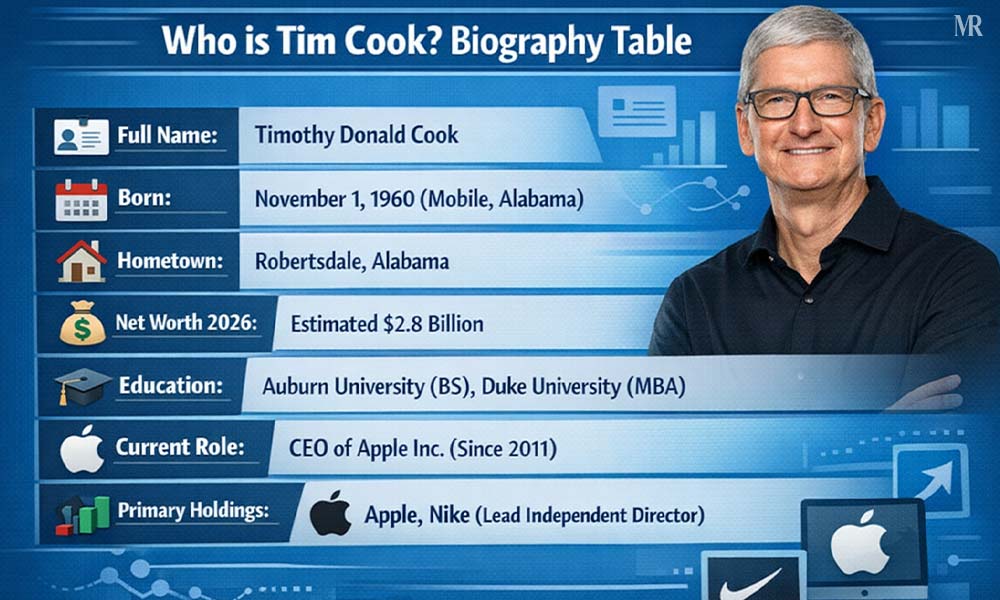
Who is Tim Cook? Biography Table
Tim Cook’s Early Life & Education
Tim Cook grew up in the working-class town of Robertsdale, Alabama. His father, Donald Cook, worked as a shipyard laborer, while his mother, Geraldine, worked at a local pharmacy.
He started his professional life as a newspaper delivery boy.
Cook famously woke up at 3:00 AM daily to deliver papers before attending school. He later worked part-time at a pharmacy and even at an aluminum plant to save money for his university education.
This discipline eventually made him the first person in his family to attend college.
Moreover, his academic path provided the technical skills needed for his future career.
| Year | Institution | Field / Role | Key Takeaway |
| 1978–1982 | Auburn University | Industrial Engineering | Learned process optimization and systems thinking |
| 1982 | IBM | Joined as an operations-focused professional | Applied engineering discipline at scale in a global corporate environment |
| 1986–1988 | Duke University Fuqua School of Business | MBA | Graduated as a Fuqua Scholar, an honor awarded to the top 10% of the class |
A Turning Point: Multiple Sclerosis Misdiagnosis
In 1996, Tim Cook was misdiagnosed with multiple sclerosis. Although the diagnosis later proved incorrect, the experience had a lasting impact. It gave him a sharper sense of urgency and clarity about how he wanted to live and work.
Pre-Apple Career: Mastering the Supply Chain
Before joining Apple, Tim Cook spent 16 years refining his operational expertise at top technology firms.
He specialized in manufacturing and distribution, making him an invaluable asset to the global tech sector.
1. Intelligent Electronics (1994–1997):
Tim Cook served as the Chief Operating Officer of the Reseller Division. He focused on streamlining logistics for electronics wholesalers.
2. IBM (1982–1994):
Cook spent 12 years at the “Big Blue.” He rose to become the Director of North American Fulfillment. There he managed manufacturing and distribution for IBM’s Personal Computer Company across North and Latin America.
3. Compaq (1997–1998):
Cook joined Compaq as the Vice President of Corporate Materials. He managed product inventory for the world’s largest PC manufacturer at the time.
Tim Cook’s Decision To Join Apple
After only six months at Compaq, Tim Cook met Steve Jobs.
On paper, the decision for his career switch was obvious.
Staying at Compaq meant working for a dominant market leader with predictable growth. Apple, by contrast, was struggling and was posting losses, shrinking its product lineup, and fighting for relevance.
But Cook saw something others missed.
He believed Apple’s problems were operational, not creative, and that the company could be fixed from the inside. Trusting that assessment and his own instincts, Tim Cook chose uncertainty over comfort and joined Apple.
The Apple Era: From Operations to the CEO
Tim Cook joined Apple in March 1998 as the Senior Vice President for Worldwide Operations. At the time, Apple faced a bleak financial future and declining sales.
- Saving Apple Through Operations
Tim Cook famously declared that inventory is “fundamentally evil.” He compared technology products to dairy items that spoil quickly.
To fix Apple’s finances, he implemented several radical changes, such as:
- Closed Internal Factories: He shut down Apple’s own warehouses and factories to cut fixed costs.
- Contract Manufacturing: He moved production to external partners in Asia, like Foxconn.
- Just-in-Time Inventory: He reduced inventory turnover from months to just a few days.
These thoughtful changes turned Apple into a manufacturing powerhouse. Consequently, Apple’s gross margins jumped from 19% to 28% within a year.
- Leading as CEO
The board of Apple appointed Tim Cook as permanent CEO on August 24, 2011, following Steve Jobs.
Cook did not try to mirror Jobs’s leadership style. His approach was quieter and more operational, with an emphasis on execution, efficiency, and long-term planning.
During his tenure, Apple reached multiple valuation milestones, crossing $1 trillion, $2 trillion, and $4 trillion in market value in 2025, reflecting the company’s continued growth at scale.
Under Cook, Apple also broadened its business. While the iPhone remained the company’s core revenue engine, products like Apple Watch and AirPods became established parts of the lineup, and services grew into a meaningful revenue stream alongside hardware.
Tim Cook’s leadership focused less on reinvention and more on running Apple consistently at global scale.
Apple CEO Tim Cook Net Worth Breakdown
After more than a decade leading Apple, Tim Cook has built substantial personal wealth, largely through long-term equity compensation rather than founder ownership.
As of early 2026, Tim Cook net worth is estimated at $2.8 billion. Unlike many tech billionaires, his fortune comes primarily from stock awards, performance incentives, and disciplined selling over time.
To understand how that wealth is structured, here’s a breakdown of his major assets:
Tim Cook’s Major Assets
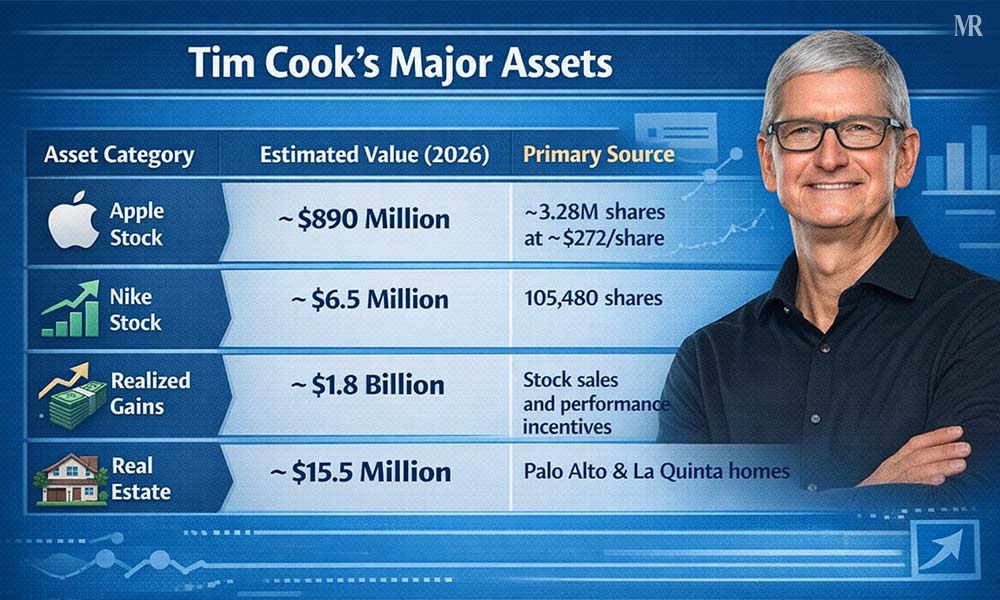
Cook currently owns about 3.28 million shares of Apple, representing less than 1% of the company. Even so, Apple’s scale makes that stake highly valuable.
In 2025 alone, his total compensation reached $74.3 million, including a $3 million base salary and approximately$57.5 million in stock awards, with the remainder tied to incentives and benefits. This makes Tim Cook one of the highest-paid CEOs in the world.
Personal Life & Routine: The 4:00 AM Habit
Apple CEO Tim Cook maintains a notoriously private and disciplined life. He describes himself as a “fitness nut” and starts his day long before the sun rises.
1. Morning Routine:
Tim Cook wakes up at 4:00 AM every day. He spends the first hour reading through 700 to 800 emails, many of them from customers.
2. Physical Discipline:
At 5:00 AM, he hits a private gym for a vigorous workout. He credits exercise with keeping his stress levels under control.
3. Lunch At Apple Cafeteria:
Despite his position and wealth, Cook often eats lunch in the Apple cafeteria alongside employees. He has said this routine helps him stay grounded and aware of the company’s everyday culture and operations.
- Is Tim Cook gay?
In October 2014, Cook made history by publicly coming out as gay. He became the first CEO of a Fortune 500 company to do so. He described the decision as a way to inspire others and advocate for human dignity.
- Is Tim Cook married?
No. Tim Cook is not married and has no publicly known spouse or children. He keeps his personal relationships private and has consistently chosen to separate his public role from his private life.
Political Influence & Global Diplomacy
As CEO of Apple, Tim Cook operates at the intersection of business and geopolitics. Apple’s scale and global supply chain require ongoing engagement with governments, particularly in the United States and China.
In 2016, Cook helped finalize a long-term investment agreement with China, reportedly valued at up to $275 billion over several years. The agreement aimed to support Apple’s growth in the region while reinforcing relationships tied to manufacturing, retail, and local partnerships.
At the same time, Cook has maintained active ties with the U.S. government across administrations.
In 2025, Apple announced an additional $100 billion commitment toward U.S.-based manufacturing and related programs during the administration of Donald Trump. That pledge brought Apple’s total announced domestic investment commitments to approximately $600 billion.
Cook has also worked to preserve Apple’s operational flexibility.
At the 2026 Apple shareholder meeting, he opposed and ultimately defeated a proposal calling for a formal “China Entanglement Audit.” The decision allowed Apple to retain discretion over how it manages geopolitical risk without binding external oversight.
Rather than taking overt political positions, Cook’s approach has focused on maintaining access, stability, and continuity in an increasingly complex global environment.
Philanthropy and Giving
Apple CEO Tim Cook has said he does not plan to pass his wealth on as an inheritance. Instead, he intends to donate most of it to charity.
In an extended interview with Fortune, Cook said he will give away $785 million (approximately A$1 billion) after setting aside funds to cover college expenses for his nephew. He described this decision as a deliberate choice to use his wealth for broader social benefit rather than personal legacy.
Cook has aligned his giving with structured philanthropy, including participation in The Giving Pledge, which encourages wealthy individuals to commit a majority of their assets to charitable causes.
His publicly stated areas of focus include human rights, equality, education, and public health, though he has not disclosed detailed allocation figures or timelines.
Legacy and Tim Cook’s Succession
As Tim Cook turned 65 in late 2025, rumors about his retirement intensified. He has admitted that he is “obsessed” with finding the right successor to lead Apple into the future.
Currently, John Ternus appears to be the leading internal candidate. Ternus, the Senior VP of Hardware Engineering, recently took over oversight of Apple’s design teams.
Analysts describe Ternus as a “steady hand” who mirrors Cook’s operational rigor while maintaining a deep focus on product engineering.
While Cook has no immediate plans to step down, he has already begun the systematic process of transferring leadership responsibilities.
End Note
The Apple CEO Tim Cook biography illustrate a journey of relentless discipline. He rose from delivering newspapers in Alabama to managing the world’s most influential technology company.
By focusing on efficiency, sustainability, and human rights, he turned Steve Jobs’ vision into a durable, multi-trillion-dollar reality.
Whether through his 4:00 AM email triage or his multi-billion-dollar philanthropic pledges, Cook remains the architect of the modern tech world.
As he prepares for the next phase of his career, Tim Cook’s legacy as the builder of the Apple empire remains unchallenged.
Maria Isabel Rodrigues
FAQs
- What is Tim Cook’s net worth in 2026?
Tim Cook net worth 2026 is estimated at approximately $2.8 billion. Most of this wealth comes from Apple stock awards and realized gains from share sales over the last decade.
- Does Tim Cook own stock in other companies besides Apple?
Yes, Tim Cook has served on the board of Nike since 2005. In late 2025, he purchased $3 million worth of Nike shares, nearly doubling his personal stake.
- Who is the most likely to be Tim Cook’s successor at Apple?
John Ternus, the Senior Vice President of Hardware Engineering, is currently the frontrunner for the CEO role. He recently expanded his role to include oversight of the design department.