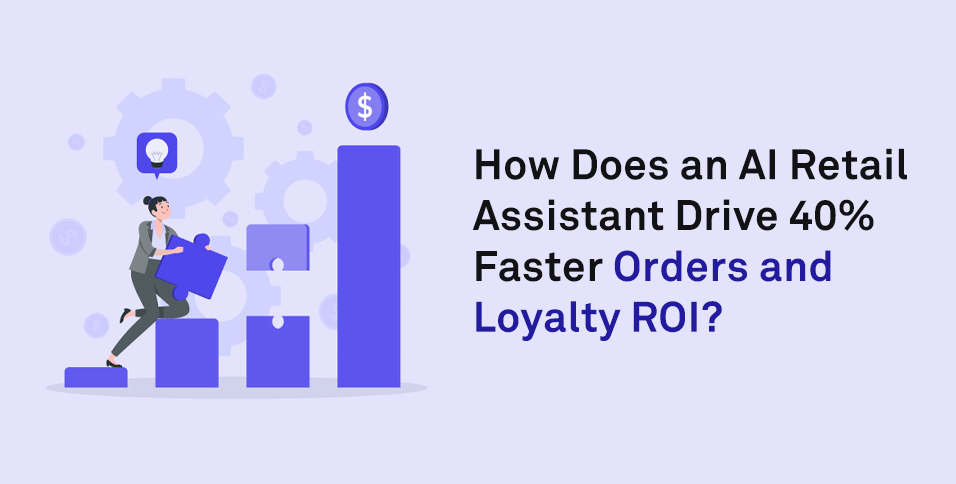
Retail has changed more in the last few years than in the last few decades. Customers now expect instant movement from the moment they click a product to the moment it reaches their door. The AI retail assistant has become central to this shift because shoppers no longer wait for slow pages updates or unclear delivery timelines. Even a few seconds of delay can push them toward another brand that feels faster and more dependable.
Research shows a slow site drives 76% of shoppers to drop a purchase at least once, and about 50% of users abandon a site when pages take longer than two seconds to load. This proves that speed is not only a technical factor but also an emotional signal. When retail moves quickly customers feel respected. When it moves slowly customers lose trust. This emotional link between speed and confidence is why faster orders now directly influence loyalty ROI.
AI shopping assistants and AI shopping agents help with this by predicting delays before they happen, fixing availability issues in real time, and guiding decisions across fulfillment and service. Agentic AI in retail and online shopping agents make hundreds of micro-improvements that together create major gains in order speed. When these systems work together retailers see how intelligence can turn friction into smooth movement.
In this blog, you will learn how an AI retail assistant helps retailers deliver up to forty percent faster orders while also increasing loyalty ROI. You will also see how an AI agent for e-commerce and enterprise AI solutions improves routing, inventory accuracy, personalization, and timing so customers receive a faster and more meaningful experience. The blog will also explain how these improvements build long-term trust and help retailers grow in a world where speed is the new measure of loyalty.
Why Retail Struggles To Reach 40% Faster Orders
Customers expect retail to move as fast as the rest of their digital life. But inside retail operations, many delays remain hidden. These delays slow down orders and quietly reduce loyalty. An AI retail assistant helps retailers identify and remove these issues so they can move closer to the 40% speed benchmark and deliver experiences that keep customers returning.
Compounding Micro-Delays Across The Retail Workflow
Small operational delays often combine into large slowdowns that directly impact order speed and loyalty ROI.
- Tiny delays stack into long waiting times: Seconds lost during stock checks, routing, or manual approvals quietly build up. Customers feel these delays immediately, even when teams do not notice them.
- Manual steps break the speed of the order journey: Human reviews and repeated confirmations make orders wait. An AI retail assistant removes these pauses with automatic decision-making, which increases overall speed.
- Slow service reduces loyalty very quickly: PwC reports that thirty-two percent of shoppers stop buying from a retailer after slow service happens more than once. Speed directly pushes loyalty ROI up or down based on how consistent it feels.
The Inventory Illusion: When Available Does Not Mean Ready
Retailers often show stock as available even when the item is not ready to ship. This instantly slows down orders and harms trust.
- System stock does not match real shelf stock: Items may be misplaced, damaged, or already assigned to another order. This mismatch causes delays and forces order changes.
- Real-time checks reduce last-minute cancellations: AI shopping assistants and AI shopping agents update availability instantly, so retailers know what is truly ready. This prevents sudden slowdowns that hurt order speed.
- Better accuracy improves delivery success: When stock is correct from the start, orders move smoothly and loyalty ROI rises because promises are kept.
Reactive Retail Cannot Support Predictive Customers
Customers want issues solved before they happen. Retailers who react too late fall behind in both speed and loyalty.
- Problems are noticed only after they cause delays: By the time teams see an issue, the customer already feels disappointed which lowers repeat purchase potential.
- AI predicts slowdowns before they occur: Agentic AI in retail and an AI retail assistant detect early signs of overload courier delays or rising demand and adjust operations instantly.
- Proactive action builds trust and increases loyalty ROI: When delays are prevented customers stay confident in the brand and are more likely to return.
Loyalty Efforts Miss Impact When Timing Is Wrong
Loyalty ROI depends heavily on timing and relevance which many manual systems cannot control.
- Early rewards feel disconnected: If offers arrive before the customer shows intent, they do not influence buying behavior.
- Late rewards arrive after the decision is already made: Once customers move on, a reward loses all value. An AI agent for e-commerce reads real-time behavior and sends rewards at the strongest moment.
- Timely actions boost loyalty ROI: When rewards match customer intent, they generate more conversions and strengthen long-term loyalty.
How an AI Retail Assistant Drives 40% Faster Orders and Higher Loyalty ROI
Retailers reach real speed when decisions happen instantly and without errors. An AI retail assistant makes this possible by bringing together data, demand, inventory, and customer behavior in real-time. It removes delays at every step of the shopping journey, so orders move faster and loyalty actions feel more meaningful. When intelligence guides the flow from checkout to delivery, retailers see higher order speed and improved loyalty ROI.
Real-Time Decision Routing That Removes Guesswork
Faster orders start with faster routing decisions. An AI retail assistant evaluates all important information at once, so orders never wait for manual checks.
- Routes are selected within milliseconds: Inventory availability, store distance, courier capacity, and workload are compared instantly so the system chooses the fastest fulfillment path.
- Bottlenecks reduce across the workflow: When routing is automatic, orders do not pile up during busy hours, which increases order speed by a large margin.
- Fulfillment stays stable during high demand: AI shopping assistants help teams manage festival sales and sudden spikes, so delivery promises stay consistent.
Continuous Inventory Accuracy That Prevents Delays Early
Accurate inventory is one of the strongest drivers of faster orders. Real-time updates remove errors that slow down fulfillment.
- Live updates reflect real shelf conditions: The AI retail assistant tracks stock movement as it happens, which reduces the difference between system stock and actual stock.
- Lower chances of out-of-stock surprises: AI shopping agents give instant updates, so customers are not promised items that cannot be delivered.
- Fewer cancellations and rerouting issues: When inventory is accurate from the start, orders move faster, and customer trust increases.
Predictive Order Orchestration That Starts Before Checkout
Many delays happen after customers place their order. Prediction removes these risks early.
- Simulates fulfillment paths automatically: Courier delays, store workload, and rush hour patterns are tested even before the order is confirmed.
- Fixes issues before they reach the customer: The AI retail assistant adjusts routing stock or timing, so orders start on the fastest track.
- Smooth flow during peak hours: Predictive action reduces cycle time, which directly supports the forty percent faster order benchmark.
Adaptive Loyalty Actions That Strengthen ROI
Loyalty grows when support arrives at the right moment. AI helps brands understand when customers are ready to respond.
- Understands user behavior signals: Pauses comparison checks and return visits show intent or hesitation. Intelligence responds to these signals instantly.
- Offers match the customer’s exact moment: An AI agent for e-commerce sends rewards when they are most influential, which raises conversion rates.
- Higher loyalty ROI with timely engagement: Customers value help that arrives at the right time, which increases repeat purchases.
Retail As A System Of Micro-Decisions
Speed increases when every small step in retail works together and not separately.
- Each action influences the next: Picking, packing, routing, and customer support work like links in a chain and not isolated tasks.
- Swarm coordination improves overall speed: Online shopping agents cooperate like a network, which creates consistent acceleration across the process.
- Enterprise AI solutions help scale performance: As micro-decisions improve, retailers see stronger order speed and long-term loyalty growth.
How CrossML Helps Retailers Build A Modern High Speed Retail Stack With AI Retail Assistant
Retailers want faster operations without disrupting the tools and workflows they already trust. An AI retail assistant makes this possible by fitting smoothly into existing systems and improving decisions across fulfillment, service, and inventory. With the right implementation approach, retailers can introduce intelligent automation safely and reach the goal of forty percent faster orders and stronger loyalty ROI.
Let us now look at how CrossML Pvt Ltd helps retailers operationalize AI assistants without disruption:
A Framework For Starting The Transformation
Retailers first need clarity on where delays occur. Once slow areas are mapped by CrossML’s AI systems, it becomes easier to introduce autonomy where it delivers quick improvement.
- Find the steps that repeat delays every day: Stock checks, approvals, slow routing, and customer escalations are common points where time is lost. When these areas are identified, an AI retail assistant can automate them and increase order speed early in the journey.
- Build stable and clean data pipelines: AI shopping assistants make accurate decisions only when data is fresh and consistent. Better data flow reduces errors and strengthens results.
- Select the decisions that can move to automation safely: Tasks like routing, availability checks, and simple service responses are ideal starting points. These create immediate performance improvements.
Seamless Embedding Of AI Retail Assistant Into Existing Systems
Retailers can adopt AI without replacing their current technology.
- AI connects smoothly to OMS, WMS, and POS systems: The AI retail assistant works with existing order management, warehouse tools, and store systems without changing their structure.
- Daily workflows stay familiar for teams: AI shopping agents run in the background, adding intelligence while keeping current processes intact.
- Adoption becomes faster and easier: Because systems stay stable, retailers begin seeing value sooner with minimal disruption.
Human-Governed Autonomy For Safer and Faster Decisions
CrossML’s technology intelligence moves quickly but still follows the company’s rules and policies.
- Business guardrails guide AI decisions: Routing pricing and loyalty rules ensure every AI action aligns with established standards.
- Sensitive actions always stay with people: Teams approve high impact decisions, which keeps autonomy safe and predictable.
- Human oversight increases trust in automation: Retailers get the speed of AI without losing control.
Training Through Retail Digital Twins For Greater Accuracy
Before the AI goes live, CrossML ensures that it learns inside realistic digital environments.
- Digital twins recreate real store and warehouse conditions: Seasonal spikes, courier delays, and stock challenges can be tested without affecting customers.
- The assistant learns from many scenarios: This training helps avoid mistakes and reduces trial and error during rollout.
- Smoother adoption across the business: Teams experience stable operations from day one because the AI enters production well-prepared.
CrossML uses this approach to help retailers deploy an AI retail assistant that keeps improving over time, learning from real operations and customer behavior to boost order speed and loyalty outcomes, sustainably.
Conclusion
Retail is now shaped by how quickly a brand can act. When customers receive fast confirmations, quick delivery updates, and smooth support, they immediately feel that the brand is dependable. Even a short delay can weaken this trust and make shoppers consider switching. Speed has become an emotional signal that shows customers whether a retailer values their time.
An AI retail assistant helps businesses meet this expectation by removing delays across the entire shopping journey. It chooses faster routes, checks inventory in real-time, predicts issues before they happen, and sends loyalty actions at the right moment. These improvements work together to create up to forty percent faster orders and much stronger loyalty ROI because customers experience consistency every time they shop.
As competition grows, retailers need intelligence that keeps improving with daily operations. Brands that use real-time insights to reduce friction will earn repeat purchases more easily and stand out in a crowded market.
CrossML supports this transformation by building AI retail assistant solutions that learn from real behavior, reduce delays, and help retailers deliver both speed and loyalty at scale. This creates long-term growth driven by trust and better customer experiences.