Intelligent automation in procurement stands at the forefront of modern transformation, enabling teams to handle complex workflows with unprecedented speed and precision.
The sooner organizations embed intelligence into procurement-led everyday tasks such as sourcing and supplier management, the sooner they will deliver benefits in accuracy and efficiency and ultimately position procurement as a true value creator for the organization.
Why AI Matters in Procurement Today
Procurement is used to mitigate volatile, supply-chain pressure and the growing need to contain costs.
AI can fulfill these needs as it processes data that is wide-ranging and in real-time, and as it suggests solutions and alternatives that humans might miss.
AI forecasts demand and detects risk, so it transforms procurement; it goes from firefighting into planned thinking.
The result?
Teams can focus on planned partnerships with suppliers, rather than getting lost in paperwork.
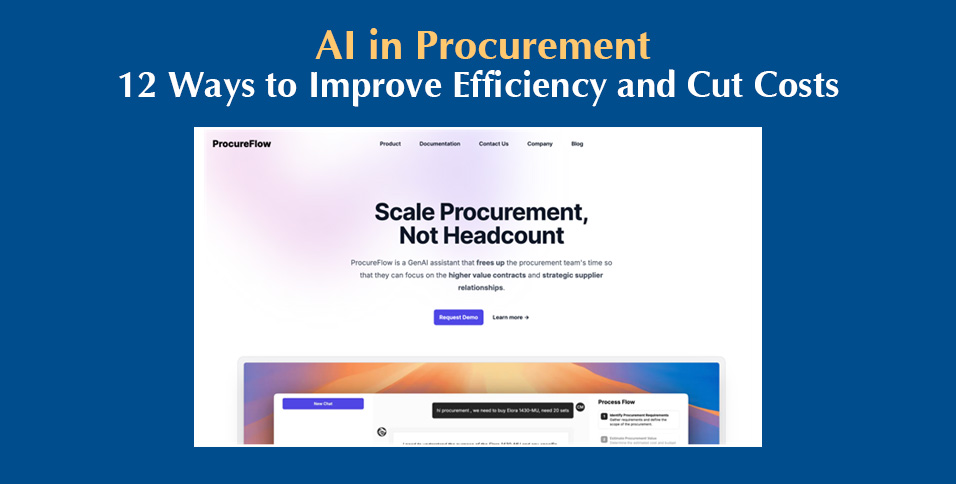
Early examples of AI assistants include ProcureFlow, which analyzes previous purchases to determine what the next best actions are at the lowest price.
12 Actionable Ways AI Transforms Procurement
The best results for this topic are around the top 12 things that can be easily applied for quick wins, and the newest automation, insights, and optimization.
1. Predict Demand with Precision
AI can synthesize demand through studying past purchases, seasonality, and the potential impact of external events, thereby reducing the costs of overstocking and stockouts.
2. Automate Supplier Discovery
Machine learning scans global vendor databases for matches in terms of price, quality, and lead time.
Sourcing events that took place over weeks happens in days.
3. Classify Spend Automatically
The AI categorizes spend with near-perfect accuracy, detects maverick spend, and identifies savings opportunities in tail spend.
4. Spot Anomalies Instantly
Real-time algorithms can detect anomalies such as pricing errors or false invoices that could hurt budgets.
5. Accelerate Contract Analysis
In natural language processing, agreements are reviewed, clauses extracted, risks identified, and amendments proposed.
6. Power Smarter Negotiations
Predictive models use past deal data and benchmarks to equip teams with data-backed negotiating power.
7. Monitor Supplier Risks Proactively
AI analyzes news, financial reports, and performance history to predict disruptions from geopolitical tension to vendor bankruptcy.
8. Streamline Invoice Handling
Computer vision maps bills to purchase orders to automatically approve them, unlocking early payment discounts.
9. Deploy Chatbots for Routine Queries
Virtual agents answer status checks or policy questions 24/7, freeing experts from repetitive tasks.
10. Refine Strategic Sourcing
AI models forecasting demand shifts and suppliers’ performance optimize long-term portfolios of categories.
11. Enforce Compliance Seamlessly
Automated checks detect policy violations for spend or contracts, lowering the risk of an audit or penalty.
12. Integrate End-to-End Automation
Clever automation for procurement enables these elements to be combined and handled automatically in a workflow with minimal human intervention.
Key Benefits Across the Board
AI can yield ROI in many dimensions, with some saving double digits from negotiation improvement and waste reduction.
It is efficient due to a reduction in the number of repeats and half of the cycle time.
When people proactively notify others of unwanted events and improve risk management, they reduce the likelihood of those events from happening and the costs when they do happen, while tracking compliance and sustainability can help people achieve environmental, social, and governance (ESG) goals.
Step-by-Step Implementation Guide
Assess and Prepare Data
Review existing data quality by deduplicating it and correcting inaccuracies to create a reliable dataset that will train AI.
Select Pilot Areas
To present the ROI of automation, start with high-volume processes such as invoice processing or spend analysis.
Build Cross-Functional Teams
Get your IT team, finance team, and procurement team to add AI into your current systems.
Train and Upskill Staff
Center on simple tools and low-training chatbots, stressing a role of complementing rather than replacing.
Measure and Scale
Measure savings, processing speed, and errors.
Scale up implementation, only with proven results, into subsequent iterations.
Emerging Trends Shaping the Future
Generative AI will become autonomous agents managing sourcing cycles or preparing negotiations.
There will be closer integration with IoT to acquire near real-time information and advanced analytics to optimize the carbon footprint of supplies.
AI will act as a tool for human decision-making via hybrid models in complex situations.
Sustainability-oriented AI will prioritize ethical suppliers according to organizational goals.
Overcoming Common Challenges
Explore federated learning methods that analyze data without centralizing sensitive information if data silos impede progress.
This is often mistrusted.
Counter with transparent AI explanations and quick wins to show value.
Scalability is no longer an issue, though security is still relevant.
Prefer systems that use strong encryption and keep an audit trail.
Long-Term Strategic Impact
AI allows these organizations to procure instead of incur costs, thus profiting.
AI provides insights into market foresight, supplier innovation, and supply chain resiliency to planned procurement teams.
AI carves a competitive advantage, displaying speed and margins.
Ultimately, start small with the 12 best practices in mind, scale smart, and use AI to unlock procurement’s potential for your business.