Artificial intelligence has moved beyond novelty. It now sits at the centre of business strategy, reshaping how companies design products, manage operations, and interact with customers. Yet, as adoption accelerates, so does the complexity of implementation.
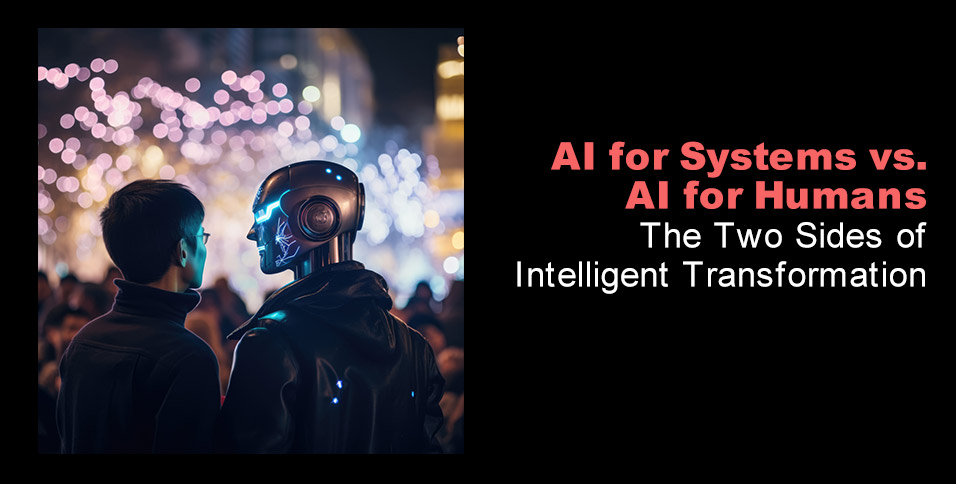
Many organisations still treat AI as a single initiative, like a feature to deploy rather than a dual ecosystem that powers both technology and people. To unlock real value, leaders need to view AI through two interconnected lenses:
- AI for Systems — the intelligent infrastructure that enables scalable automation and smarter decisions.
- AI for Humans — the experiences and interfaces that make that intelligence usable, trustworthy, and empowering.
Together, these perspectives form the foundation of effective AI business solutions — systems that work efficiently and people who can confidently work with them.
AI for Systems: The Architecture of Intelligence
AI for systems represents the unseen architecture that powers modern organisations. It’s the layer responsible for data integrity, workflow automation, and scalable digital operations.
For CTOs, tech founders, and enterprise teams, this side of AI is about more than algorithms, it’s about designing AI solutions that are robust, reliable, and ready to evolve. These systems form the core of predictive analytics, process optimisation, and real-time insights that drive business outcomes.
This approach requires integrating AI services directly into product development pipelines, not as an add-on, but as part of the software’s DNA. When built this way, products can test themselves, monitor performance, and adapt dynamically to user behaviour.
Technology partners such as Swivel Tech focus on helping organisations engineer this backbone of intelligence. Their teams specialise in embedding AI solutions into scalable applications, streamlining QA cycles, enhancing DevOps efficiency, and enabling faster MVP builds.
The goal isn’t hype; it’s sustainability. AI for systems represents a quieter revolution, one that improves speed, accuracy, and scalability without compromising the integrity of the underlying architecture.
AI for Humans: The Experience of Intelligence
While AI for systems focuses on the foundation, AI for humans focuses on the experience. After all, even the smartest automation can fail if people don’t trust or understand it.
This human-centred dimension of AI deals with how individuals from operations managers to healthcare practitioners interact with technology daily. It’s where AI services evolve into practical tools that simplify work, improve communication, and support better decisions.
For example, voice assistants that handle patient calls, internal GPTs that surface insights instantly, and AI-powered learning systems that make compliance effortless.
A company like humaniseAI operates in this space, building AI business solutions designed around usability and empathy. Their voice agents, automation tools, and training platforms are built to complement human workflows rather than replace them.
In sectors like healthcare and professional services, where privacy and trust are paramount, AI solutions must enhance transparency and accountability. AI for humans ensures that automation doesn’t alienate people, it enables them.
The Balance Point: Where Infrastructure Meets Interaction
The true value of AI emerges when workflow automation and human experience operate in sync. Neglect one, and the other loses impact.
If an organisation invests heavily in backend systems but overlooks usability, employees struggle to engage with the tools. Conversely, building user-friendly AI interfaces without a strong technical foundation leads to inefficiency and data fragmentation.
The balance lies in coexistence; designing systems that integrate feedback loops between human and machine. When engineering meets empathy, the result is AI business solutions that are both scalable and sustainable.
Imagine a healthcare provider using Swivel Tech’s AI-enabled systems to manage patient records securely, while humaniseAI’s conversational platform supports patient communication and staff onboarding. The outcome: an intelligent, connected workflow where information moves seamlessly between systems and people.
That’s what real transformation looks like, not just technology for its own sake, but technology in service of humans.
Rethinking AI Adoption in 2025
As AI adoption matures, the conversation is shifting from speed to alignment. The question is no longer “Can we use AI?” but “Are we using it effectively across both systems and people?”
This new phase demands re-evaluating how AI services are implemented.
- Success isn’t just measured in automation rates but in human adaptability.
- It’s not just about uptime or accuracy, but about accountability and trust.
- It’s less about cost-cutting, and more about continuous learning and readiness for change.
Organisations that embrace this dual perspective will move beyond isolated automation projects. They’ll cultivate AI ecosystems; intelligent environments where data, design, and decision-making evolve together. These companies treat AI not as a plug-in, but as a strategic capability; a way to align people, process, and performance under one intelligent framework.
The Future of Intelligent Business
The future of AI won’t be defined by who adopts it first, but by who integrates it best. Enterprises that master both AI for systems and AI for humans will lead the next wave of digital innovation, combining technical precision with human intuition.
- AI for systems will continue to drive operational efficiency, predictive analytics, and scalable workflow automation.
- AI for humans will ensure that every interaction from training to communication, remains transparent and meaningful.
Together, they form a cycle of improvement: systems learning from people, and people improving through systems. This is the future of AI business solutions, where automation meets empathy, and intelligence becomes an organisational mindset rather than a department initiative.
Closing Thought
Artificial intelligence isn’t just about smarter machines.
It’s about smarter organisations, those that use AI solutions to build stronger foundations and AI services to empower the people who depend on them.
AI for systems gives your business structure.
AI for humans gives it purpose.
And when both evolve together, innovation becomes not just possible, but inevitable.