Artificial intelligence (AI) is increasingly entrenched in the life of work and academia. To assist students in essay writing or professionals in report writing, emails, and presentations, AI-facilitated writing tools such as ChatGPT, Claude, or Gemini have redefined the way content is produced. As much as these tools promise efficiency, they pose serious issues regarding authenticity, originality, and accountability. Theirs is where AI detection technology comes in—furnishing institutions, businesses, and educators with tools to decide if a written work is written by humans or computers.
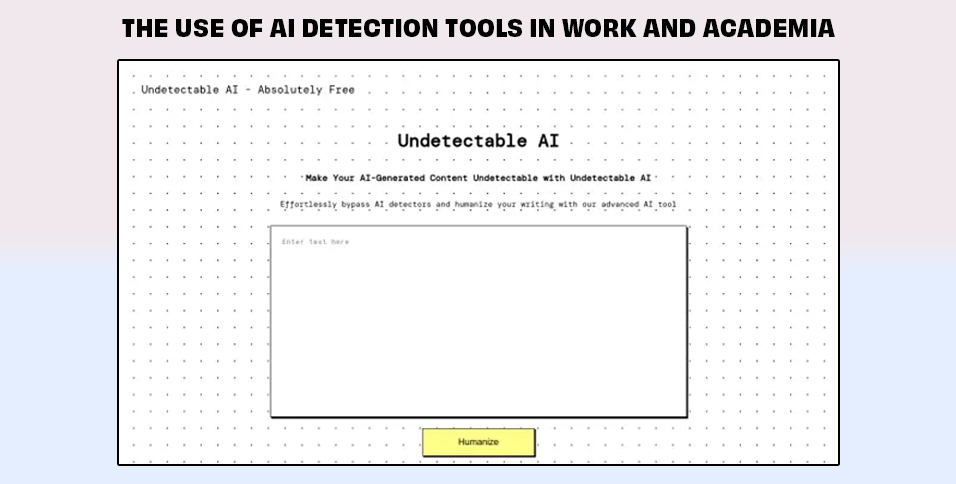
In response to the increasing use of AI text generators, platforms such as undetectable ai have emerged to both identify and humanize machine-written content. Some only identify passages from AI, but others provide more advanced functions where one may observe how machine outputs can be reshaped or blended with human writing. This dual-sided functionality serves the fine line that institutions must walk: encouraging innovation and upholding standards of integrity.
Why Academic Institutions Depend on AI Detection
In learning, cognitive development and creativity are put at the forefront. The students are not just required to submit assignments but also put in their critical thinking, analytical thinking, and creativity. The creation of AI essay generators distorts these expectations. Whatever level the student is willing to allow a chatbot to do the work, the result can nullify the learning process.
AI detection software gives schools, universities, and research institutions the plagiarism security of a new type—AI-generated plagiarism. It’s different from the classical type of plagiarism, which is direct copying from available texts. AI outputs are original but not necessarily authentic. A detector can assist teachers in finding out if the student’s work is original or a processed output from an AI program.
In addition to discouraging abuse, these tools also enable instructors to define the standards of ethical use. Rather than banning the technology, most institutions now put the conversation on the grounds of responsible adoption. For instance, students can be permitted to utilize AI for idea generation or outlining ideas but not for writing. Detection software encourages accountability to this measure.
Professional Environments and the Requirement for Verification
Outside the educational environment, AI detection also applies. Most companies use reports, proposals, and marketing copy that has to read a particular way and meet corporate guidelines. If workers produce work all done by AI and submit it, it would bring with it the potential for miscommunication, fact errors, or loss of company reputation.
For example, in journalism, accuracy and authenticity are the most important things. Detection tools can be employed by editors to make sure that news items are not too dependent on AI because at times AI fabricates facts or provides only surface information. Likewise, when it comes to finance or law, experts are supposed to provide advice based on expertise and adherence. If AI were used without any constraints, it would kill credibility as much as accountability in the law.
Detection tools also benefit human resources departments and recruitment agencies. As resumes and cover letters become more polished through the assistance of AI, recruiters must spot differences between genuine applicant effort and submissions assisted by AI. This enables them to better understand candidates’ communication abilities and motivation.
Strengths of AI Detection Tools
The power of AI detection software is that it can recognize linguistic patterns, sentence structure, and statistical repeatability of machine-generated content. Unlike human failure to detect finer patterns, the software can pick up on repeated sentence patterns, simplicity of tone, or deviance of vocabulary usage.
Key advantages are:
- upholding standards of Integrity: Contravening academic integrity and professional credibility.
- Promoting Transparency: Enabling institutions to create succinctly defined guidelines for the application of acceptable AI usage.
- Reducing Reviewers’ Time: Giving rapid data-based insights instead of manual speculation.
- Establishing Trust: Empowering stakeholders—employers, clients, students—to believe in the originality of written work.
Limitations and Ethical Concerns
While AI-detection software can be spoofed, sometimes they may flag human writing as AI-generated or overlook subtle AI support and thus dismiss false negatives. Relying too much on these tools may unjustifiably punish writers who compose in machine-like styles, i.e., overly formal or stripped-down language.
There is the issue of equity and privacy as well. Should all documents be AI-proofread? Where would the line be drawn between maintaining integrity and respecting autonomy? These are challenging issues for employers and teachers. The aspiration should not be to demonize AI but create frameworks wherein human work and machine aid can coexist in the open.
Another ethical issue is associated with the process of detection tools being shut down by “AI humanizers”—software that rephrases information to avoid detectors. This constant “cat and mouse” situation implies that future AI detection will be synonymous with relentless development and technological innovation.
The Future of AI Detection in Education and Business
As AI programs develop further, so shall the surveillance technologies used to detect it. Already, developers are building AI detection as part of wider plagiarism scanner, compliance, and content management systems. In education, it will likely become adaptive platforms that not only warn of AI use but also teach students the art of improved writing. In business, it will likely become part of wider corporate governance systems that check documents before publication to the external world.
Finally, AI detection tools are not watchdogs but trust facilitators in a technological era that keeps making it harder to differentiate between man and machine. They do not aim to stop progress but help ensure that progress is responsibly made, with accountability and transparency.
Conclusion
AI writing will not disappear, and its use in education and in the workplace will continue to grow. With that growth is the requirement of transparency, originality, and ethical accountability. AI detection programs are a necessary protection to provide authenticity, integrity, and accountability.
Though far from flawless, they are an important component in the construction of a future where the power of human imagination and the power of machine efficiency can be harnessed together—yet without destroying the trust on which the process of learning depends and the process of working depends.
Also Read: Why AI Checker Tools May Be the Next Big Legal Controversy in Education