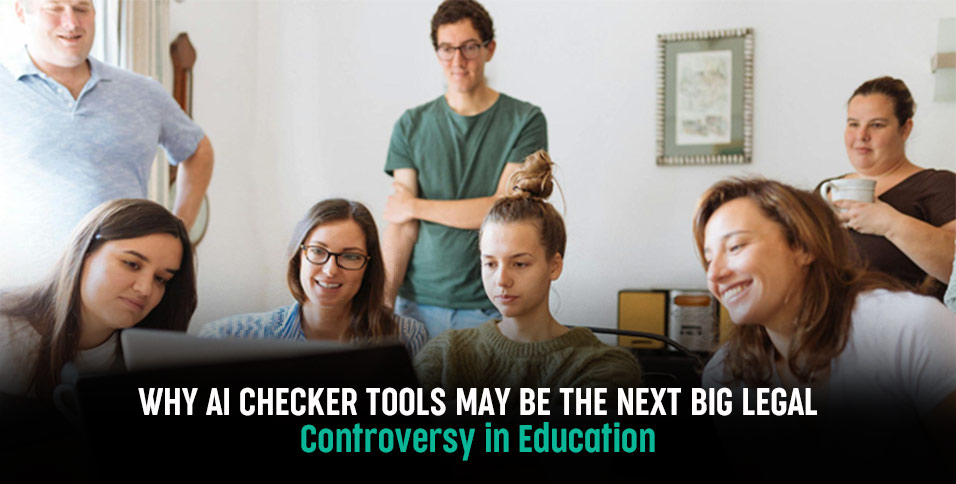
From adaptive learning platforms to virtual tutors, AI transforms how students learn and how educators assess. However, one particular application of AI—plagiarism and content detection tools, often referred to as AI checkers—is stirring up debate and may soon find itself at the center of major legal battles. As these detection tools become more widely used, questions about their accuracy, fairness, and legality are beginning to emerge.
AI checker tools have been developed in response to the increasing use of generative AI by students. In an attempt to maintain academic integrity, institutions have turned to AI checker tools, such as GPTZero, Turnitin’s AI detection tool, and others. Some promote themselves as “AI checker free” tools. They gain popularity among students and educators alike due to their accessibility.
Accuracy of AI Detection Tools
However, beneath the surface of this seemingly simple solution lies a complex and potentially litigious problem. The first primary concern is the accuracy of AI detection tools. While these programs claim to be able to detect AI-generated content, there is increasing evidence to suggest they are often unreliable. A study by researchers at Stanford University found that some of the most popular AI detectors falsely labeled human-written content as AI-generated up to 42% of the time. Conversely, some AI-generated content went undetected altogether.
Imagine a scenario where a student submits an original, personally written essay, only to be flagged by an AI checker as having been generated by a machine. In many institutions, such a flag can lead to serious consequences: academic probation, failing grades, or even expulsion. Students may find themselves unjustly punished based on questionable algorithms.
Due Process and Student Rights
This brings us to the second legal issue: due process and student rights. Educational institutions, especially public ones, are legally required to uphold students’ constitutional rights, including the right to due process. Suppose a school penalizes a student based solely on an AI checker’s report, without providing the student an opportunity to contest the result or understand the methodology behind the accusation. In that case, the institution may be violating the student’s rights. Legal experts have warned that this could open the door for lawsuits, especially if students can prove they were wrongly accused due to a tool’s inaccuracy.
Lack of Transparency
Another controversial aspect of AI checker tools is the lack of transparency in how they operate. Most of these tools function as black boxes: they provide a result (e.g., “80% AI-generated”) but offer little to no explanation of how that result was determined. Unlike traditional plagiarism detection, which can point to specific copied sources, AI checkers operate based on patterns and statistical models. This opacity makes it difficult for students or educators to evaluate the validity of a detection. When academic penalties are based on unexplained scores, it raises ethical and legal concerns about fairness and accountability.
Privacy
Privacy is also a looming legal frontier in this debate. Many AI detection tools require students to upload their assignments to online platforms. This creates data privacy concerns, especially if students are unaware of how their work will be stored, used, or shared. Under laws such as the Family Educational Rights and Privacy Act (FERPA) in the United States, educational institutions have a responsibility to protect students’ academic records. If a student’s work is stored indefinitely or shared with third parties without consent, schools and software providers could face legal challenges.
Intellectual Property Rights
Furthermore, there’s an emerging concern regarding intellectual property rights. When students submit their original content to AI checkers, who owns the content? If the platforms retain a copy, use it to train their algorithms, or sell aggregated data to third parties, they could be infringing on students’ intellectual property rights. Unless explicitly stated in terms of service—and even then, potentially challengeable—this data harvesting could spark another wave of legal scrutiny.
Regulatory Vacuum
As the use of AI continues to expand, so too does the regulatory vacuum surrounding it. Most legal systems have not yet developed clear rules for AI-generated or AI-detected content in educational settings. Courts are only beginning to grapple with the implications of AI in broader contexts, and education-specific cases are likely to emerge soon. Legal scholars have compared the current moment to the early days of online copyright infringement, when institutions and companies rushed to adopt tools and policies without fully understanding their legal liabilities.
In light of these issues, educational institutions need to proceed with caution. Schools should not rely exclusively on AI checker tools to enforce academic integrity policies. Instead, a more nuanced, human-centered approach is necessary. This might include reviewing suspicious assignments manually, engaging students in oral defenses of their work, or even rethinking assessment strategies to focus more on in-class participation, critical thinking, and project-based learning.
Standardized Guidelines
Moreover, there is a growing call for standardized guidelines on the use of AI in education. Policymakers, educators, and technologists must collaborate to develop fair, transparent, and legally sound practices for AI detection. Just as standardized rubrics and due process procedures were created for plagiarism accusations, similar frameworks must now be developed for AI-generated content.
The rise of AI checker tools represents a crossroads for education. On one hand, schools are justified in seeking tools to uphold academic standards in the face of new technology. On the other hand, reliance on under-tested, opaque AI detectors could lead to wrongful accusations, legal disputes, and erosion of trust in the academic system. As institutions navigate this complex terrain, they must weigh the promise of AI against its potential pitfalls. Because if the legal alarms aren’t sounding yet, they soon will be.
Also Read: Should Schools Ban AI Essay Writers or Teach Students to Use Them?