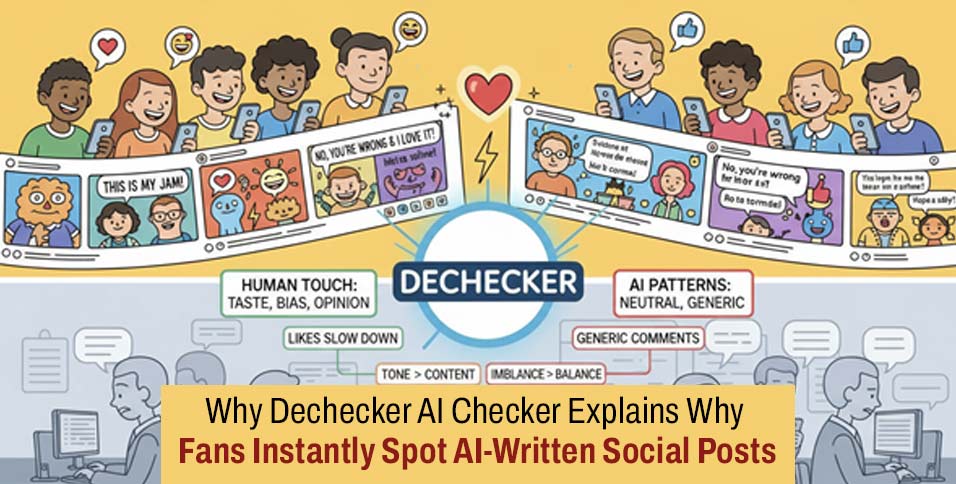
Most brands don’t realize their social media content feels artificial until engagement drops. There’s no warning message, no explicit complaint. Likes slow down. Comments turn generic. Followers scroll past without reacting. Fans rarely say “this was written by AI,” but they sense it immediately. Dechecker helps explain why that instinct is usually right.
The Unspoken Contract Between Accounts and Followers
Social feeds reward judgment, not information
On social media, people don’t follow accounts to learn definitions. They follow for taste, reaction, and judgment. When a post explains too much, balances every statement, or avoids committing to a view, it breaks that contract. Many AI-assisted posts fail here, not because they’re incorrect, but because they feel emotionally neutral.
Running these posts through an AI Checker often reveals the same pattern. The flagged sentences are usually the ones that explain instead of react, summarize instead of choose, or smooth over tension that real humans would leave visible.
Fans read tone before content
Followers skim fast. They don’t parse logic line by line. They sense tone in seconds. AI-generated language often signals itself through excessive clarity and emotional safety. Dechecker highlights where that tone creeps in, sentence by sentence, before it costs attention.
How AI Patterns Show Up in Social Posts
Over-contextualization in short formats
Social posts don’t need full context. Humans assume shared understanding. AI doesn’t. It fills space with setup, clarification, and hedging. Dechecker frequently flags opening sentences that sound like introductions rather than statements. Removing or rewriting them instantly changes how a post lands.
Balanced phrasing where an imbalance is expected
Real people have preferences. They exaggerate, understate, and contradict themselves. AI-generated posts often try to be fair to every angle. In a feed that reads as indecision. Dechecker’s sentence-level detection makes those moments visible, allowing editors to restore bias and personality.
Why “Good Writing” Still Fails on Social Media
Polished language feels anonymous
Ironically, the better an AI-polished post sounds, the less it feels owned. Fans expect rough edges, especially from brands that claim authenticity. Dechecker surfaces sentences that are technically sound but socially empty. Editors can then decide where to inject opinion, humor, or constraint.
Generic emotion is worse than no emotion
AI often inserts safe emotional phrases that look expressive but carry no risk. Followers spot this immediately. Dechecker doesn’t measure emotion, but it flags the structures that produce hollow sentiment. Revising those lines restores credibility.
Brand Accounts Versus Personal Voices
When brand voice turns into template voice
Many social teams rely on internal templates. AI amplifies that repetition. Over time, posts become interchangeable across accounts. Dechecker helps identify which sentences resemble previous outputs too closely. The AI Checker becomes a way to protect brand distinctiveness at scale.
Founder and creator accounts face higher stakes
Personal accounts suffer faster when an AI tone appears. Followers expect inconsistency, mood shifts, and strong opinions. Dechecker helps creators see which lines sound manufactured rather than personal. Often, deleting a single flagged sentence improves trust more than rewriting the entire post.
The Role of Multi-Language Social Content
Localization without losing personality
Global brands post in multiple languages. AI-assisted translation often preserves structure but erases cultural nuance. Dechecker’s multi-language detection helps teams spot where translated posts sound overly formal or generic compared to native social norms.
Avoiding accidental “corporate tone”
In some languages, AI defaults to professional phrasing inappropriate for social feeds. Dechecker highlights these patterns so local teams can rewrite with natural cadence instead of literal accuracy.
From Spoken Ideas to Scheduled Posts
Social content often starts as voice
Many social posts begin as spoken reactions in meetings or brainstorms. Teams record ideas, transcribe them, then polish. When those transcripts come from an audio to text converter, the first draft often feels alive. Excessive AI cleanup removes that life.
Running the final version through an AI Checker helps teams identify where speech-like phrasing was replaced by generic copy. Restoring fragments of the original wording often improves engagement noticeably.
Preserving immediacy in scheduled content
Scheduled posts risk sounding distant from the moment. AI makes that worse by neutralizing urgency. Dechecker helps editors reintroduce time, context, and limitation into posts that otherwise feel timeless and irrelevant.
What Social Teams Learn After Repeated Use
Certain sentences always get flagged
Over time, teams notice patterns. The same transitions, disclaimers, or framing devices appear across posts. Dechecker turns this into actionable insight. Editors adjust guidelines upstream, reducing reliance on detection later.
Detection changes writing instincts
Writers start asking better questions before publishing. Does this sound like something a person would say out loud? Does it commit to a reaction? The AI Checker fades into the background as habits improve.
What Dechecker Cannot Fix on Social Media
It won’t manufacture personality
If an account has no clear point of view, detection won’t create one. Dechecker assumes there is a voice worth preserving. The AI Checker refines expression, not identity.
It won’t protect against backlash
Human-sounding posts can still be wrong. Dechecker helps with authorship clarity, not correctness. Judgment remains human.
Where Dechecker Fits in Social Content Strategy
As a pause, not a filter
The most effective teams use Dechecker as a moment of reflection. A final glance before publishing. Which sentence feels too safe? Which one sounds like no one is in the room?
Protecting trust at scale
As posting frequency increases, trust becomes fragile. Dechecker helps teams scale without flattening voice. The AI Checker doesn’t slow output. It preserves recognition.
Fans don’t need to know how a post was written to know whether it feels real. They respond to judgment, tone, and risk. Dechecker operates in that subtle space where one sentence can decide whether a post is ignored or remembered. The AI Checker doesn’t teach brands how to sound human. It helps them notice when they stop.