In today’s fast-paced manufacturing landscape, the aerospace industry faces a core challenge: how to balance extreme reliability, lightweight design, and cost-effectiveness?
- The Problem: According to the National Institute of Standards and Technology (NIST), non-optimized designs can lead to up to 50% waste in material and machining time.
- The Solution: CNC machining has emerged as a critical solution.
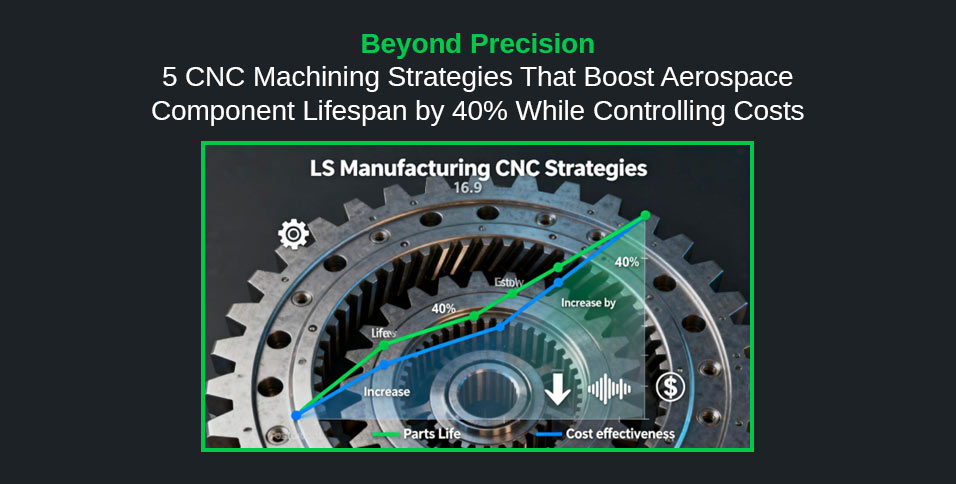
- This Article’s Goal: The article explores five proven strategies that can help your business achieve a 40% increase in component lifespan while optimizing costs.
These strategies are applicable not only to aerospace but also to industries like automotive and medical, showcasing LS Manufacturing’s expertise in high-precision CNC machining services.
1. What Cost and Reliability Challenges Does the Aerospace Manufacturing Sector Face?
The aerospace sector demands an uncompromising equilibrium between reliability, weight reduction, and cost. A single component failure can have catastrophic consequences, while every gram saved enhances fuel efficiency. However, traditional manufacturing approaches often escalate costs when pushing for higher performance. CNC machining services offer a digital and automated solution. For instance, LS Manufacturing utilizes advanced 5-axis CNC machining to validate designs during prototyping, reducing downstream modification costs.
2. How Can Design for Manufacturability (DFM) Eliminate Hidden Costs at the Source?
Design for Manufacturability (DFM) is a collaborative process that integrates manufacturing expertise into design decisions. The American Society of Mechanical Engineers (ASME) highlights that effective DFM can reduce production costs by 30%. In CNC machining, DFM involves simplifying internal geometries and avoiding unnecessarily tight tolerances. LS Manufacturing’s engineering team provides proactive DFM feedback, ensuring designs are both innovative and economically viable. This approach is fundamental to precision manufacturing and applies across services from CNC machining to injection molding.
3. How Do Material Selection and Heat Treatment Act as “Invisible Guardians” of Longevity?
Material choice and heat treatment are pivotal for component lifespan, especially under high-stress environments. For example, titanium alloys offer excellent strength-to-weight ratios, while aluminum alloys are more cost-effective for non-critical structures. LS Manufacturing enhances properties like hardness and wear resistance through precise processes such as carburizing and quenching. In a satellite bracket project, the use of 7075-T6 aluminum with specific aging treatment increased fatigue life by 40%. This command of materials science is critical not only for structural components but also for dynamic systems like transmissions and gearboxes, where material performance directly dictates efficiency and noise levels. For an in-depth exploration of manufacturing critical transmission components, such as the intricate processes involved in gear machining, LS Manufacturing’s detailed blog post on gear machining processes, materials, and types provides valuable insights.
4. What Unique Advantages Does 5-Axis CNC Machining Offer for Complex Geometries?
For components with intricate contours like turbine blades, 3-axis CNC machining requires multiple setups, whereas 5-axis CNC machining allows the tool to approach the workpiece from any direction in a single setup. This improves accuracy, surface finish, and enables complex parts. LS Manufacturing’s 5-axis technology is a cornerstone of high-precision CNC machining, serving aerospace and medical sectors. This capability is essential for producing complex components like aerospace gears with unparalleled accuracy.
5. Going Beyond ISO: How Does a Rigorous Quality Control System Ensure Absolute Reliability?
Certifications like ISO 9001 and AS9100D are foundational, but LS Manufacturing implements stricter protocols including First Article Inspection (FAI) using Coordinate Measuring Machines (CMMs). This ensures every batch meets specifications, minimizing failure risks. This quality control system is key to LS Manufacturing’s leadership.
6. From Prototype to Production: How to Build a Seamless and Efficient Manufacturing Workflow?
Agility is crucial in modern manufacturing. LS Manufacturing offers an integrated workflow from rapid prototyping to mass production. For example, after validating a design with 3D printing, it can seamlessly transition to CNC machining for bulk orders. This reduces delays and enhances efficiency, helping clients respond quickly to market demands.
Conclusion
By leveraging strategies like DFM, materials science, 5-axis machining, and quality control, aerospace manufacturers can achieve both longevity and cost control. Research from the National Institute of Standards and Technology (NIST) highlights that non-optimized designs can lead to significant waste in material and machining time, underscoring the need for these strategic approaches. Furthermore, as highlighted by the American Society of Mechanical Engineers (ASME), effective implementation of Design for Manufacturability (DFM) can reduce production costs by up to 30%, proving that precision and cost-efficiency are not mutually exclusive [
About the Author:
This article was contributed by the technical team at LS Manufacturing, a leader in precision manufacturing solutions. With over 15 years of experience and certifications including ISO 9001:2015 and AS9100D, LS Manufacturing specializes in CNC machining, sheet metal fabrication, and rapid prototyping for the aerospace, automotive, and medical industries. The team is dedicated to helping businesses optimize their manufacturing processes for maximum reliability and efficiency. Learn more about their capabilities at LS Manufacturing’s official website.
FAQs
- What is the typical lead time for aerospace parts at LS Manufacturing?
Prototypes can be delivered in as fast as 3 days, while production runs may take 2-4 weeks, depending on complexity.
- Which file formats are accepted for quoting?
All major CAD formats like STEP and IGES are supported for seamless collaboration.
- Can you handle both low-volume and high-volume production?
Yes, from prototypes to large-scale production, flexible solutions are available.
- How does LS Manufacturing ensure quality for complex parts?
Through multi-stage quality control, including in-process inspections and CMM verification.
- What materials are common for aerospace components?
Materials include aluminum 7075, titanium Ti6Al4V, and more, selected based on application needs.