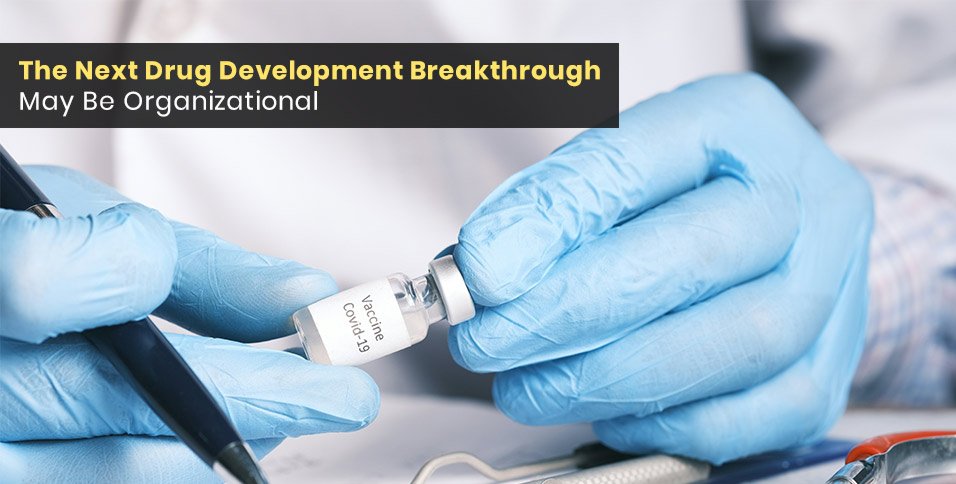
Drug development has never been short of scientific breakthroughs. CRISPR, mRNA vaccines, metabolic medicines, and new biological platforms have expanded what modern medicine can attempt. Yet a persistent challenge remains. Discovering a promising candidate does not guarantee that it will become a safe, scalable, and usable medicine.
That gap is becoming harder to ignore. McKinsey found that pharmaceutical R&D productivity has remained essentially flat at the industry level since 2012. The challenge, therefore, may extend beyond discovering better drugs. Companies also need to consider how efficiently promising ideas move through development, manufacturing, clinical testing, and regulatory processes.
The next major advantage in biotech may come from redesigning that journey itself. In this environment, better integration could matter as much as better discovery.
A Promising Molecule Is Only the Beginning
A promising molecule starts a long chain of decisions, experiments, trials, manufacturing challenges, and regulatory requirements. Every handoff introduces the possibility of delay or lost information.
The economics make those delays increasingly expensive. Boston Consulting Group estimates that bringing an asset to clinical trials now costs between $150 million and $300 million. That is as much as twice the cost a decade ago. Meanwhile, end-to-end drug development success rates remain around 10%.
This creates an uncomfortable reality. A company can have excellent science and still struggle to turn it into a successful medicine.
BCG identifies poor decisions and fragmented effort as two major sources of lost value. In other words, the bottleneck is not always scientific discovery. Sometimes, it is everything surrounding discovery.
Biotech Has Changed Where Innovation Comes From
The industry’s innovation engine is also becoming more distributed. In 2003, 17 of the 20 best-selling drugs originated at large biopharma companies. By 2023, that figure had fallen to seven. Today, biotech companies account for nearly 65% of the industry’s total pipeline, according to BCG.
That shift creates a new organizational challenge. Large companies increasingly need to connect with external science while still possessing the capabilities required to develop promising assets efficiently.
Simply acquiring more external innovation may not solve the problem. BCG notes that greater reliance on external sources has not translated into higher R&D productivity. The emerging advantage could therefore belong to organizations that are better at connecting capabilities rather than simply owning more of them.
Integration Could Become the New Competitive Advantage
McKinsey’s research points toward a different approach. It argues that pharmaceutical companies should reconsider governance, processes, and organizational structures. Companies can build capabilities where they create distinctive value while partnering for others that provide flexibility.
An emerging example is the product development organization (PDO) model. It brings traditionally separate stages of drug development into a more connected structure. This can include research, discovery, preclinical work, clinical development, and supporting capabilities.
As Alloy Therapeutics notes, the idea is gaining attention as drug development becomes more complex. Instead of repeatedly moving programs between disconnected teams, an integrated structure can create clearer accountability across development stages.
The potential benefit is not simply having more expertise in one place. It is reducing friction between teams and limiting unnecessary handoffs. McKinsey similarly points to integrated R&D hubs and dedicated organizations with end-to-end accountability as potential ways to improve development productivity.
AI Can Accelerate Discovery Without Fixing the Whole System
AI is already changing parts of this equation. According to NVIDIA data cited by Forbes, 70% of biotech, pharma, and healthtech organizations were actively using AI in 2026, compared with 63% in 2025. Nearly half of pharmaceutical companies reported using AI agents for drug discovery and biomarker identification.
But discovery is only one part of the journey. Forbes reports that just 38% of organizations planned to adopt workflow orchestration and AI in manufacturing and supply chains over the following one to two years.
That difference matters. Filippos Tourlomousis, CEO of a biotechnology company, argues that advanced therapies may be limited less by their underlying science. The bigger challenge could be producing them reliably and at scale.
For cell and gene therapies, that challenge is particularly visible. Many treatments are still produced for individual patients at specialized facilities and can cost hundreds of thousands of dollars per patient.
AI may find a better candidate faster. But someone still has to figure out how to make it consistently.
The Future May Belong to Better Connections
Global biotech competition offers another lesson. Scientific strength alone does not guarantee that discoveries will translate into better medicines.
China spent nearly 280 billion yuan, or $40.6 billion, on basic research in 2025. This accounted for 7.1% of its total R&D spending. C&EN also reports growing efforts to connect fields such as AI, materials science, and biology.
This interdisciplinary approach reflects a broader shift in drug development. Complex medical problems increasingly require expertise from multiple scientific and technical fields. Connecting these capabilities can help researchers move more effectively from understanding a biological problem to developing, testing, and producing a potential treatment.
The lesson extends beyond China. Drug development depends on connecting disciplines that often operate separately. A breakthrough in biology still needs engineering, clinical insight, manufacturing expertise, and commercial planning to become a viable treatment. Stronger connections between these areas could therefore matter as much as stronger individual capabilities.
FAQs
Why do promising drug candidates often fail after early research?
A promising candidate can encounter unexpected safety, efficacy, manufacturing, or regulatory challenges later. Early laboratory results cannot fully predict how a treatment will behave in humans. Each development stage introduces new evidence that can change whether a candidate remains viable.
How can smaller biotech companies compete with larger pharmaceutical firms?
Smaller biotech companies can focus resources on specialized scientific areas rather than building every capability internally. Strategic partnerships can provide access to expertise, infrastructure, and development resources without requiring major upfront investment. This can help them advance promising programs while maintaining greater organizational flexibility.
Could better organizational design improve drug development outcomes?
Organizational design can influence how quickly teams make decisions, share information, and respond to setbacks. Clear responsibilities can prevent important decisions from becoming trapped between departments. This matters because development programs often depend on several scientific and operational functions moving forward together.
Key Statistics Shaping Biotech Development
| Biotech’s share of the industry pipeline | Nearly 65% |
| End-to-end drug development success rate | Around 10% |
| Cost to bring an asset to clinical trials | 150–300M |
| Organizations using AI in biotech, pharma, and healthtech | 70% |
| China’s basic research spending in 2025 | $40.6B |
The next major biotech advantage may therefore be organizational rather than purely scientific. Companies that can shorten the distance between an idea and a viable medicine could gain an advantage over those that simply generate more ideas. AI will certainly help. So will robotics, better data, and stronger research platforms.
But technology alone cannot eliminate fragmented decision-making or disconnected expertise. The more important shift may be learning to build medicines as an integrated system.
The next breakthrough may not come from discovering something nobody has seen before. It may come from finally building a better path for turning what we discover into something patients can actually receive.