Finance teams have learned to read AI product pages the way they read SaaS order forms. The dangerous line is rarely the monthly price. It is the gap between the model name in the headline and the buttons that actually spend money today. Tools marketed around Seedance 3.0 make that gap easy to see when a studio sells next-version education while the live panel still routes spend through the previous generation.
That gap is now a normal procurement problem in creative ops. Vendors ship education hubs, prompt libraries, and comparison pages for a model family before the same site flips the production switch. Buyers who only skim the hero banner approve budgets for a future lane, then discover the team is iterating on whatever is already unlocked. The cost is not fraud in the cartoon sense. The cost is a mismatched statement of work.
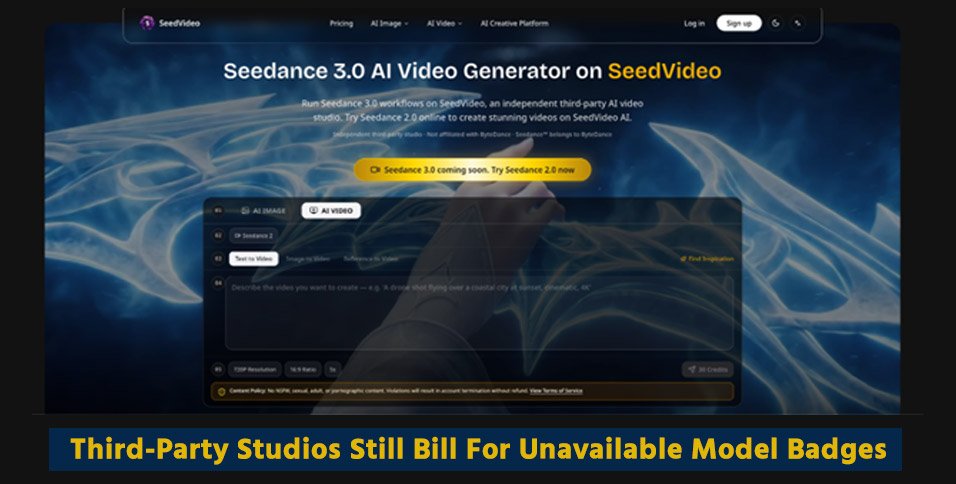
SeedVideo makes the pattern easy to inspect because it labels itself clearly: an independent third-party AI video studio, not affiliated with ByteDance, while Seedance remains ByteDance’s mark. The same surface tells visitors that Seedance 3.0 is coming soon and invites them to try Seedance 2.0 now. For a business magazine reader evaluating vendors, that sentence is the diligence hook, not a footnote.
The Banner Gap Between Marketing And Live Buttons
A practical buyer walkthrough starts on the create surface. The studio exposes AI IMAGE and AI VIDEO, a Seedance 2 lane, and mode choices such as Text to Video, Image to Video, and Reference to Video. Beside a short draft you can see concrete controls—resolution, ratio, duration, and a credit preview—before you commit. That is the live product. The education layer around a Seedance 3.0 AI Video Generator workflow sits next to it as guides for access checks, pricing planners, reference roles, and prompt patterns.
The mismatch appears when a creative brief, agency deck, or internal OKR says “migrate the pipeline to 3.0 this quarter,” while the people clicking Generate are still validating motion on 2.0 settings. Nobody is necessarily lying. The organization simply wrote the roadmap from the loudest label on the page. Procurement should force the opposite order: write the roadmap from the button that deducts credits today, then treat the next model name as a dated upgrade clause.
What Independent Studio Status Changes In Contracts
Independent status is not a smear. It is a contract category. When SeedVideo says it is not an official ByteDance property, several operational facts follow for anyone signing a vendor form:
- Support, refunds, queue behavior, and export rules belong to the studio’s own terms
- Model availability can lag or lead whatever a model owner announces elsewhere
- Brand claims on a third-party site need verification against payment descriptors and account email domains
- Commercial use still sits under both the studio terms and the upstream model providers’ policies
Teams that ignore the distinction often paste “official Seedance access” into a client deck. Then legal asks for the affiliation letter that does not exist. Rewrite the sentence before the invoice: you are buying a workflow studio that hosts Seedance-family generation, not a ByteDance storefront. That rewrite keeps sales language and finance language on the same planet.
Run Seedance 2.0 Checks Before Any Upgrade Story
If the live lane is Seedance 2.0, diligence should stress-test that lane first. The useful checks are boring on purpose:
- Confirm the model name shown at generate time matches the name in the purchase request
- Record resolution, ratio, and duration used for the acceptance sample
- Save the credit preview next to the output file name
- Export once on paid usage and confirm watermark behavior matches the plan copy
Paid plan copy on the same site already publishes credit floors, rollover language for subscriptions, and never-expire language for packs. Those lines belong in the vendor appendix even if marketing is emotionally attached to a future model badge. Do not approve a PO that only cites the badge.
A next-version buying story only becomes honest after those 2.0 checks pass. Otherwise you are funding education pages and hoping the production switch arrives on your calendar, not the vendor’s. The first preview can look fine until finance asks which selector actually deducted credits beside the original purchase request.
Ten Signup Credits Rarely Prove Video Fit
New accounts receive a one-time signup gift currently described as 10 credits. The same terms note that signup credits may expire and that video jobs usually cost more than image jobs, so the gift may not cover a meaningful video trial. That is a gift-shaped smoke test, not a pilot.
A business review should refuse the sentence “we tried it, it works” when the evidence is one under-length render burned on trial balance. Ask for a paid short draft with the same subject, camera, and ratio the campaign will use. Ask whether unused subscription credits actually remained after a quiet week. Ask whether the team needed priority queue during a launch afternoon. Those answers map to real money. A ten-credit click does not.
Image-side tools on the same account, including Nano Banana at a published 2 credits per image floor, can distract the pilot. Stills are cheaper and easier to celebrate in a Slack channel. They do not prove the video lane your budget line named.
Diligence Questions Finance Should Ask Vendors
Borrow the access-checklist spirit from the studio’s own guides, then translate it into finance English:
- Which model deducts credits today? Good answer: a screenshot of the live selector. Red flag: a deck that only shows a future badge.
- Who owns support and refunds? Good answer: studio terms named in the PO. Red flag: “same as the model creator” with no document.
- Do unused credits survive the month? Good answer: rollover or never-expire rules in writing. Red flag: verbal assurance only.
- What kills an account without refund? Good answer: a clear prohibited-use summary. Red flag: the team uploading borderline ads “to see.”
- What does paid export remove? Good answer: watermark-free language tied to paid usage. Red flag: assuming every download is client-ready.
Content policy on the create surface is blunt: no NSFW, sexual, adult, or pornographic content, with termination without refund called out as the enforcement path. That belongs in the same appendix as pricing. A single banned upload can zero a credit balance faster than any inefficient prompt habit. That discard of the account is a hard fail for the quarter’s creative plan—warped brand trust, unreadable reporting, and a wasted afternoon of rework.
Write The SOW Against Today’s Export Rules
If the campaign needs client-ready files next week, the SOW should cite today’s watermark, queue, and model-access rules—not a planned hub page. If the campaign can wait for a model upgrade, write the wait as a dated dependency with a fallback: continue on Seedance 2.0 settings already proven, or pause spend. Ambiguous “we’ll switch when 3.0 lands” language is how leftover budget evaporates on retries nobody can explain.
Separate Education Spend From Production Spend
Prompt libraries and reference-role explainers are valuable. They are still education. Production spend is credits burned on accepted clips. Keep them on different lines if your org argues about AI waste. SeedVideo’s guide structure actually helps here: access, pricing, prompts, examples, and troubleshooting are separate jobs. Mirror that split in the internal budget so nobody confuses reading time with render cost.
Keep The Purchase Tied To Repeatable Draft Packets
Once the vendor passes the banner test, creative ops should demand a repeatable packet: one prompt brief, named reference roles, fixed ratio and duration for the first draft, and a one-variable revision rule. The studio’s own how-to pattern—choose mode, write a short production brief, run a low-cost draft, fix one issue at a time—is enough structure for most SMB teams. The packet is what makes next quarter’s model upgrade measurable. Without it, every new badge resets the organization to vibes.
Reference discipline matters in the contract sense too. If identity, product shape, scene, and style all compete in one upload set, the team will burn credits diagnosing “the model” when the brief was overloaded. Procurement cannot price that chaos, but it can require that accepted pilots include the reference-role note beside the file.
Close The Loop In Writing Not Hype
Approve SeedVideo when the purchase order names the live model lane, the credit clock you are buying, and the export rule you need for client delivery. Delay the badge-driven upgrade story until the create panel and the invoice tell the same story.
Hold the purchase if your team only has a hero screenshot and a hope that a future switch will erase weak briefs. Independent studios can be the right buy. They become the wrong buy when nobody records which button spent the money. Put that sentence in the vendor review, then let the creative team animate.