The roofing trade is having its Wall Street moment, and most of the country’s roofers never asked for it.
Over the past two years, private equity firms have moved into residential and commercial roofing at a pace that has startled even veteran industry advisers. By mid-2025, sponsors were acquiring a U.S. roofing platform roughly every 48 hours, with well over a hundred deals expected across the year – more than double the volume seen in 2021, according to trade publication Roofing Contractor. The logic is straightforward from an investor’s chair: a fragmented, cash-generative industry built on non-discretionary repairs, aging housing stock and an unpredictable but reliable pipeline of storm damage. Analysts covering the sector expect the market, valued at roughly $23 billion in 2024, to nearly double within a decade.
What that means on the ground is a wave of local roofing companies being folded into national “platforms,” their branding replaced, their founders bought out, and their crews absorbed into a bigger machine. It is a familiar American story – the same one that reshaped veterinary clinics, HVAC firms and dental practices before it – and it is now playing out roof by roof across the Midwest and Sun Belt.
Not every operator is selling, though. Some are making the opposite bet: that staying independent, and staying local, is itself a competitive advantage while the rest of the industry consolidates around them.
A Kansas City holdout
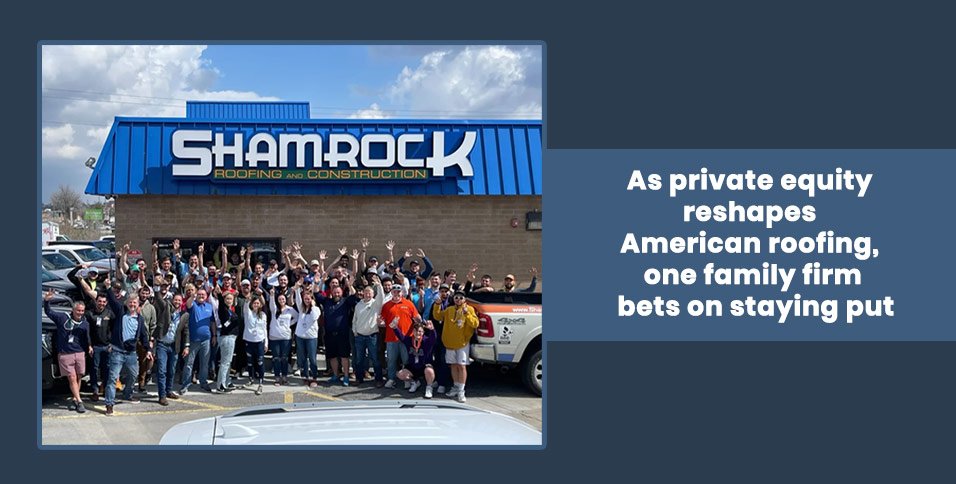
Shamrock Roofing and Construction is one of the companies making that wager. The firm has operated as a Midwest roofing contractor since it was founded in Kansas City in 1977, and it has grown into a multi-state operation without a single acquisition, franchise agreement or outside investor on its cap table – an increasingly unusual position in a trade where roll-ups have become the norm rather than the exception.
The company is still owned by the same family that started it, and it has leaned into that distinction publicly, positioning itself against what it calls “storm chasers” and corporate consolidators. It is also woman-owned in its leadership structure, a detail that put it on the Kansas City Business Journal’s list of women-owned businesses in 2024, and it has picked up a run of regional recognition in the past two years, including a spot on a national ranking of the country’s top 100 roofing contractors in 2025 and a placement on the Kansas City Business Journal’s “Fast 50” list of the region’s fastest-growing companies that same year.
Today the company is licensed across eight states – Missouri, Kansas, Arkansas, Oklahoma, Nebraska, Iowa, Colorado and Texas – operating out of roughly a dozen and a half local offices rather than a single flagship city. That is a meaningfully different growth model than the one favored by sponsor-backed platforms, which typically expand by acquiring existing local firms and consolidating their back offices rather than opening new branches organically.
Why independence is getting harder to find
The broader trend explains why a company built the old-fashioned way is starting to look like the exception worth writing about. Sponsor-backed platforms such as Tecta America, now among the largest private-equity-backed commercial roofing operators in the country, have expanded into markets long dominated by small, regional firms. Software providers serving the trade have themselves drawn nine-figure investments, a sign that institutional capital is betting on the industry’s back office as much as its ladders and shingles.
For homeowners, the shift raises a question that rarely came up a decade ago: who owns the company sending a crew to the roof after a hailstorm? Firms that have grown through acquisition often retain a familiar local name even after ownership changes hands entirely, which can make it difficult for a customer to know whether they are dealing with a founder-run business or a portfolio company several ownership layers removed from the crew on the ladder.
That distinction is central to how Shamrock has chosen to describe itself – a roofing company since 1977 that has expanded market by market rather than through the kind of buyout activity now sweeping the trade. Whether that model holds up as consolidation accelerates through 2026, as most analysts expect it will, is an open question facing every independent contractor in the sector, not just one company in Kansas City.