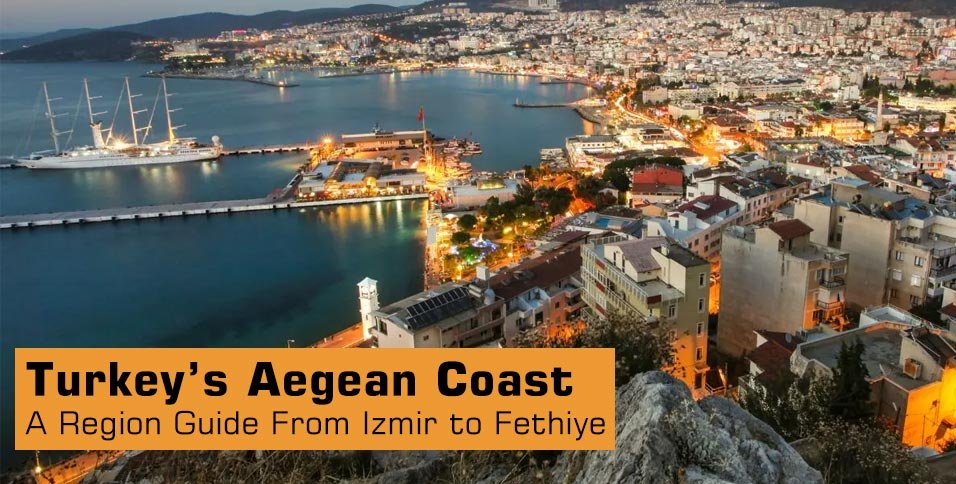
The Turkish Aegean coast runs for roughly 600 kilometres, from the port city of Izmir in the north down to the edge of the Turquoise Coast in the south, and it holds a genuinely wide range of destinations under one loose geographic label. Ancient Greek ruins, laid-back fishing villages, upscale marina towns, and long sand beaches all sit within a few hours’ drive of each other, which makes the Aegean coast turkey label a bit misleading if you’re picturing one uniform strip of resorts. This guide breaks the coast into its main stretches, north to south, to help sort out which parts actually match what you’re after.
Getting Your Bearings
Two airports effectively split this stretch of coast in half. Izmir’s Adnan Menderes Airport serves the northern half, including Ephesus, Kusadasi, and Cesme, while Dalaman, further south, is the main gateway for the southern end, including Marmaris, Fethiye, and the start of the Turquoise Coast proper. Sorting out Dalaman airport transfers in advance is worth doing if your trip is anchored in the south, since taxi availability at the airport thins out considerably late at night and public transport options are limited outside daytime hours.
Renting a car makes sense if your plan covers more than one stretch of this coast, since bus connections between the northern and southern halves generally route through Izmir or inland, adding significant time compared to a direct coastal drive.
Izmir: The Region’s Anchor City
Izmir itself gets treated as a transit hub more often than a destination, which undersells it. Turkey’s third-largest city has a genuinely lively waterfront promenade along the Kordon, a sprawling bazaar that predates most of the country’s tourist infrastructure, and a more relaxed, secular atmosphere than either Istanbul or the more conservative interior. It’s also considerably cheaper than the resort towns further along the coast, making it a reasonable one or two-night base before heading onward.
Ephesus and Kusadasi
Ephesus, just outside the town of Selçuk, is one of the best-preserved ancient cities in the Mediterranean and the single most-visited historical site on this coast. The Library of Celsus and the Great Theatre, which once seated 25,000 people, give a sense of scale that’s hard to get from photos alone. Cruise ship crowds from nearby Kusadasi can make midday visits genuinely crowded, so arriving at opening or in the late afternoon makes a noticeable difference.
Kusadasi itself functions mainly as a resort and cruise port, with a lively but fairly generic beachfront strip. It’s a convenient base for Ephesus and the nearby House of the Virgin Mary, but it’s not really a destination in its own right the way some of the smaller towns further south are.
Cesme and the Alaçatı Peninsula
Cesme, west of Izmir, has developed a reputation as the more upscale, design-conscious end of the Turkish Aegean, driven largely by the nearby village of Alaçatı, a former Greek settlement of restored stone houses that’s become known for windsurfing, boutique hotels, and a food scene that punches well above its size. The peninsula’s beaches, particularly around Ilıca and Çiftlik, are lined with fine sand and shallow water, and the whole area has a noticeably different, more Aegean-island feel than the coast further south.
Bodrum and the Bodrum Peninsula
Bodrum is probably the best-known name on this entire coast internationally, built around a compact old town, a Crusader-era castle housing an underwater archaeology museum, and a marina that draws yachts from across the Mediterranean in summer. The town itself gets loud and crowded in July and August, but the peninsula around it holds quieter alternatives: Gümüşlük, built over the ruins of ancient Myndos, has kept a low-rise fishing village character and a strict no-loud-music policy that’s rare for the area, while Türkbükü and Yalıkavak lean more upscale and marina-focused.
The Datça Peninsula
East of Bodrum, the Datça Peninsula is narrower, quieter, and considerably less developed than its more famous neighbour, despite similar scenery. The drive out to the peninsula’s tip passes the ruins of ancient Knidos, scattered across a headland with views over both the Aegean and Mediterranean at once, a genuinely striking spot that sees a fraction of Ephesus’s visitor numbers.
Marmaris and the Southern Approach
Marmaris marks the transition point where the Aegean coast blends into the Turquoise Coast, and it’s developed accordingly: a large marina, a busy nightlife strip, and a good base for boat trips out to smaller bays along the coastline. It’s less architecturally interesting than Bodrum’s old town but works well as a practical stopover for anyone driving between the Aegean stretch and destinations further south and east toward Fethiye and Dalaman.
Food Along the Coast
Aegean cooking leans heavily on olive oil, wild greens, and whatever the local waters produce that day, a noticeably lighter style than the meat-focused cuisine of central and eastern Turkey. Meze spreads built around dishes like ezme, a spicy tomato and pepper relish, and a wide range of cold vegetable preparations dressed in olive oil are standard at any proper seafood restaurant along this coast, usually followed by grilled fish sold by weight. Cesme and Alaçatı in particular have built a reputation for a more refined, farm-to-table approach to this same base of ingredients, with several restaurants sourcing directly from the peninsula’s own vineyards and farms.
When to Visit
May, June, and September offer the most comfortable combination of warm weather and manageable crowds across the whole coast. July and August bring reliably hot, dry conditions and the heaviest crowds, particularly in Bodrum and Cesme, along with the highest accommodation prices of the year. Spring and early autumn also suit Ephesus and the other archaeological sites better than midsummer, when walking around exposed ruins in the middle of the day becomes genuinely uncomfortable.
The Turkish Aegean coast rewards picking a stretch rather than attempting the whole 600 kilometres in one trip. Pairing Izmir with Ephesus and Cesme in the north, or Bodrum with the Datça Peninsula and a run down toward Marmaris in the south, both make for a coherent week to ten days without excessive driving eating into time actually spent at any one place.