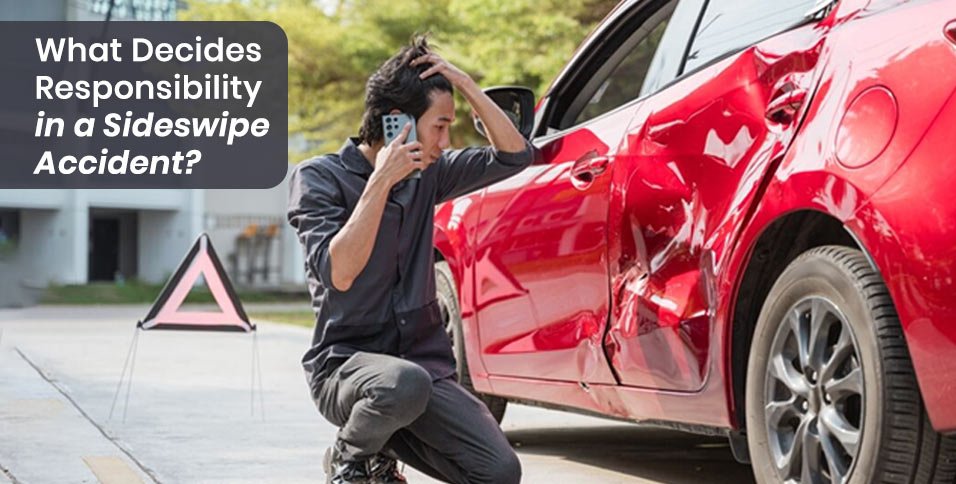
Responsibility in a sideswipe accident is usually determined by identifying which driver failed to maintain their lane, made an unsafe lane change, or otherwise acted negligently. Insurance companies, law enforcement officers, and courts look at the evidence to determine who caused the collision.
While some cases are straightforward, others can be more complicated when both drivers provide different versions of what happened. Understanding the factors used to assign fault can help drivers better protect their rights after an accident. Many people also wonder how to tell who sideswiped whom by damage, since vehicle damage patterns often play an important role in determining responsibility.
What Is a Sideswipe Accident?
A sideswipe accident occurs when the sides of two vehicles make contact while traveling in the same or opposite directions. These crashes commonly happen on highways, multi-lane roads, and busy intersections where drivers are changing lanes or merging into traffic.
Although sideswipe accidents may seem minor compared to head-on or rear-end collisions, they can still cause significant vehicle damage, injuries, and even secondary accidents. In some cases, a sideswipe can force a vehicle off the road or into another lane, creating a dangerous chain reaction.
The Most Common Cause: Unsafe Lane Changes
One of the leading causes of sideswipe accidents is an unsafe lane change. Drivers are responsible for ensuring that a lane is clear before moving into it. This includes checking mirrors, looking over their shoulder for blind spots, and using turn signals appropriately.
If a driver moves into another lane without confirming it is safe and strikes another vehicle, they are often considered at fault. The law generally requires drivers to stay within their designated lane unless it is safe to change lanes.
For example, if Driver A drifts into Driver B’s lane and the vehicles make contact, Driver A will likely bear responsibility for the accident.
How Evidence Helps Determine Fault
Determining fault in a sideswipe accident often depends on the available evidence. Insurance adjusters and investigators review several sources to understand what happened.
Common types of evidence include:
- Photographs of vehicle damage
- Dashcam footage
- Traffic camera recordings
- Witness statements
- Police reports
- Accident scene photographs
- Physical evidence such as skid marks or debris
Vehicle damage can be particularly useful. The location, direction, and severity of the damage may reveal which vehicle moved into the other’s path. Investigators often analyze paint transfers, scrape marks, and impact angles to reconstruct the accident.
The more evidence available, the easier it becomes to determine responsibility.
When Both Drivers May Share Responsibility
Not every sideswipe accident involves a single at-fault driver. In some situations, both drivers may contribute to the crash.
For example, imagine two drivers attempting to merge into the same lane at the same time. If neither driver checks their surroundings carefully, both may share some responsibility for the collision.
Many states use comparative negligence rules, which allow fault to be divided among multiple parties. Under these systems, each driver’s actions are examined, and a percentage of responsibility may be assigned to each person involved.
This shared-fault approach can affect how much compensation an injured party ultimately receives.
Common Factors Investigators Consider
Several factors are often reviewed when determining who is responsible for a sideswipe accident:
Lane Position
Investigators look at which vehicle was properly established in a lane and which vehicle entered that lane.
Use of Turn Signals
Failure to signal before changing lanes may indicate negligence.
Speed
Excessive speed can reduce a driver’s ability to react safely and may contribute to fault.
Distracted Driving
Activities such as texting, adjusting a GPS, or eating while driving can play a role in sideswipe collisions.
Road Conditions
Weather, construction zones, and lane closures may also be considered when evaluating responsibility.
Why Police Reports Matter
A police report can be an important piece of evidence after a sideswipe accident. Officers typically document the accident scene, collect driver statements, note visible damage, and identify potential traffic violations.
While a police report does not always determine fault by itself, insurance companies often use it as part of their investigation. The report can provide valuable details that help clarify how the accident occurred.
Protecting Yourself After a Sideswipe Accident
If you are involved in a sideswipe accident, gathering evidence as soon as possible can make a significant difference. Taking photographs, obtaining witness contact information, and seeking medical attention when necessary can help support your case.
Reporting the accident promptly and cooperating with the investigation may also improve your ability to establish what happened and protect your interests during the claims process.
Key Takeaways
- Responsibility in a sideswipe accident is typically based on which driver acted negligently.
- Unsafe lane changes are one of the most common causes of sideswipe collisions.
- Evidence such as vehicle damage, witness statements, photos, and video footage helps determine fault.
- Vehicle damage patterns can often reveal which driver moved into another vehicle’s lane.
- In some cases, both drivers may share responsibility for the accident.
- Police reports can provide valuable information during insurance investigations.
- Gathering evidence immediately after an accident can help support a claim and clarify liability.