
There is a small glass canister fitted into the dashboard of the original Volkswagen New Beetle. Most people assume it was designed to hold a tiny flower, a cheerful decorative touch for an already cheerful car. But the workers on the assembly line at Volkswagen de Mexico’s plant in Puebla will tell you something different. According to them, it holds the tequila shot you need to survive the drive along the autopista on the Mexican altiplano.
Bill Newman knows this story because he was there. Standing on that factory floor in Puebla, watching the very last of the new Beetles roll off the assembly line with his own eyes.
He laughs when he tells it. And in that laugh, you begin to understand something essential about the man: he has been in enough rooms, on enough factory floors, and in enough boardrooms across four continents to know exactly where the tequila goes, and more importantly, why it is needed.
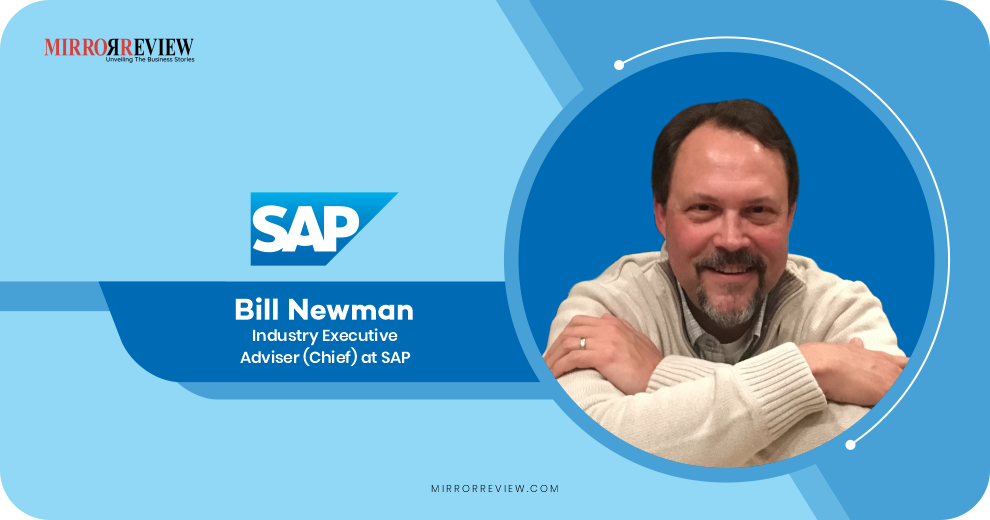
Bill is currently SAP’s Industry Executive Advisor for the Automotive Segment, a role that is as much about human understanding as it is about enterprise software. A man who began his career building aircraft he could not speak about, and who has spent more than three decades since earning his place in the automotive world, one deliberate pivot at a time.
The Airplane Guy
Bill graduated from UCLA with a degree in Aerospace Engineering and a minor in Economics. He was, plainly, an airplane guy. His first full-time position after university was with Northrop Corporation, now known as Northrop Grumman, where he was assigned to a project so classified that when anyone asked what he worked on, he and his young colleagues were advised to say, “If anyone asks you what you make, tell them you make a paycheck every week” and then change the conversation. He could not tell his family. He worked for five years inside a windowless, top-secret environment on what the world now knows as the B-2 Spirit Stealth Bomber.
What is perhaps more quietly significant, however, is what was happening at the edges of that experience. During his time at Northrop, a technological shift was underway: the migration from mainframe computing to what we now call client-server computing, the moment when information moved from a locked room to a desktop. Bill found himself drawn to it. He became the Apple resource coordinator for a department of roughly 100 engineers, moving steadily away from design engineering and toward network and data services.
It was the first of several such pivots in his career. Each one deliberate. Each one building quietly on the last.
The Long Road to Detroit
After Northrop, Bill transitioned into consulting. First, through training work at a small firm, then through DMR Consulting Group, now a part of Fujitsu Consulting, where he spent close to five years working in California and Oregon operations as a senior consultant and in business development.
During this stretch, he earned his Certified Management Consultant (CMC) designation and became active in the Institute of Management Consultants. He also completed his MBA at Loyola Marymount University in Los Angeles, which required him to pick an industry for his thesis. As an aerospace man, he had no particular attachment to automobiles. But the automotive industry happened to be available, and so he studied how vehicles were produced across the United States and Western Europe, touring facilities at Volvo, GM, Vauxhall, and Porsche.
He figured he would never need any of it. Then he married a Michigan girl, and everything shifted again.
Moving to the Detroit area, Bill found he at least had some context for the industry that surrounded him. He returned to DMR Consulting in the Midwest, worked through a few other consulting firms, and eventually landed at Volkswagen, where he helped launch their technology division, Gedas. He worked directly for the division’s president and CEO, and it was there that the automotive world began to feel less like an accident and more like a calling.
One Thousand Consultants and a Y2K Clock
In 1998 and 1999, as industries worldwide braced for a potential technological collapse at the turn of the millennium, Bill was doing something quite extraordinary. He had become a global trainer for the Automotive Industry Action Group’s Year 2000 remediation program, leading a team of consultants and facilitating training and risk mitigation services across the sector.
He personally instructed more than 1,000 consultants across four continents, preparing the trainers who would go on to lead Y2K readiness efforts within their own organizations.
That work built relationships. Those relationships, in turn, opened a door that led him back, years later, to something he is still proud of: the creation of the first industry-based cloud platform for managing and reporting conflict minerals under the Dodd-Frank Act. He believes that the platform remains operational in some form to this day.
Twelve Years at SAP: Three Roles and One Clear Purpose
Bill joined SAP as a Principal Management Consultant with the company’s services division. He is now celebrating his twelfth year with SAP, having moved through Value Advisory before arriving at his current position as Industry Executive Advisor for the Automotive Segment.
He describes his function within SAP’s industry advisory practice with the ease of someone who has earned the right to the title: the “senior senator” for automotive. It is a role built on relationships, context, and the particular authority that only comes from having lived through the experiences you are now advising others to navigate.
Bill works with business executives at SAP’s automotive customers to translate operational needs into technology strategy and, increasingly, into the language of artificial intelligence. His client scope is intentionally broad: anything that does not fly or sail commercially. Motorcycles, passenger vehicles, commercial trucks, golf carts, recreational vehicles, electric bikes, and even aerial taxis fall within his domain.
What gives Bill his edge in those executive conversations is not the software. It is the biography. He has been an SAP customer. He has been a system integrator. He has sat in the very chair occupied by the people he now advises. “I’ve been in their shoes,” he says. When a CIO recently told him, “I need you to tell me what I need to do so that I don’t get fired and I keep my job,” he understood precisely what was being asked. Not a product demonstration. Not a roadmap presentation. A clear, experience-backed, plain-English read on reality.
“I’m going to speak truth to data,” is how he frames his own approach. And in a world that sometimes prefers comfortable narratives to honest ones, that is no small thing.
Business AI, Intelligent Operations, and the Human in the Loop
The word “AI” is everywhere right now, which means it has also become somewhat difficult to say anything specific about it. Bill is precise.
His focus at SAP is Business AI: not general-purpose large language models deployed without structure, but artificial intelligence that operates within a secured corporate environment, drawing on a company’s own data, supplemented by public domain information and external sources as needed, to accelerate decision-making and eliminate repetitive work. Tasks that once consumed hours can now be completed in seconds. Work that requires the attention of skilled professionals can be handled autonomously, freeing those professionals for higher-order strategic thinking.
SAP is increasingly exploring frameworks in which AI assistants and intelligent agents can execute business processes with varying levels of human oversight, helping organizations operate more efficiently while still keeping people involved in critical decision-making. “Keeping humans in the loop” is a phrase Bill returns to with deliberate emphasis. The automation is real and growing, but so is the governance around it.
There is also early-stage work underway in what SAP calls Physical AI, exploring how automation might address shortages in manual labor markets. Bill addresses this territory with care, fully aware of its sensitivity in the context of labor organizations and industrial workforces. It is a frontier, not yet a defined destination, but one that he expects will become more significant with time.
The biggest challenge, he observes, is not technological. It is organizational. Companies are so consumed by daily operational firefighting, geopolitical risk, financial pressure, and rapid policy changes, particularly in the electric vehicle space, that they struggle to find the time to modernize the very systems that would help them fight those fires more effectively. Here, he reaches for a phrase from his longtime personal touchstone, UCLA coaching legend John Wooden: “Be quick, but don’t hurry. Because if you hurry, you make mistakes.”
The tension between urgency and care is, in many ways, the defining challenge of the automotive industry in 2026.
Two Books, a Historical Novel, and a Man Who Has Always Written
Away from boardrooms, Bill writes. He is the author of two books, each the sequel of the other, built around Financial Performance and Analysis (FP&A) and enterprise performance management. Developed in connection with early work in the enterprise performance management space, the books address the practical mechanics of running a high-functioning financial organization: rapid financial closures, analytical rigor, and sustainability reporting.
The deeper question the books ask is not simply how to execute what is required, but how to use financial data to understand where a company stands and where it is genuinely headed.
He is also a working freelance writer, with years of published commentary and professional writing behind him. And he is currently developing a historical fiction project, the details of which he holds close, but which he mentions with the affection of someone for whom writing has always been less a career choice and more a fundamental orientation toward the world.
Sustainability: Across the Full Value Chain
In automotive, sustainability is not a single conversation. It is several, layered, and interconnected: ESG governance, carbon footprint, supplier accountability, investor commitments, and regulatory compliance, all running simultaneously.
SAP is among the major enterprise platforms capable of delivering accurate, comprehensive Scope 1, 2, and Scope 3 carbon reporting across an organization’s complete value chain. Scope 3, which captures emissions that extend across the entire supplier and partner network, is notoriously difficult. Most organizations simply do not have visibility into that data. SAP’s position across the operational, planning, and reporting layers of its customers’ businesses gives it a perspective that few platforms can replicate.
For OEMs and their suppliers, this capability is becoming consequential in a very direct way. As OEMs make public sustainability commitments through their investor relations work, the suppliers who serve them must be able to report accurately on those commitments. It is no longer just a matter of compliance. It is a matter of being viewed as a credible, sustainable partner.
Bill speaks about the triple bottom line of sustainability, people, economics, and environment, not as a framework to be cited but as a lens through which real business decisions are made. The distinction, in his telling, is the difference between sustainability as a checkbox and sustainability as a strategy.
The Road Ahead: Five Years, Shifting Ground
Ask Bill where the automotive industry is heading over the next five years, and the answer is clear-eyed and honest.
He sees Greater China accelerating capacity at a pace that will define a new competitive benchmark, by making transportation more affordable and reshaping what vehicle access looks like across global markets. The transition away from fossil fuels will continue, but likely more gradually than some projections suggest. Hybrid technology is gaining meaningful momentum in passenger and personal-use vehicles, with particular force in markets governed by the California Air Resources Board, whose standards currently influence 16 additional states beyond California. European Union emissions standards, he notes, apply broadly to automotive manufacturers operating in the U.S. market as well.
Hydrogen-based vehicles remain part of the longer horizon. Autonomy, however, is already underway. In Europe, autonomous commercial vehicles have been platooning on highways for over a decade, with companies like Volvo in Sweden leading that work. In consumer transportation, Waymo and Zoox are making the robo-taxi model an increasingly ordinary reality.
What shifts most fundamentally, in Bill’s view, is the concept of vehicle ownership. As mobility-as-a-service becomes more accessible, the industry’s most important metric will no longer simply be units sold per year. It will be vehicle miles traveled, a KPI that reframes the entire business model. What the industry calls non-vehicle sales revenue, the services, subscriptions, and experiences that extend beyond the vehicle itself, will become a central pillar of how automotive companies sustain themselves in the years ahead.
“It’s an exciting, challenging, but very real time,” he says. “People have their efforts on the line.”
Stonewood Farms, Temecula, and the Organic Orange
If Bill, the industry advisor, is precise and measured, then Bill the accidental farmer and beverage creator is something altogether warmer: unguardedly, specifically delighted.
Stonewood Wine began in Michigan out of practical necessity. Shipping wine to Michigan from California, Oregon, Washington State, or Europe is expensive, and purchasing in higher volume simply made economic sense. Over time, it grew into something richer: a hospitality endeavor now serving an ad hoc concierge of over 100 households. His wife, Teresa, who served as a wine ambassador for two different brand organizations over the years, is deeply part of that story. During the pandemic, Bill deepened his wine education formally, completing his WSET Level 3 Sommelier certification, and is now considering a post-retirement path as a wine educator and hospitality owner.
The couple has made their home in Temecula wine country in Southern California, on a small plot of land that came with organic Valencia orange trees and vineyards. From those trees, they are producing organic orangecello, alongside a vermouth and a Cointreau project. They are currently awaiting approval from the California Alcohol and Beverage Control to begin shipping their products.
He also holds active affiliate memberships with the Center for Automotive Research and the Motor Equipment Manufacturers Association (MEMA). He has served as an adjunct professor at both the University of Michigan-Dearborn and Northwood University, and is in the process of completing his Automotive Aftermarket Professional designation, a joint program between Northwood University and MEMA’s aftermarket suppliers group.
A Grandfather Who Lived to 103
Bill comes from a family with, as he puts it, “some pretty unusual actuary tables.” His grandfather lived to 103. Most of his family members have lived well into their 80s and 90s. That kind of longevity, he reflects, gives a person a different relationship with time, and a different sense of what deserves attention within it.
He once asked his grandfather how he stayed so sharp for so long. The answer was uncomplicated: always be learning. Bill has carried that forward not as a professional maxim but as a way of moving through the world. He speaks about perpetual curiosity with the easy conviction of someone who genuinely practices it, citing the spirit of Ted Lasso’s signature counsel: always be naturally curious. He means it without irony.
He also speaks, with particular warmth, about the value of kindness. The pandemic, he reflects, sharpened his awareness of how little we tend to know about what other people are carrying. Every person has a story you may not know. Being open to that story, being willing to slow down and receive it, is something he considers as important as any professional credential.
It is a philosophy that sounds simple. But in a man who has spent over three decades navigating aerospace classified programs, global Y2K remediation efforts, Volkswagen assembly lines in Mexico, SAP executive briefings, and the orange groves and vineyards of Temecula, it reads as something genuinely hard-earned and sincerely meant.
For anyone looking for a leader to watch in 2026, Bill Newman makes a compelling case not through noise or pronouncements, but through decades of accumulated credibility, cross-industry curiosity, and a genuine interest in the people and problems in front of him.
Quotes
Read more : Automotive Innovation, AI Transformation & Industry Leadership Leaders to Watch in 2026


