
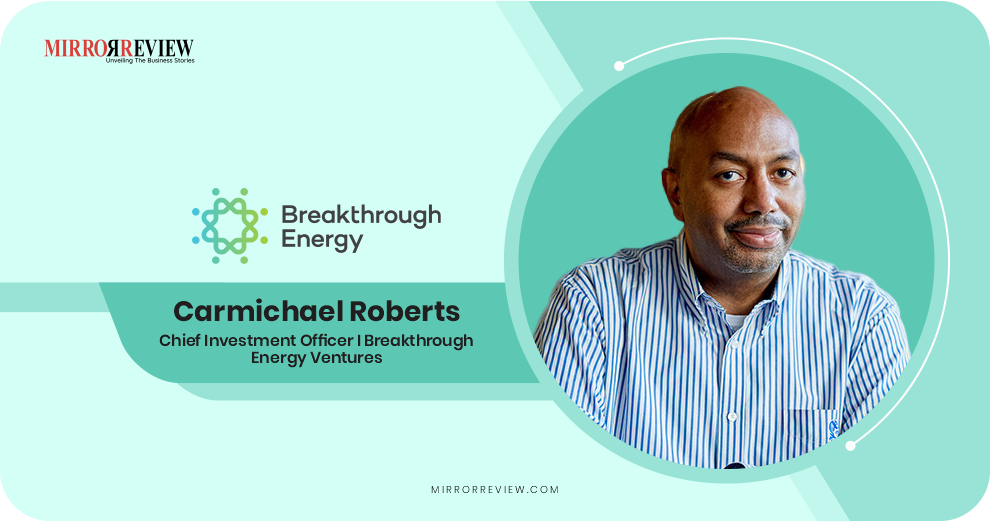
Not everyone who studies the molecular structure of organic compounds ends up managing one of the most consequential climate investment platforms in the world. But then, not everyone is Carmichael Roberts.
Carmichael earned his Bachelor of Science and PhD in organic chemistry from Duke University, then completed a postdoctoral National Science Foundation fellowship at Harvard University. If that were the whole of his academic preparation, it would already be formidable. But he also holds an MBA from MIT Sloan School of Management.
That is a combination of credentials that rarely appears in the same person. A research chemist with a business school education, a scientist who learned to speak fluently in the language of capital and strategy. The result is someone who moves between the laboratory and the boardroom without losing anything in translation.
The Material Impact Foundation
Before Breakthrough Energy, there was Material Impact. Carmichael is the Founder and Managing Partner of Material Impact, a fund built around a strategy that is, in many ways, a direct expression of how he thinks about building companies from science.
Material Impact seeks out transformative technologies and builds them into enduring companies that solve real-world problems. The fund’s approach is rooted in Carmichael’s career as an entrepreneur-investor in advanced materials and operates through a model that distinguishes it from conventional venture: licensing university technology and commercializing it through targeted partnerships with large enterprises.
This is not the standard path from idea to market. It is a more deliberate architecture, one that connects the research institution, where the fundamental science is developed, to the commercial ecosystem, where the resources exist to bring that science to scale. Carmichael sits at the center of that connection, translating discovery into deployment.
The Breakthrough Energy Platform
His role at Breakthrough Energy Ventures extends that same philosophy to a global scale. As Chief Investment Officer of Breakthrough Energy and Managing Partner of Breakthrough Energy Ventures, Carmichael leads investment and company-building efforts focused on technologies capable of materially reducing greenhouse gas emissions.
The mandate he operates under is not incremental. The objective is to accelerate the development and deployment of solutions across energy, industry, agriculture, and materials sectors that collectively define the trajectory of the global climate transition.
He partners closely with entrepreneurs to scale technologies that cut carbon and reshape industrial systems. He is not merely allocating capital; he is helping build companies. That distinction matters in deep-tech climate ventures, where the path from laboratory validation to commercial scale is long, capital-intensive, and operationally complex.
The Unique Leverage of Scientific Fluency
There is a particular advantage that Carmichael brings to climate investing that cannot be replicated by financial training alone. He understands the science. Not in the way that a generalist investor understands it, but at a level that allows him to evaluate whether a technology is fundamentally viable.
That fluency matters when assessing whether a breakthrough is real or incremental. It matters when a founder is navigating unsolved materials challenges. It matters when the question is not just “is this a large market?” but “is this scientifically possible at scale?”
In deep-tech climate investing, that second question often determines everything. Carmichael has built his career around answering it with rigor.
Between the Lab and the Market
What Carmichael Roberts has built is, in essence, a bridge between scientific discovery and commercial execution.
That bridge runs through Material Impact’s company-building model. It runs through the global investment platform of Breakthrough Energy Ventures. And it extends into partnerships with large industrial and corporate players capable of scaling transformative technologies.
In 2026, as climate-tech investment shifts toward harder, more complex sectors, from industrial decarbonization to advanced materials, Carmichael represents a model of capital that is both technically informed and operationally engaged.
That combination of deep science, patient capital, and disciplined company-building is rare. But it is increasingly essential to deliver the kind of climate solutions the global economy now demands.
Read More: Sustainable Investment & Climate Tech: The Top Visionary Leaders to Watch in 2026


