
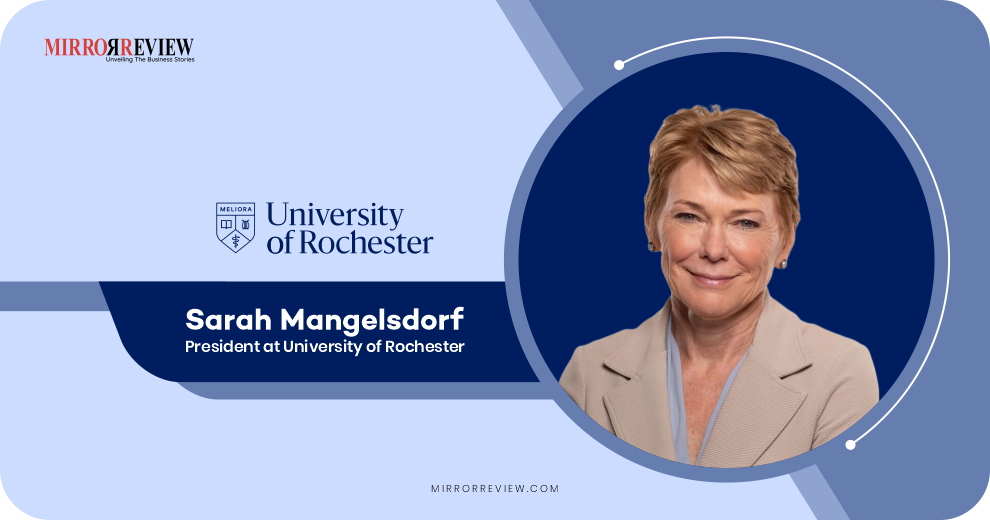
There is a particular quality that separates leaders who merely manage institutions from those who genuinely transform them. It is something harder to name than ambition and more durable than enthusiasm. It is the willingness to look at something already good and ask, with complete sincerity, how it could become great.
Sarah Mangelsdorf brought that quality to the University of Rochester when she assumed the presidency in 2019. She arrived as a respected academic executive with a clear record behind her, someone recognized in higher education circles for her ability to improve academic quality, advance research, and expand educational access. These were not abstract commitments. They were the threads she would weave, one deliberate decision at a time, into something far larger than any single initiative.
Rochester is a city with a complicated and compelling story of its own. The University that carries its name has long been one of the region’s defining institutions. In 2019, it gained a president who understood both the weight of that legacy and the urgency of its future.
Investing Where It Matters Most
One of the earliest and most consequential priorities of Sarah’s presidency was her commitment to strengthening the University’s investment in its research and clinical enterprises. This was not a modest adjustment or a symbolic gesture. It was a deliberate, sustained effort to deepen the institution’s identity as a place where discovery is not incidental but absolutely central.
Research and clinical growth became the organizing principle of much of what followed under her leadership. The resources, attention, and institutional will directed toward these areas reflected a clear-eyed understanding that the future of higher education belongs to universities that take their research mission seriously and act accordingly.
At the same time, Sarah oversaw record annual fundraising for the University. That kind of financial momentum does not happen by accident. It reflects the confidence of donors in a direction, a strategy, and a leader who has made the institution’s ambitions feel credible and worth investing in.
The Work Beneath the Surface
Not all consequential leadership is visible from the outside. Some of the most important work a president can do is structural, the kind of institutional work that rarely generates headlines but quietly determines whether a place functions well or merely functions at all.
Sarah led a comprehensive overhaul of the University’s human resources infrastructure and compensation programs. This is the kind of reform that demands patience, negotiation, and a genuine belief that the people who make an institution run deserve systems that are fair, transparent, and built for the present rather than the past.
It is unglamorous work. It is also indispensable work.
She also created new leadership positions specifically designed to strengthen the University’s engagement with the Greater Rochester community. This was a meaningful signal, an acknowledgment that a university does not exist in isolation from the city around it, but as a participant in its life, its challenges, and its possibilities. For an institution of Rochester’s stature, that kind of intentional outreach is not just good practice. It is the right thing to do.
Boundless Possibility: A Vision for 2030
In the vocabulary of higher education, the phrase ‘strategic plan’ can sometimes carry the faint suggestion of bureaucratic obligation, a document produced, approved, and quietly shelved. The University of Rochester’s 2030 Strategic Plan, titled Boundless Possibility, is not that kind of document.
Developed under Sarah’s direct leadership, Boundless Possibility is a serious, forward-looking effort to define what the University of Rochester should look like, stand for, and achieve as a global research university of the future. It asks genuinely hard questions about identity, purpose, and aspiration, and then provides answers that are both specific and ambitious.
The plan communicates a set of values: that knowledge matters, that research serves the world, and that a great university should never stop reaching.
Honored Among the Best
The academic world has its own ways of marking distinction, and in 2020, it marked Sarah’s in two significant ways.
She was selected as a Fellow of the American Academy of Arts and Sciences, one of the oldest and most distinguished honorary societies in the United States. Fellowship in the Academy is not extended casually. It recognizes individuals whose contributions have made a demonstrable difference, not only in their fields but in the broader landscape of human knowledge.
That same year, she received the Distinguished Alumni Achievement Award from the University of Minnesota, an honor that acknowledged both the journey she had made and the impact she had already built along the way.
Two honors. Two institutions. One year. Each arrives at the same conclusion through a different door.
What Steady Leadership Looks Like
The best university presidents understand something that is easy to overlook from the outside. A university is not a hierarchy, not a corporation, not a government office. It is something more complicated and more human than any of those things, a place where research and teaching and community and ambition all converge, and where the job of the leader is to hold those things together while pushing them forward simultaneously.
Sarah Mangelsdorf has demonstrated, through her years at the helm of the University of Rochester, that she understands this completely. She has invested in research. She has reformed internal systems. She has extended the institution’s reach into its surrounding community. She has crafted a long-range vision that gives the University a direction worth believing in.
The University of Rochester is becoming something new. And the woman shaping that transformation arrived in 2019 not with fanfare, but with a plan.
Read More: Visionary Women in Higher Education: Driving Transformational Impact in 2026


