
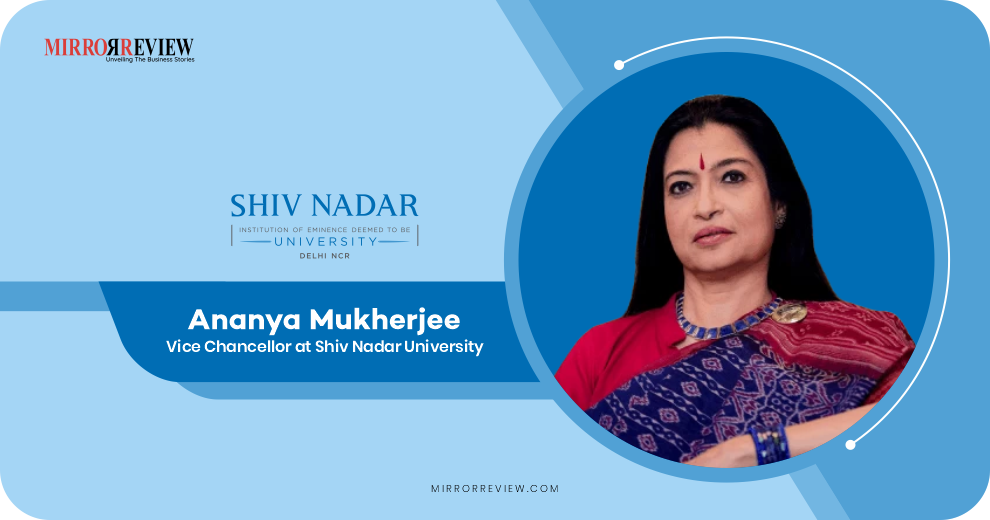
There is a particular kind of courage involved in leaving behind what is already excellent in pursuit of something that could become extraordinary. Professor Ananya Mukherjee made that kind of decision when she left Canada for India, trading the security of an established position at one of the world’s top-ranked universities for the challenge of building something newer, younger, and enormously promising.
She did not make this move reluctantly. She made it with intention.
The institution that drew her back was Shiv Nadar University, located in the immediate vicinity of New Delhi, in India’s Delhi-NCR region. Recognized as an Institution of Eminence by the Government of India, Shiv Nadar University holds the distinction of being the youngest institution to have received this recognition, a fact that speaks to both the University’s ambition and the confidence the government has placed in it.
For Professor Mukherjee, that combination of youth, promise, and formal recognition was precisely the kind of opportunity that justified crossing an ocean.
A Foundation Built Across Two Hemispheres
Before she arrived at Shiv Nadar University, Ananya had spent more than two decades at two of the largest universities in Canada: the University of British Columbia and York University. Her academic formation, however, began far from Canada.
She earned her BA and MA degrees in Economics from Jadavpur University in India before pursuing her PhD from the University of Southern California in the United States. Her scholarship has focused throughout her career on international development and sustainable development goals, with particular attention to India and South Asia, a focus that gives her work both a global frame and a deeply rooted regional purpose.
Her academic journey moved across three countries and across decades of sustained intellectual work before arriving at its current chapter. That breadth of experience is not incidental to her leadership. It is foundational to it.
Twenty-Three Thousand Students and a Global Secretariat
Between 2015 and 2018, Professor Mukherjee served as Dean of the Faculty of Liberal Arts and Professional Studies at York University in Toronto. The scale of that responsibility was striking. She led the largest liberal arts faculty in Canada, a community of 23,000 students drawn from 123 countries.
Leading a faculty of that size and that diversity demands more than administrative competence. It demands the ability to hold many different kinds of people and purposes together under a single, coherent vision.
During this period, she also established the International Secretariat for Human Development (ISHD), serving as its Founding Director. Under her leadership, the ISHD built collaborations with institutions of global significance, including the International Labor Organization, the UN Office for Project Services in Rome, the UN Development Program, the UN Research Institute for Social Development (UNRISD), and others.
“This was not simply an administrative achievement. It was the deliberate construction of a network dedicated to research for social change.”
Leading a Campus of a World-Ranked University
Following her time at York, Professor Mukherjee took on one of the most prominent academic leadership roles in Canadian higher education. She became Provost and Vice-President Academic at the University of British Columbia’s Okanagan campus, a fast-growing campus of a university that ranks among the top 40 in the world.
The Provost’s role is, in many ways, the most complex in university administration. It sits at the intersection of academic vision and institutional operations, and it requires a leader who can think strategically without losing sight of the individual faculty member, student, and program that make a university real.
Her tenure at UBC Okanagan confirmed what York had already suggested: Professor Mukherjee was not merely an accomplished scholar. She was an institution-builder.
Recognition That Spans Three Countries
The honors Professor Mukherjee has received trace a geography of their own, a map of the different worlds in which her work has made a mark.
In 2021, she was named one of Canada’s 100 Most Powerful Women, an acknowledgment of the impact she had made during her years in Canadian higher education. In 2022 and 2024, she was recognized as one of the 15 most influential women in Education by Business World in India, a recognition that arrived both before and after her return to the subcontinent.
In 2024, the Cambridge Research, Education and Training Enterprise (CREATE) Global Leadership Academy recognized her for what it described as her “transformative contributions to higher education leadership.” In 2025, she received the Economic Times Education Excellence Award for visionary leadership, one of the more significant honors in Indian higher education and business circles.
She has also been named among the 2026 Top 50 global voices in education and recognized as one of the Outlook 2026 Women Torchbearers of Viksit Bharat, a designation that reflects her growing national profile in India’s educational landscape. Her reach, measured by the 85,000-plus followers who engage with her voice and ideas, suggests that her influence extends well beyond any single institution or geography.
The Youngest Institution, in the Best of Hands
Shiv Nadar University’s recognition as an Institution of Eminence carries weight. It places the University in distinguished company, and it signals a set of expectations that its leadership must meet with consistency and seriousness. Professor Mukherjee accepted those expectations when she took on the role of Vice-Chancellor, and everything in her career suggests she understood precisely what she was signing up for.
She brought with her a scholar’s discipline, an administrator’s pragmatism, a development economist’s understanding of why education matters beyond the campus, and a leader’s ability to build things that outlast any single tenure.
Ananya Mukherjee returned to India not to coast on an extraordinary international career, but to build something worthy of it. At Shiv Nadar University, that work is well underway.
Read More: Visionary Women in Higher Education: Driving Transformational Impact in 2026


