
There are leaders who arrive at an institution carrying a single defining idea, a flagship program, a headline initiative, a number they want to hit. And then there are leaders who arrive carrying something more fundamental: a method. A way of approaching problems that is durable enough to apply across every challenge an institution might face, regardless of shape or size.
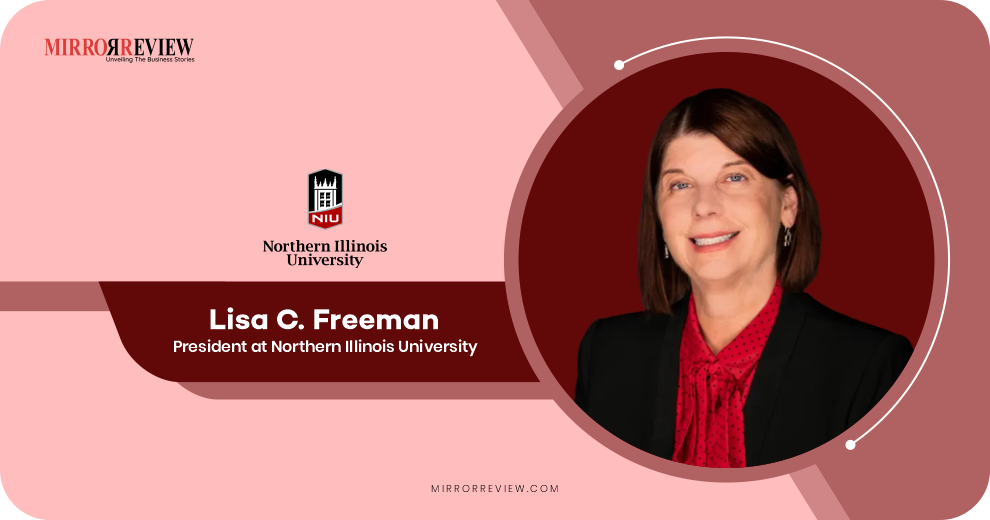
Lisa C. Freeman is the second kind of leader.
As President of Northern Illinois University, Freeman has built her entire academic career around a deceptively simple premise: that complex problems are best solved by bringing the right people and the right resources together, and then letting evidence guide what happens next. It sounds straightforward. In practice, it is one of the hardest things a university president can actually do.
Complexity as a Calling
Most institutions, if they are honest with themselves, are not short on problems. They are short on leaders who know how to hold complexity without flinching, who can look at a challenge that touches finance, faculty, students, community, and governance all at once, and respond not with a retreat into familiar solutions but with genuine intellectual engagement.
Freeman has made complexity her calling.
Her focus on bringing people and resources together is not simply a management philosophy. It is a recognition that the hardest problems facing higher education today do not yield to solitary thinking or top-down directives. They yield to collaboration, to the careful construction of shared purpose among people who might otherwise be working in separate directions.
At Northern Illinois University, that orientation toward collaboration is not a background value. It is the active, organizing principle of her presidency.
The Case for Transparency
In higher education, data is everywhere. Enrollment figures, retention rates, graduation outcomes, budget allocations, research productivity, the numbers accumulate in spreadsheets and annual reports and accreditation documents, and they are frequently used to tell the story that an institution most wants told.
Freeman has taken a different position on what data is actually for.
She is committed to data transparency and integrity, a commitment that carries more weight than it might first appear. Transparency means making data visible not only when it is flattering but also when it is uncomfortable. Integrity means ensuring that the numbers being used to make decisions are the right numbers, collected honestly and interpreted carefully.
Her belief that data should be used to promote participation and accountability in decision-making reflects a specific vision of how a university should govern itself. It is a vision in which information is not held by a few and deployed strategically, but shared broadly so that more people can meaningfully contribute to the directions an institution takes.
“That is a quiet kind of radicalism in a sector that has not always been known for its openness.”
Inclusion as Infrastructure
There is a version of diversity and inclusion work that lives primarily in the language of mission statements and strategic plans, visible on paper and in public remarks, but less evident in the day-to-day structure of how an institution actually operates.
Freeman’s commitment runs deeper than language.
She is a leader who values diversity, inclusion, access, and academic equity as foundational elements of what a university is and does. These are not supplementary commitments layered onto a more primary agenda. They are woven into the way she understands the purpose of the institution she leads.
Academic equity, in particular, is a value that speaks to something real and urgent. It asks whether the opportunities a university offers are genuinely available to all students, or whether access is distributed unevenly in ways that reproduce existing inequalities rather than challenging them. Asking that question seriously, and then organizing institutional resources around answering it honestly, is the work of a leader who understands what higher education is ultimately for.
A Collaborative Model for a Complicated Moment
Northern Illinois University exists in a moment when higher education broadly is being asked to justify itself in new and sometimes uncomfortable ways. Questions about cost, access, relevance, and equity are being raised by students, families, policymakers, and communities with an urgency that is hard to ignore.
Freeman’s leadership model is, in many ways, well-suited to this moment.
A leader who believes in collaboration is a leader who does not assume she has all the answers. A leader committed to data transparency is a leader who is willing to surface difficult truths rather than manage perceptions. A leader who centers diversity, inclusion, and academic equity is a leader who has decided that the university’s success should be measured not only by what it achieves for its most advantaged students, but by what it makes possible for all of them.
These are not soft values. They are demanding ones. They require consistency, courage, and the willingness to be accountable to the standards you have publicly set.
What It Means to Build This Way
The work of a university president is, at its core, the work of building. Building academic programs and research capacity, certainly, but also building trust, building culture, building the kind of institution that people believe in and want to be part of.
Lisa C. Freeman is building Northern Illinois University according to a clear set of principles: that people matter more than hierarchy, that evidence matters more than assumption, that transparency strengthens rather than threatens, and that a university which genuinely serves its community is one that has made equity a practice rather than a promise.
There is nothing accidental about the kind of institution that emerges from that kind of leadership. It is the product of deliberate choices, made consistently, by someone who understood from the beginning what she was trying to build and why it mattered.
At Northern Illinois University, the building is ongoing. And the architect at its center is someone who has spent an entire career learning exactly how to do this work well.
Read More: Visionary Women in Higher Education: Driving Transformational Impact in 2026


