
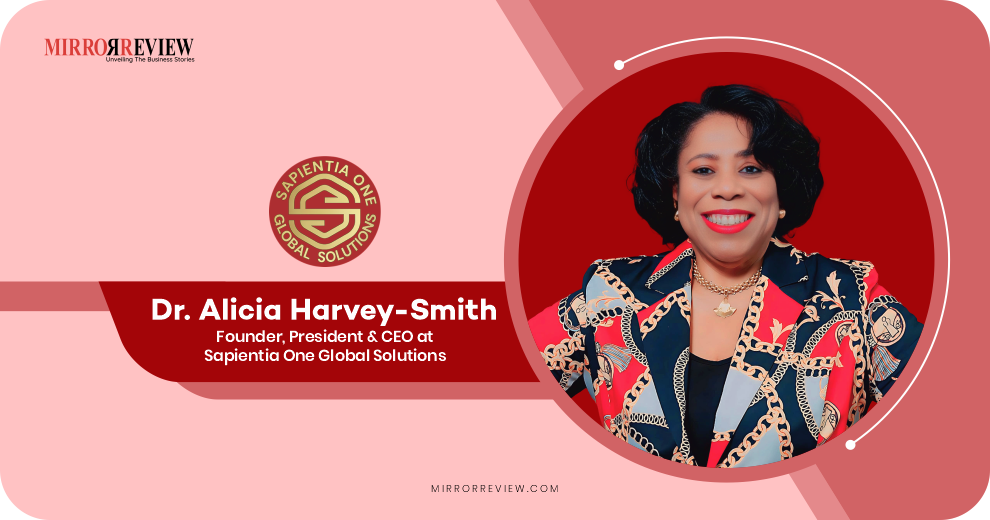
Wisdom is a heavy word. In Latin, it is Sapientia. It implies more than just knowledge or the accumulation of facts. It suggests a discernment that sits deep in the marrow, a capacity to see the architecture of a problem while others are still staring at the cracks in the paint. In the high-stakes, high-pressure world of modern higher education, where institutions are often trembling under the weight of demographic shifts and financial volatility, wisdom is the currency that matters most.
Dr. Alicia B. Harvey-Smith has dedicated her life to accumulating, refining, and reinvesting this vital currency into the educational systems that she has shaped— systems whose influence extends far beyond classrooms to the world we share.
As the Founder, President, and CEO of Sapientia One Global Solutions, Dr. Harvey-Smith describes the dual realities she embraces in organizational life. One is the world of hard strategy: financial projections, high-stakes performance, and operational disconnects. The other is the world of the human spirit: organizational trauma, belonging, and the quiet, urgent need for validation. While most consultants choose one domain, she has built the connective framework that unites them — transforming tension into possibility.
With more than thirty years in educational leadership — including over fifteen years at the presidential and executive vice chancellor levels — Dr. Harvey-Smith is recognized as one of higher education’s most distinguished leaders. She has guided institutions through crises, restoring stability and vision, and has also led institutions to monumental successes — achieving significant gains in student retention and graduation, advancing learning outcomes, securing major fundraising milestones, and developing award‑winning programs that continue to shape the field. She emphasizes that such transformation requires more than leadership alone; it demands a willing culture that embraces collective efficacy — the shared belief that by working collaboratively and supporting one another, even the most difficult challenges can be overcome.
Her work now extends far beyond academia, bringing transformational insight to global consulting, corporate training, and executive leadership development. Today, Dr. Harvey-Smith is doing something more radical. She is asking institutions to stop merely surviving and start feeling. She is asking leaders to look at their spreadsheets and see the people behind the numbers. She is reimagining education and organizational life more broadly, not just as a transfer of knowledge or a measure of performance, but as a mechanism for transformational impact. In doing so, she bridges the divide between strategy and spirit, showing that true success is measured not only in outcomes but in the lives transformed along the way.
The Genesis of Wisdom
Every great endeavor has an origin story, a moment where the status quo becomes intolerable. For Sapientia One Global Solutions, that moment was born from a realization that the systems we trust to build the future were faltering — failing both the builders and those they serve.
Dr. Harvey-Smith looked at the landscape of leadership development and saw a profound fragmentation. She saw leadership pipelines that were broken, lacking the values-driven development necessary to handle modern complexity. She saw a disconnect between visionary strategy and the actual, messy work of execution. But most vividly, she saw a loss of human-centered leadership, resulting in a workforce that was disengaged and burning out.
“Sapientia One Global Solutions evolved from many years of experience and training and a desire to understand what systems and processes have the most impact in creating and nurturing the most effective and high-performing cultures,” Dr. Harvey-Smith explains.
It was not a solo venture. Built with the support of her husband, Major Donald W. Smith, a retired U.S. Army and Capitol Police Officer, the consultancy is rooted in a blend of discipline and service. Together, they established a firm grounded in integrity, designed to empower clients to lead with purpose.
The gap she identified was not just technical; it was cultural. Institutions were trying to solve 21st-century problems with 20th-century tools, ignoring the erosion of civility and the desperate need for resilience. Sapientia was created to fill that void, delivering high-impact consulting, leadership development, and strategic transformation. It was built to bridge intellect and heart.
The Seventh Principle: A Framework for Evolution
To understand how Dr. Harvey-Smith is reshaping organizations, you have to understand the Seventh Learning College Principle.
Decades ago, Dr. Terry O’Banion introduced the Learning College Model, outlining six principles to guide institutions toward becoming learning-centered. It was seminal work. But during her doctoral studies at the University of Maryland–College Park, Dr. Harvey-Smith realized something was missing. The original principles were robust, yet they lacked a unifying force to address the inevitability of flux.
She introduced the Seventh Principle: “Create and Nurture an Organizational Culture that is Open and Responsive to Change and Learning.”
It sounds deceptively simple, yet it changes everything. It reframes the organization as a living ecosystem. It asserts that learning is not just what happens in a classroom; it is an institutional ethos. It must be embedded in leadership, operations, and engagement.
“The Seventh Learning College Principle directs attention to this outcome,” Dr. Harvey-Smith notes. “With leadership exposure early in my career and now with decades of experience in higher education, I knew this concept held promise — and practice has confirmed that when applied, it truly makes a difference.”
The validation of this work was absolute. Dr. O’Banion himself endorsed the research. In the foreword to her book, The Seventh Learning College Principle: A Framework for Transformational Change, he wrote that this principle “transcends the principles of the original learning college, bringing an organizing focus that adds heft and ballast to the evolving concepts.”
He further stated that, “…the seventh learning college principle serves as an umbrella principle that encompasses and supports the other six principles of the Learning College.”
The umbrella metaphor highlights the importance of holistic integration rather than piecemeal adoption of reforms. It signals that transformational change requires a guiding principle that protects and sustains all others and elevates it as a structural necessity.
In an era defined by disruption, from AI to funding cliffs, this principle offers more than just theory. It offers a survival mechanism. It empowers organizations to re-center their purpose around human development and build cultures that can outlast crises.
The CARE Model: Armor for the Soul
If the Seventh Principle is the architectural blueprint, the CARE Model© is the mortar that holds the bricks together.
Leadership, particularly in times of transformation, is abrasive. Friction is inevitable. Dr. Harvey-Smith developed the CARE Model: Compassion, Appreciation, Respect, and Empowerment, not as a soft-skill add-on, but as a strategic imperative.
It emerged from her research, defining four essential leadership standards. It directs critical attention to transforming organizational cultures with greater intentionality. These are not just nice words to put on a breakroom poster. They are operational imperatives that support building inclusive cultures and emotionally intelligent leadership pipelines.
The relevance of CARE extends far beyond the campus quad. Whether in the corporate sector, global enterprises, nonprofit organizations, or public service, the CARE Model provides the tools to heal fractured cultures. It addresses the emotional reality of the workforce, creating environments where people feel safe enough to innovate and supported enough to stay.
Healing the Invisible Wounds
This focus on the human element leads to perhaps the most profound aspect of Dr. Harvey-Smith’s work: Trauma-Informed and Trauma-Infused Leadership.
We live in a traumatized world. The aftershocks of global pandemics, social unrest, and economic instability have left deep marks on the workforce. Dr. Harvey-Smith recognizes that you cannot lead a person if you do not understand their pain.
“Trauma-Informed Leadership recognizes the widespread impact of trauma, whether personal, systemic, or organizational, and integrates this awareness into leadership practices,” she explains. But she takes it a step further with Trauma-Infused Leadership. This approach embeds trauma sensitivity into the very DNA of the institution: its policies, its daily operations, its culture.
It is a strategy grounded in neuroscience and psychology, aligning with principles from the Substance Abuse and Mental Health Services Administration (SAMHSA). The benefits are measurable. A 2023 McKinsey study found that psychological safety directly improves decision quality and team effectiveness. Conversely, when organizations fail to support their people, they risk “institutional erosion,” weakening trust and effectiveness.
Sapientia One Global Solutions stands out in this space. While many consulting firms focus on metrics and compliance, Dr. Harvey-Smith leads with an insight into the human condition. She knows that transformation begins with trust. By fostering psychological safety, she helps organizations lower turnover, improve team cohesion, and build resilience.
A Coalition of the Willing
No leader changes the world alone. Dr. Harvey-Smith has assembled a formidable network of partners and collaborators who share her mission of cultural restoration.
She serves as the US Strategic Advisor for TeachingHOW2s in the UK, an evidence-based platform empowering educators. She collaborates with M-PowerHouse of Greater Pittsburgh, a non-profit empowering underserved youth through STEAM education. She is also a member of The Registry, providing executive transitional leadership to colleges and universities across the nation.
Her reach extends to Kenya, where she partners with the Lehigh Talent Academy, an emerging K–12 institution. Together, they are co-creating a model of education that honors heritage and fosters globally competent learners.
Closer to home, she serves as the Educational Chair for The Strong Families Commission, Inc., working to eliminate systemic barriers preventing fathers from engaging in family life. She also leans on the expertise of the Duquesne University Small Business Development Center (SBDC) for strategic planning and regional expansion.
The gravity of her work requires engaging with influential local forces. In her base of operations, the African American Chamber of Commerce of Western Pennsylvania (AACCWP) serves as a critical engine for economic and social empowerment, driving regional growth for minority- and women-owned businesses. This necessity for broad, collaborative action highlights Dr. Harvey-Smith’s intuitive understanding that systemic change requires knitting together a diverse tapestry of allies.
Whether engaging with the AACCWP or collaborating with high-level college boardrooms, she applies the same foundational wisdom: leveraging diverse perspectives to refine her human-centered frameworks. These partnerships are not simply affiliations; they are strategic alliances that ensure her models are continually grounded in evidence-based planning, fostering regional growth while actively championing the advancement of women-led enterprises.
Through the Chamber’s partnership with Entrepreneurs Forever, she participates in the inaugural CEO cohort, advancing peer-driven strategies that fortify small business resilience and amplify the Chamber’s mission of economic empowerment. This deliberate coalition building is the living proof of her Seventh Principle: always seeking to learn and evolve.
The Crucible of Leadership
It is easy to speak of leadership in the abstract. It is harder to practice in the fire. Dr. Harvey-Smith’s leadership was forged in a crucible. She recalls a period of profound organizational upheaval at a struggling institution where she served as the first Black woman appointed President and CEO. The community was fractured. Trust had eroded. The scrutiny was hyper-visible.
“In that crucible, I learned that transformational leadership demands more than vision and strategy,” she reflects. “It requires composure under pressure, courage in uncertainty, and the unwavering integrity to lead when the spotlight is sharpest.”
She did not fight fire with fire. She fought it with CARE. She used emotional intelligence as her armor and cultural understanding as her compass. She listened to dissent. She acknowledged the pain in the room. She refused to engage in reactive discourse.
“Leadership demands holding the center when others cannot,” she says. “It means modeling wisdom over reaction.”
In that moment, she did not just endure; she transformed. She led the institution through the storm, proving that the Seventh Principle and the CARE Model were not just academic theories, but survival strategies for the real world.
The Measure of Impact
In the world of business and education, vision must eventually translate into results. Dr. Harvey-Smith’s career is defined by metrics that prove the efficacy of her philosophy.
She has provided executive-level leadership for over twenty years. She has overseen more than one hundred grants totaling over $43.6 million across five institutions. She has secured $1.95 million in NSF grants. Perhaps most impressively, she transitioned a for-profit college to nonprofit status, reducing its debt by $18 million and securing over $25.1 million in external funding. She extended the institution’s operations by more than four years beyond its projected closure, saving jobs and student futures.
Her insights are cited in Redesigning America’s Community Colleges, a landmark text published by Harvard University Press. She has authored influential books, including Higher Education On The Brink: Reimagining Enrollment Management in Colleges and Universities.
Dr. Harvey-Smith has been recognized with the Brave Women Project Pillar Award, the Smart50 Innovation, Impact & Sustainability Award, and the Pittsburgh Technology Council CEO of the Year. She is also a distinguished member of Alpha Kappa Alpha Sorority, Inc., and previously served on high-impact boards like the American Association of Community Colleges (AACC).
The Balance of Being
To carry such weight requires a strong foundation. Dr. Harvey-Smith does not preach burnout as a badge of honor. She models balance.
“I have cultivated a rhythm that honors both professional purpose and personal joy,” she says.
She and her husband share a disciplined commitment to wellness, training together to maintain strength and connection. They travel to gain a global lens on life. She finds solace in creative pursuits like writing and theatre, and holds time with family and friends as sacred.
“These practices are not separate from my work; they sustain the clarity, creativity, and resilience I bring to it,” Dr. Harvey-Smith insists.
The Road Ahead
Dr. Harvey-Smith is not slowing down. Her vision for Sapientia One Global Solutions is global. She intends to scale the consultancy into a worldwide force, serving colleges and corporations with human-centered frameworks. She plans to launch a branded podcast and a curated Substack to foster global dialogue. She will continue to write, to speak, and to challenge the status quo.
“We will embed learning into every layer of leadership and cultivate high-performance cultures that rise through challenge and evolve with purpose,” she declares.
The Why and The Who
At the core of it all, beneath the strategy and the accolades, lies a steady heart and an abiding faith in possibility. It is the “Why” that drives her: the conviction that organizations can be places of healing and transformation. It is the “Who” she serves: the students, the faculty, the leaders, the clients, and the institutions striving to make a difference in a fractured world. For her, every engagement—whether with individuals or entire systems—is an opportunity to restore trust, cultivate resilience, and advance human-centered frameworks that empower people and strengthen communities.
Her message to them is clear.
“Lead with wisdom, authenticity, and never forget your why,” she urges. “Leadership is not about titles—it’s about people. It’s about showing up with clarity when others are confused, with courage when others are afraid, and with compassion when others feel unseen.”
She pauses, reflecting on a truth she learned long ago.
“People do not care how much you know, until they know how much you care.”
In a world that often feels devoid of both wisdom and care, Dr. Harvey-Smith is proving that you don’t have to choose between them. You can build a strategy that heals. You can lead an institution that loves. And you can change the world, one leader at a time.
For more information about Sapientia One Global, please visit: https://sapientia1global.com/
Quotes
Read More: Visionary Women in Higher Education: Driving Transformational Impact in 2026


