
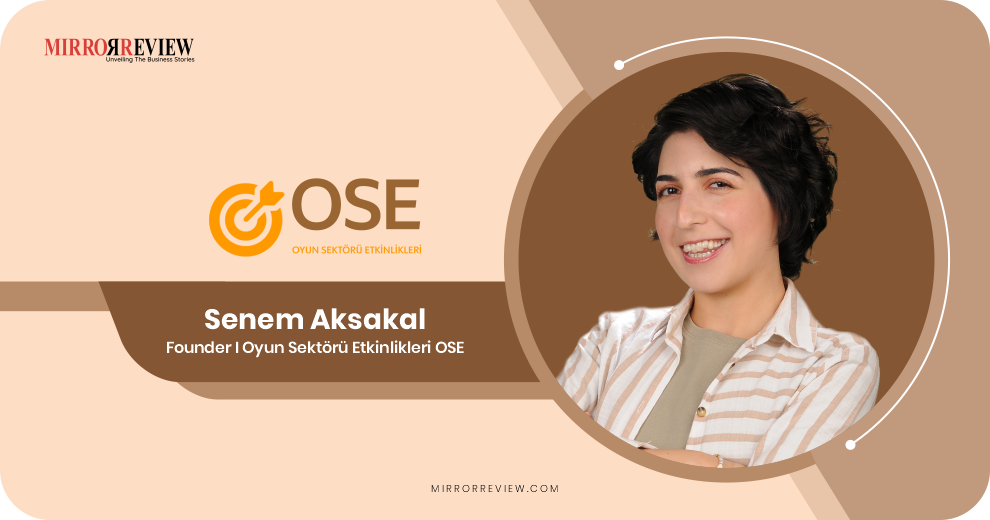
There is a unique kind of magic that happens when a child sits in front of a glowing monitor for the first time. For most, the screen is just a flat piece of glass offering colorful distractions. But for a select few, it is a window into a mechanical universe waiting to be understood. Senem Aksakal began learning the language of this machine before she even knew how to walk. In the year she was born, her family had a desktop computer. She would sit quietly and watch her older brother launch games using MS-DOS commands. Glowing green text, deliberate keystrokes, and pixels suddenly springing to life: these were the foundational memories that would shape her entire career trajectory.
Over time, gaming evolved from a childhood pastime into an all-consuming passion. But what made Senem unique was that she didn’t just want to consume the digital worlds presented to her; she wanted to know how the walls were built. She wanted to understand the invisible architecture that makes a player feel joy, frustration, or triumph. This burning curiosity about how the player experience is constructed, combined with a desire to design better ones, ultimately led her to the field of Game Design.
Today, Senem is a monumental figure in the Turkish gaming ecosystem. Based in Ankara, she is an experienced QA (Quality Assurance) Team Lead, a community manager, and the founder of Oyun Sektörü Etkinlikleri (Game Industry Events), widely known to the masses as OSE. Since 2016, she has been deeply involved in many areas of the industry, from game testing to development, and from game design to community management. However, her true impact lies in how deeply she understands her “purpose.” She doesn’t just build games; she inspires the people who build them.
The Anatomy of Quality
To understand Senem, you have to understand the philosophy of Quality Assurance. In the gaming industry, QA is often misunderstood as simply playing a game over and over to find bugs. In reality, it is a relentless, empathetic pursuit of perfection. It requires a person to step into the shoes of a thousand different players and anticipate their confusions, their missteps, and their desires.
Through her extensive experience spanning multiple roles, Senem developed a comprehensive understanding of the industry’s complex dynamics. She has led teams to optimize workflows, enhance player experiences, and solve deeply complex problems using a strategic and collaborative approach. Her leadership style is deeply rooted in service. She believes implicitly in fostering an open and transparent work environment, empowering her team members through active mentorship, and ensuring that collective efforts consistently exceed quality expectations. She does not hoard her knowledge. She distributes it.
It is this sharing spirit that has carried her beyond the boundaries of her daily job and into the very heart of the game development community. Over the years, she has participated in over 60 production-focused industry events, including grueling game jams, hackathons, and ideathons. She has mentored young developers at 21 of these events and served as a jury member at 18. These physical and mental marathons have not only sharpened her own technical skills but also continually fueled her passion for innovation and lifelong learning.
Gathering the Scattered Pieces
By 2022, Senem was attending a dizzying number of seminars, webinars, and game jams as both a speaker and a participant. She was deeply rooted in the scene. Yet, as she navigated this vibrant ecosystem, she noticed a glaring structural flaw: game industry events in Turkey were being announced in a chaotic and scattered manner. There was no centralized tracking point. A fantastic seminar happening in one city could completely slip under the radar of eager university students just a few miles away.
Many people would have simply complained about the inconvenience. Senem, driven by an innate desire to serve the community, decided to fix it. She realized she was already tracking all these events for her own schedule, so she decided to gather them under a single, accessible roof. That exact need birthed Oyun Sektörü Etkinlikleri.
Founded in 2022, OSE quickly grew into a vital social entrepreneurship platform connecting the Turkish gaming community. When asked about the core mission of the platform, her answer is grounded in absolute clarity. “Our mission is to consolidate all public gaming industry events held in Turkey into a single, organized, and accessible platform,” Senem explains.
But the “why” behind OSE runs much deeper than mere organization. It is about access and equity. OSE provides a completely free and reliable event feed for university students and professionals who are desperately looking to step into the industry. Simultaneously, it gives event organizers a dedicated space to gain visibility and reach the precise audience they need.
By turning scattered announcements into a cohesive whole, Senem has streamlined access to industry events and fostered a much more conscious culture of participation. She has created a starting point for developers eager to step into the industry.
The 48-Hour Crucible
When you spend as much time in the trenches with young developers as Senem does, you begin to see patterns. At game jams, where teams are tasked with building a functional prototype in a sleep-deprived 48-hour window, the struggles are rarely technical.
“I have observed that the biggest struggle, especially in the game jams I attend, is game design,” Senem points out. She notes that young developers usually arrive with a strong foundation in technical areas like coding or visual design. Their prior education is often sufficient to produce a working prototype under intense pressure. The code works; but the soul of the game often stumbles.
“When it comes to game design, they struggle with things like the clarity of the game loop, level design, and building player motivation,” she observes.
This insight reveals a profound truth about interactive entertainment. A game is not just code; it is an applied psychology. “Game design isn’t a skill that develops just by being a player; it requires systems thinking, analysis, and repetitive practice,” she says. She actively teaches young creators that the projects of teams who consciously practice in this area, or who have formal academic training, tend to be vastly more balanced and cohesive. She is showing them how to build the invisible architecture she sought to understand as a child.
The Currency of Trust
Leading a community and managing a platform like OSE requires a meticulous daily rhythm. On any given day, Senem is tracking industry news, scouring for event announcements, and painstakingly curating public events to ensure OSE remains the most accurate feed in the country. Concurrently, she produces insightful content on LinkedIn, analyzing industry developments and sharing the “kitchen” of the business with her followers.
For Senem, the critical aspect of leadership at this stage is not flashiness or viral moments. It is the quiet, heavy burden of consistency. “Maintaining repetitive processes with discipline, setting a standard for content, and creating a sustainable publishing schedule are what determine the reliability of both OSE and my personal brand,” she says.
But true leadership is eventually tested by conflict. For Senem, a defining test arrived in the form of an artificial intelligence controversy. A PDF book was being heavily marketed to aspiring developers as a premium product full of personal industry expertise. Senem, always looking out for the community, bought and reviewed the book. What she found was alarming. The content was largely generated by AI, entirely devoid of original experience or genuine field insight. It was a hollow cash grab targeting vulnerable beginners.
The easiest path would have been silence. Calling out the product meant taking a highly visible, potentially controversial stance. “Staying silent would have been much more comfortable, because openly criticizing it meant taking a visible stance,” she admits.
Despite the discomfort, she knew exactly who she was serving. She wrote a detailed review under the advertisement. It was not a personal attack, but a clinical, concrete breakdown of her findings. “My goal wasn’t to start a polemic, but to help people make informed decisions,” she explains.
The post immediately sparked intense discussions. Several individuals publicly thanked her, explicitly stating that they knew her from her LinkedIn content and implicitly trusted her evaluation. They had almost wasted their money. She had protected them.
“This situation showed me that leadership isn’t just about producing content; it’s about using your trust capital in the right place,” Senem reflects. “Being a role model doesn’t mean supporting every trend; it means having the courage to stand critically when necessary.”
The Weight of Representation
In the global gaming industry, the proportion of female employees still lags significantly behind men. This glaring gap deepens even further when looking at leadership and entrepreneurial positions. Senem is highly aware of her position. She carries the responsibility of being a visible female leader not as a burden, but with a profound sense of duty.
The true measure of her impact isn’t found in metrics or site traffic, but in those quiet moments at physical events. Young women, in particular, frequently approach her to tell her how much they benefit from her digital content. “They express that seeing a name they follow digitally in person for the first time is very meaningful to them. This feedback is one of the most tangible indicators of the impact I’ve created,” Senem shares.
The turning point for this widespread visibility occurred in 2020. During the isolation of the pandemic, Senem pivoted hard into digital outreach. She gave numerous presentations and interviews on the gaming industry and game design as a guest on various webinars. That intense period of digital sharing allowed her to reach vastly wider audiences, growing her sphere of influence and solidifying her status as a guiding light for marginalized voices in the Turkish tech scene.
The Rhythms of Life
Meeting the demands of a QA Team Lead role, managing OSE, and maintaining a prolific presence as an industry mentor is a task worthy of Wonder Woman. When asked about work-life balance, Senem offers a very honest assessment.
“Frankly, I can’t say I’ve established a ‘perfect’ balance,” she admits. Her pace is incredibly intense, particularly during the harsh winter months when university student events spike. During this season, curating the OSE platform and attending events as a guest speaker consume the vast majority of her free time.
Because her schedule is so demanding, she has to consciously carve out room for her personal life. Playing PC games remains a natural, vital part of her routine. But to truly mentally reset, she steps away from the screens entirely. She immerses herself in reading books, she loses herself in the thumping rhythms of house and electronic music concerts, and during the warm summer months, she finds solace in swimming in the sea. These intentional breaks are the oxygen that sustains her demanding professional fire.
The Magnitude of Unspread Wings
Looking toward the horizon, Senem’s vision is expansive. Digital games are not just a profession to her; they are a lifelong field of creation. She is fiercely determined to continue her career in the gaming industry, but her ultimate goal is deeply altruistic.
“My vision is to somehow touch the journey of everyone in Turkey who is interested in games, wants to create in this field, or is simply curious about the industry,” she states. She brings this massive vision to life daily through her LinkedIn content, her guest appearances, and the tireless curation of OSE. Long-term, she intends for OSE to transform into a sustainable, self-sufficient structure that can thrive on its own dynamics, completely independent of her direct involvement.
When asked about the guiding principles of her leadership journey, Senem points to three simple but profoundly powerful stories that have anchored her mind over the years.
The first is the story of the ‘deaf frog,’ a parable that reminds her that the ability to tune out the negative noise of the outside world is directly tied to achieving success.
The second is the tale of the ‘woodcutter sharpening his axe,’ a constant reminder that relentless grinding leads to a dull blade, and that sustainable performance is only possible through intentional, restful breaks.
The third is the story of the ‘eagle that lived like a chicken and died like a chicken.’ It is a heartbreaking narrative that emphasizes a core truth: living without realizing your own potential is the greatest tragedy of all.
Her entire understanding of leadership has been forged around these three axes. She focuses intensely. She continuously improves herself. And most importantly, she takes full, uncompromising responsibility for her own potential, while desperately trying to unlock the potential in others.
She summarizes her philosophy with a quote that captures the essence of her mission in the Turkish gaming industry. It serves as a reminder to every young developer, every aspiring female leader, and every tired creator staring at a glowing screen wondering, “Am I good enough?”
“The greatness of unopened wings is unknown.” – André Gide.
Senem Aksakal has already spread her wings. Now, she is simply teaching the rest of the industry how to fly.
Quote
“The greatness of unopened wings is unknown.” – André Gide.
Read More: Women in Gaming & Licensing: Pioneering the Future of Interactive Entertainment


