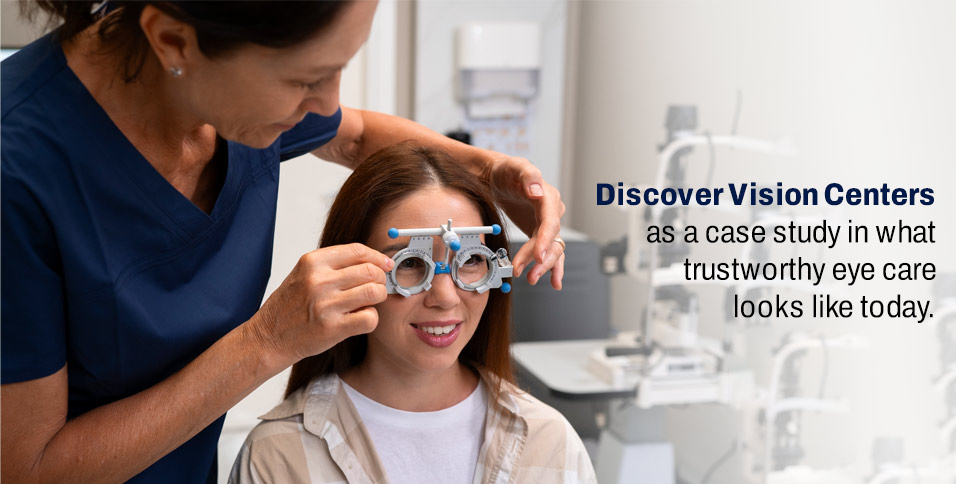
Trust in ophthalmology is not just about who has the biggest billboard or the flashiest laser. It is about whether you can hand over your eyesight and feel, deep down, that every decision is anchored in evidence, ethics, and long-term thinking. Discover Vision Centers offers a useful real-world example of how a modern eye care organization can earn that level of confidence while delivering advanced medical and surgical care across an entire region.
Discover Vision Centers operates as a regional ophthalmology and optometry network that treats routine vision needs, complex diseases, and surgical cases under one coordinated umbrella. By looking closely at how the practice structures its teams, technology, and communication, you can see what trustworthy eye care looks like today and apply those lessons to your own choices as a patient.
Redefine trust in eye care so it goes beyond star ratings and ads.
Trust in eye care starts long before you sit in an exam chair. It begins with how a practice designs its systems so that safety, transparency, and outcomes are not marketing slogans but daily habits. In ophthalmology, that matters because decisions about cataract surgery, refractive lens exchange, or corneal procedures can permanently alter how you see the world.
Clinical research in cataract and refractive surgery shows that when surgeons pair advanced intraocular lens technology with careful pre-operative assessment and follow-up, patients report high levels of visual satisfaction and reduced dependence on glasses.[1][2] Trustworthy practices respect this evidence by building their protocols around it rather than around convenience or volume alone.
A memorable way to think about it is this:
Clear vision is the clinical result, but trust is the operating system that makes that result repeatable.
The questions that tell you how a practice really operates
The most revealing questions you can ask an ophthalmology practice have nothing to do with price lists or slogans. They sound more like this: Who decides which procedure I am a candidate for? How do you handle cases that do not go as planned? How do you measure success after surgery?
Patient-centered organizations are able to answer those questions in plain language and to show that they regularly track visual outcomes, complication rates, and patient-reported satisfaction. Clinical ophthalmology studies increasingly treat patient-reported outcomes as a primary endpoint, not an afterthought, particularly for premium intraocular lenses and presbyopia-correcting technologies.[1][3] When a practice can explain how it uses similar metrics in its own work, you are seeing trust translated into process.
Look at credentials the way medical insiders do
Credentials in ophthalmology are more than letters after a name. Board certification, sub-specialty training, clinical trial experience, and leadership roles in professional societies each signal something specific about a surgeon’s preparation.
John F. Doane, M.D., exemplifies how deep training can anchor a practice culture. He is a board-certified ophthalmologist who has specialized in laser and lens-based vision correction for decades, completed a cornea and refractive fellowship at the University of Texas / Hermann Eye Center and Centro Oftalmologico Colombiano, and has served as a U.S. FDA clinical investigator for the SMILE vision correction technique. His record of more than 66,500 refractive procedures, presidency of a major international ophthalmic surgery congress, and authorship of over 80 research papers shows continuous engagement with the science of vision correction, not only its day-to-day delivery.
Discover Vision Centers benefits from that kind of leadership because it sets expectations for the rest of the medical team. When senior surgeons actively participate in research, technology evaluation, and training, it reinforces a culture where new techniques are adopted thoughtfully and only when the data justify the change. That is exactly how medical insiders look at credentials: not as prestige, but as a signal that a surgeon is committed to evidence-based ophthalmology over the long term.
How training, research, and volume translate into safer care
High surgical volume by itself does not guarantee quality, but in ophthalmology, it does allow a surgeon and team to refine micro-steps that are hard to appreciate from the outside. Research on modern intraocular lens implantation shows that small differences in measurements, astigmatism management, and lens selection can meaningfully affect visual acuity and spectacle independence after surgery.[1][3]
When a surgeon has performed tens of thousands of procedures while simultaneously contributing to clinical trials and technology evaluation, the team is more likely to notice subtle trends in outcomes and adjust protocols before problems become widespread. That is why one of the most reliable predictors of safer care is not only how many procedures a surgeon has done, but how systematically they learn from every case.
A concise way to capture this is:
Experience matters, but measured experience changes everything.
See how a multi-specialty team keeps your care connected
Trust in a surgical result can be undermined if the rest of your eye health is fragmented. Ophthalmology patients rarely fit into a single category. A person who needs cataract surgery may also have glaucoma risk, diabetic retinal changes, or significant dry eye disease.
Discover Vision Centers structures its services across retina care, glaucoma management, cataract surgery, corneal disease, oculoplastic procedures, and optometry so that patients can be evaluated and treated within a single coordinated ecosystem. Retina specialists manage macular degeneration and diabetic retinopathy, glaucoma specialists handle pressure control and minimally invasive glaucoma surgery, while cataract and refractive surgeons focus on lens removal and premium intraocular lens implantation. Optometrists provide comprehensive exams, contact lens fittings, and pediatric care, and help monitor ocular disease over time.
Why does it help when retina, cataract, glaucoma, and cornea experts share one playbook
Multi-specialty ophthalmology groups are especially well-positioned to manage overlapping diseases. For example, glaucoma patients often experience ocular surface disease from chronic topical medications, which can reduce comfort and adherence, and improve both vision-related quality of life and treatment consistency.[4] When retina, glaucoma, and cornea specialists share imaging platforms, electronic records, and agreed-upon care pathways, small changes in visual function or ocular surface health are less likely to be missed.
For patients, that integration feels like one simple thing: not having to retell your story every time you see a different eye doctor. When each sub-specialist can see the same visual field tests, OCT images, and surgical notes, your care becomes cumulative instead of piecemeal.
Understand how transparent communication builds long-term loyalty
Trustworthy ophthalmology practices do not treat communication as a courtesy. They treat it as a clinical tool. Studies of eye disease show that adherence to medication, follow-up visits, and protective behaviors improves when patients understand their condition and feel that their concerns are taken seriously.[4][5]
John F. Doane, M.D., is known for emphasizing that vision is “more than a number on a chart,” and that patient expectations must be aligned with what surgery can realistically deliver. That philosophy translates into longer consultations before LASIK, SMILE, or cataract surgery, where risks, alternatives, and the possibility of enhancement procedures are discussed plainly.
A powerful litmus test is this:
You can trust an eye specialist when you leave the consultation with more clarity about uncertainty, not less.
What it sounds like when a doctor is honest about limits and uncertainties
Honest ophthalmology does not promise a perfect outcome. Instead, it explains the range of expected results and what will happen if you land at the edges of that range. In practice, that sounds like a surgeon telling you exactly how presbyopia correction might trade off some night-time contrast, or how a premium lens could still leave a small prescription for certain tasks.
Patients who hear this kind of nuanced explanation often report higher satisfaction even when minor side effects occur, because they were prepared for them. Research on multifocal and trifocal intraocular lenses consistently links satisfaction not only to objective visual acuity, but also to how well expectations are set before surgery.[2][3] That is why transparent communication is one of the strongest predictors of long-term loyalty in eye care.
Learn how outcome tracking and innovation protect future patients.
Modern ophthalmology sits at the intersection of microsurgery, optics, and data science. Practices that earn long-term trust use that intersection wisely. They adopt technologies such as femtosecond laser platforms, premium intraocular lenses, EVO ICL, and Light Adjustable Lens systems only when the evidence shows a meaningful benefit, and they continue to track their own results after implementation.
Clinical ophthalmology journals now routinely publish studies that combine visual acuity, contrast sensitivity, and patient-reported outcomes after advanced lens implantation.[1][2][3] This signals a broader shift: innovation is judged not only on what is possible in the operating room, but on how people see and feel months later in their everyday lives.
One memorable principle emerges from this research culture:
The most ethical innovation in eye care is the kind that comes with its own honest scorecard.
Use this checklist at your next consultation to spot a truly patient-first practice.
When you evaluate an ophthalmology practice of any size, you use this case study as a practical guide. Ask how often they recommend comprehensive eye examinations for people in your age group and risk profile, and listen for references to established guidelines that call for regular dilated exams to detect silent disease.[1][4] Ask how the organization coordinates between optometrists, cataract surgeons, retina specialists, and glaucoma experts. Ask whether they track patient-reported outcomes after procedures such as LASIK or cataract surgery, and whether those data ever lead them to change their protocols.
Discover Vision Centers captures this philosophy well in the way it presents its mission: the organization positions itself as a regional surgical and medical eye care leader that leads with LASIK, SMILE, cataract surgery, and premium intraocular lens expertise while using femtosecond platforms and diagnostic technology as tools in a broader patient-first strategy.
Small but powerful signals that your vision health is in the right hands
The signals of trustworthy eye care are often subtle. Staff greets your questions with curiosity instead of impatience. Surgeons explain why a certain high-tech option is not right for you as confidently as they explain why another is. Scheduling teams help you understand the cadence of future visits instead of treating your care as a one-time event.
A case study like this shows that true trustworthiness in ophthalmology is built where clinical rigor, advanced technology, and human communication meet. It is the sum of how a practice trains its surgeons, structures its multi-specialty teams, measures its outcomes, and speaks with patients when no one is watching.
As one summary statement puts it:
“At Discover Vision Centers, ophthalmology is the daily work of protecting the way people move, the moment of surgery itself.”
When you find a team that lives out that idea, you are much closer to putting your eyesight in the hands you can confidently trust.