
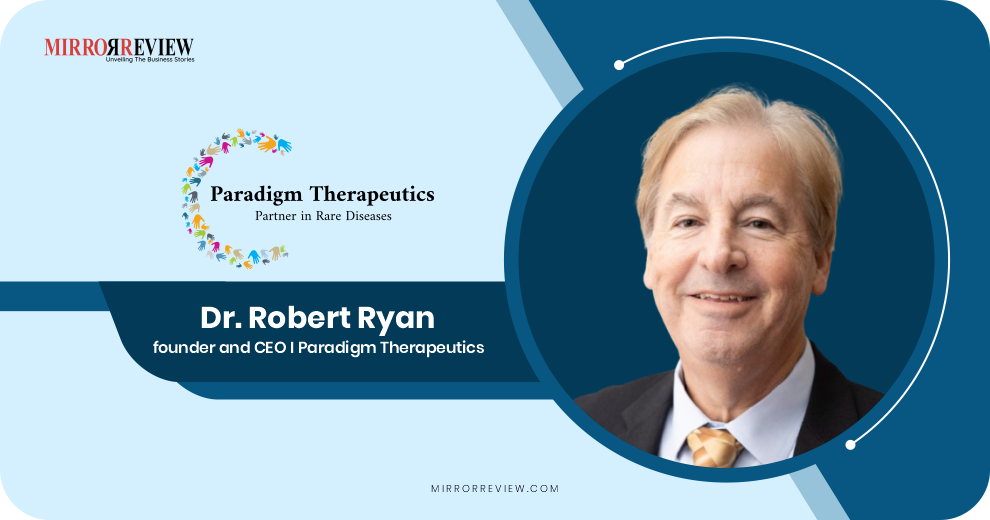
The skin is an organ that many of us often take for granted. As the body’s largest organ, it serves as a durable barrier that holds us together while protecting us from the outside world. However, for Dr. Robert Ryan, the founder and CEO of Paradigm Therapeutics, the skin symbolizes an urgent and challenging frontier. It is the battleground for a devastating condition that affects children born with Epidermolysis Bullosa (EB). For these patients, their skin is exceedingly fragile, resembling a butterfly’s wing; it blisters and erodes with the slightest touch, or sometimes even without any touch at all.
Dr. Ryan talks about this condition not as a corporate executive discussing quarterly projections, but with a deep, personal intensity. He has witnessed the struggles of families who are running out of time. With over thirty years of experience in the pharmaceutical industry, Dr. Ryan’s career spans across the globe and encompasses the complexities of drug development. Yet, he has chosen to focus his life’s work in Mount Pleasant, South Carolina, on a disease that often goes unnoticed by the broader public.
Paradigm Therapeutics was founded in 2023, but Dr. Ryan’s dedication to this mission dates back much further. His work is driven by a simple, yet profound question that fuels the most impactful leaders: Who is this for?
The View from the Beginning
To understand Dr. Ryan’s current position, one must consider the foundations of his early life. His entry into the pharmaceutical industry was not a coincidence; it was largely shaped by his upbringing. His father was an executive at a large pharmaceutical company, and the young Robert viewed the industry through a unique lens. He didn’t just see a business; he recognized the tangible need for effective treatments. He understood that a well-developed therapeutic compound could significantly impact someone’s life.
This insight became a turning point for him. It propelled him toward a career spanning over 35 years, encompassing every challenging step of the global development process, from preclinical research to Phase IV trials. His resume serves as a roadmap of some of the industry’s most influential companies: Roche, Bristol-Myers Squibb, UCB, and Pfizer. He has also held senior regulatory positions at three of the top five clinical development firms, including PPD, INC Research, and Quintiles.
In the early part of his career, Dr. Ryan focused on cancer, working to develop effective therapies to meet the substantial unmet needs in oncology. However, a pivotal moment that ultimately led to the founding of Paradigm Therapeutics occurred in 1998.
While working with a company centered on Epidermolysis Bullosa (EB), he gained his first real insight into the rare disease community. He encountered families grappling with the harsh realities of EB and witnessed the devastation wrought by a disease that affects every part of the skin. He understood then that, for rare diseases, the medicine cabinet was often bare.
“I realized at that time how devastating the disease was and the lack of treatment options for rare diseases like EB,” Dr. Ryan recalls. This realization planted a critical seed in him, fostering a hope that he would one day have the autonomy and opportunity to develop an effective therapy. That hope evolved into a journey, leading to the creation of SD-101, also known as Zorblisa™.
The Gap in the Ecosystem
The landscape of drug development is often cluttered with “me-too” drugs, which are slight variations of existing treatments created to capture market share. However, Paradigm Therapeutics was founded with a different goal in mind: to address a significant unmet need.
Epidermolysis Bullosa (EB) is a genetic disorder that typically manifests at birth. It is not just a localized issue; it represents a systemic failure of the skin’s architecture. The skin remains compromised because it lacks the anchoring fibers necessary to maintain stability between its layers. For patients, this leads to chronic wounds, life-threatening infections, sepsis, failure to thrive, and an alarmingly high risk of squamous cell carcinoma.
Dr. Ryan observed a disconnect in how the industry approached treatment. Previous attempts often focused on closing a single wound, but an EB patient may have up to 90 percent of their body covered in wounds. Dr. Ryan believed that addressing one lesion while the rest of the body suffers from inflammation was akin to trying to bail out a sinking ship with a thimble.
“Treating a single wound while most EB patients endure extensive wound burdens across their entire skin surface offers little benefit,” Dr. Ryan explains.
He and his wife, who shares this vision, decided to pursue a more challenging path. They aimed to develop a therapy that would treat the entire body, rather than just providing a cosmetic fix. Their goal was to transform the management of the disease from birth onward. This shared vision required countless late nights and moments of deep uncertainty, but the reason behind their mission, the patients, kept them motivated.
The Science of Empathy
The result of this dedication is SD-101 (Zorblisa™). Although it is a late-stage topical therapy, simply calling it a cream does not capture the engineering behind it.
The science is impressive in its simplicity. SD-101 is a topical emulsion cream that is applied once daily over the entire skin surface. It is designed for ease of use, requiring no complex preparation. The emulsion dissolves quickly and is delivered locally to the skin, with no systemic absorption. This feature is crucial for patient safety, especially for infants with immature immune systems.
Dr. Ryan collaborated with a formulation chemist for several years to perfect this therapy. The goal was to create a product that could be used daily without causing side effects, yet potent enough to address the broad spectrum of clinical manifestations of the disease.
The design of this therapy was directly informed by listening to patients. When Dr. Ryan and his team asked patients and caregivers what they truly needed, the responses were consistent. They needed to reduce the risk of skin cancer, minimize the number of wounds, ensure wounds closed faster, and lower the risk of infection. Most urgently, they needed to alleviate itching.
“Reduction in itching has been consistently identified by both EB patients and their caregivers as one of the most devastating aspects of the disease on a daily basis,” Dr. Ryan notes. It is an incessant, frustrating symptom that diminishes the quality of life every hour.
SD-101 was evaluated in clinical trials involving daily treatment across the entire skin surface. The results addressed the exact concerns voiced by patients: a reduction in the overall coverage of wounds, accelerated wound closure, diminished itching, and fewer skin infections. This is science dedicated to empathy.
Navigating the Regulatory Maze
Developing a drug for a rare disease is notoriously complex. It is resource-intensive and often a lonely endeavor. However, the biggest challenge Dr. Ryan faced was not just the chemistry; it was the bureaucracy.
When he began this journey, regulatory authorities like the FDA had a limited understanding of EB. No drugs existed that were designed to treat the condition throughout the body. The regulators were unsure what clinical benefits were relevant because the necessary data simply didn’t exist.
Dr. Ryan had to become as much an educator as a CEO. Relying on his extensive knowledge of the disease, he helped design clinical trials with measurable outcomes that the regulators could agree upon.
His leadership was tested early on. In preparation for his first direct interaction with the FDA, Dr. Ryan compiled a briefing package containing 20 specific proposals. He sought agreement on multiple topics to streamline the path forward. The board of directors was skeptical, advising him to play it safe and focus on just two or three topics.
This was a moment that required a particular kind of courage. Dr. Ryan had to trust his experience over his advisors’ caution. He convinced the board to allow him to proceed with all 20 proposals. When the meeting concluded, the FDA agreed to all of them. It was a victory not just for the company but also for the speed at which they could bring the therapy to patients.
A Culture of Service
Today, Dr. Ryan leads Paradigm Therapeutics from its headquarters in Mount Pleasant. His leadership style is straightforward and unpretentious. He describes himself as a “roll-up-your-sleeves” type of person, believing that no task is too menial for any team member, regardless of their position within the company.
Dr. Ryan has assembled an exceptional team of passionate entrepreneurs. The key criterion for joining was not just functional expertise, but a genuine heart for the mission. He sought individuals who were willing to acknowledge what they didn’t know and who were deeply committed to helping patients with EB.
This culture of dedication extends to the partners and stakeholders who support the mission. It includes EB physicians and key opinion leaders managing treatment centers across the U.S., Europe, South America, the Middle East, and Australia. It also involves patient advocacy groups such as DEBRA (Dystrophic Epidermolysis Bullosa Research Association), where Dr. Ryan has served as a board member for over 12 years.
Additionally, there are key stakeholders like Fred Eshelman, who understood the importance of this mission and provided the financial support necessary for quick action. In the biotech world, speed is not just about return on investment; for a child with EB, it can mean the difference between life and death.
Recognition and the Road Ahead
The impact of this work is starting to gain recognition on a global scale. In the fall of 2024, Paradigm Therapeutics received a nomination for the 2025 Prix Galien USA award. Often described as the “Nobel Prize of biopharmaceutical research,” this award honors excellence in the life sciences. For a company focusing on rare diseases, this nomination serves as validation that the industry is finally paying attention to patients who have long been overlooked.
However, Dr. Ryan is not resting on this nomination; his vision is expanding. Through his other venture, Innova Therapeutics, also based in South Carolina, he is returning to his early roots in oncology. He is applying the same patient-centered approach to develop a novel cancer therapy. Innova is working on a platform that has the potential to revolutionize treatment for both solid tumors and hematological malignancies. Additionally, they are developing a sensitive cancer diagnostic tool for identifying the early stages of cancer.
“I have worked on more than 75 cancer therapies in my career,” Dr. Ryan reflects. He believes that the current platform at Innova has the highest potential he has ever encountered to improve patient survival, particularly for children with bone cancer.
The Man behind the Mission
Despite the weight of his responsibilities, Dr. Ryan leads a grounded life. He acknowledges that maintaining a work-life balance is challenging. The suffering of his patients constantly motivates him, making it difficult to switch off from work. He understands that every year, patients die from infections, and this knowledge drives the urgency of his daily activities.
However, he does find moments of peace. He enjoys boating, working outdoors, playing golf, and traveling with his wife and friends. These moments of normalcy allow him to return to his demanding work with renewed energy.
Dr. Robert Ryan has dedicated his life to the complex, high-stakes world of pharmaceuticals, yet his philosophy remains remarkably simple. When asked for a guiding principle, he doesn’t refer to a business handbook; instead, he emphasizes the human element.
“If you ever have the opportunity to make a difference for a patient with a devastating disease, don’t miss that chance,” he advises.
This statement serves as a reminder that even in an era dominated by high-tech biotechnology, the most vital component remains the human heart. Dr. Ryan has built a career, and a company, on the belief that prioritizing patient care will naturally lead to scientific advancements. For families living with Epidermolysis Bullosa, this belief makes a profound difference.


