There is a specific kind of quiet that settles over a laboratory when a computer screen displays a match that shouldn’t exist. It is not the eureka moment of the movies, with champagne and shouting. It is usually just a man, sitting in a chair, realizing that the map he has been reading for years is upside down.
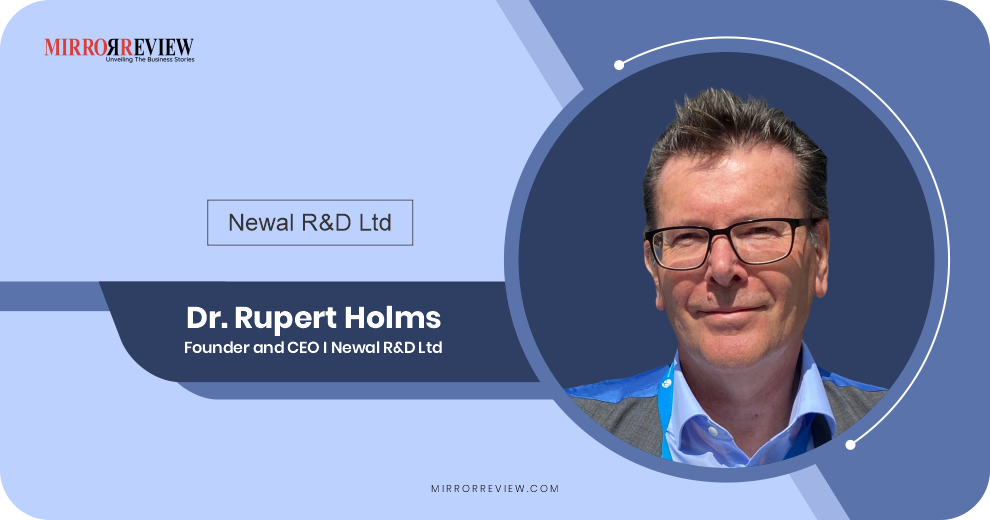
In the early 1990s, Dr. Rupert Holms was that man. He was looking at a protein sequence of the HIV virus, specifically a thirteen-amino acid string that seemed to be the key to how the virus disrupted the human immune system. He had run a database search to see if this viral sequence looked like anything human. The computer spat back an answer: Ezrin.
At the time, Ezrin was a protein so newly discovered that most immunologists had barely heard of it. Yet here was the HIV virus, mimicking this obscure human protein to hijack the body’s defenses. Most scientists would have published a paper and moved on. Dr. Holms did something else. He wondered if he could use that same sequence not to harm the body, but to heal it. He wondered if he could reverse-engineer the virus’s weapon into a shield.
Dr. Holms is not your typical pharmaceutical executive. He does not wear the uniform of the corporate boardroom, nor does he speak in the sanitized, risk-averse dialect of the biotech industry. He is a man who once managed a billion-dollar fund for a Swiss bank and also wrote a book about the solar system originating as a binary star system. He has ten children. He has lived on the fashionable streets of Moscow and the historic lanes of Canterbury. He is a polymath in an age of specialists, a man who views the human immune system not as a mystery to be feared, but as a software program that just needs the right code to reboot.
Today, as the Founder and CEO of Newal R&D Ltd, Dr. Holms is pitching a revolution that is deceptively simple. While the rest of the world chases million-dollar gene therapies and fragile mRNA vaccines, he is betting on peptides—short, stable, affordable chains of amino acids that he has spent thirty years proving can cure infections, heal ulcers, and perhaps even slow the ticking clock of age itself.
The Analyst in the Lab Coat
To understand Dr. Holms’s trajectory, you have to understand that he has never really picked a lane. In the UK school system, you are supposed to be a scientist or an artist, a banker or a biologist. Dr. Holms decided to be all of them.
He began his career in the traditional way for a bright young Brit from Canterbury. He did a gap year in research at Pfizer, got his degree in biochemistry from York, and a PhD in molecular biology. By 1983, he had developed one of the first gene therapy technologies. He was on the fast track to a quiet life in academia.
Then he did something unexpected. He called a Swiss bank.
“Rather than continue a career in academia, I contacted the private Swiss bank Lombard Odier,” Dr. Holms recalls. The bank had just raised a massive global science and tech fund. Dr. Holms suggested, with the pragmatic confidence that defines him, that they might actually need a scientist to understand what they were buying. They hired him on the spot.
For five years, he lived a double life. By day, he was a life science analyst and investment manager in the City of London, designing novel financial mechanisms to fund biotech start-ups. By night, or at least in the parallel processing of his mind, he was still a scientist obsessed with the growing AIDS epidemic.
In 1986, he created HIVER Ltd, a vaccine company. He invested $2 million of his own fund’s profits into it. He recruited the heavyweights: the Medical Research Council, University College London, Cancer UK. He was trying to solve the biggest medical crisis of the 20th century while managing a portfolio of a bank in Monaco.
It worked, until it didn’t. The banking partners eventually pointed out that they seemed to be working for him, rather than the other way around. They parted ways amicably. Then HIVER’s lead antibody vaccine candidate failed in animal trials.
“HIVER was running out of money and with its peptide vaccine project also in trouble, the company could not attract new investment,” Dr. Holms says.
Most people would have gone back to banking. It was safer. It paid better. But Dr. Holms had seen something in the problems with the HIV peptide vaccine. The peptide they tested had been toxic, causing a reaction that looked like graft-versus-host disease. To Dr. Holms, toxicity isn’t just a failure; it is evidence of power. If the peptide could cause that much chaos, it was pushing buttons in the immune system that mattered.
The Discovery of Ezrin
This led to the computer search with Dr. Andrew Coulson in Edinburgh. They found the homology with Ezrin. It was a 70% match. The HIV virus was using a mimic of the human Ezrin protein to confuse the immune system.
Dr. Holms’s hypothesis was radical. If he could synthesize the natural human sequence of Ezrin that the virus was mimicking, perhaps he could induce immunological tolerance. Perhaps he could shut down the pathological process.
He called it HEP-1 (Human Ezrin Peptide 1).
In 1993, the AIDS crisis was at its peak. There were no cocktails, no long-term survival plans. A patient in London, told he had six months to live, pressed Dr. Holms to let him be the first subject.
“I was the human safety test,” Dr. Holms says, noting he took 10mg HEP-1 a day to ensure it wouldn’t kill the patient. It didn’t. In fact, it seemed to stop a cold he was developing and healed his oral ulcers.
The patient took the peptide for 30 days. The results were, in Dr. Holms’s words, “astounding.” The viral load dropped by a factor of 100 to 1000. Opportunistic infections vanished. The patient lived for years.
“It was a great result but we were doing science backwards,” Dr. Holms admits. “We had a safe and effective treatment, but the wrong mechanism.”
It wasn’t tolerance. It was amplification. The peptide wasn’t telling the immune system to stand down; it was telling it to wake up and fight properly.
The Moscow Pivot
In the late 1990s, developing a drug in the UK or the USA required tens of millions of dollars. Dr. Holms had raised $10 million from his banking connections. It was a fortune to a normal person, but pennies to a pharmaceutical company.
So, he went to Russia.
“I decided to develop ezrin peptides in Moscow, because I already had an excellent clinical and scientific network in Moscow,” he explains.
This was the era of the Wild East, but also an era of immense scientific capability in Russia that the West largely ignored. Dr. Holms partnered with Professor Ravshan Ataullakhanov, a brilliant immunologist at the Ministry of Health.
They worked fast. They found that HEP-1 didn’t just suppress HIV; it triggered a cascade of T-cell and B-cell activity. It activated the body’s innate ability to repair tissue. It induced interferons and it was anti-inflammatory.
In 2001, they launched the drug in Russia under the brand name “Gepon.” It was approved for HIV and opportunistic infections. But as they distributed samples to clinics across the vast Russian Federation, reports started coming back that they hadn’t anticipated.
Doctors were using it for everything. Drug-resistant syphilis. Herpes. Candida. Stomach ulcers. Ulcerative Colitis.
“By 2005, it was clear that HEP1 was an effective therapy for all types of drug-resistant sexually transmitted infections caused by viruses, bacteria, fungi, and even protozoans,” Dr. Holms says.
It was a panacea, a word that makes scientists nervous. But the mechanism made sense. The peptide wasn’t attacking the specific bacteria or virus; it was upregulating the body’s own defense mechanism, Ezrin, which acts as a general of the immune army. It was like giving the troops better radios and sharper maps.
The Exile and the Return
Dr. Holms spent decades building a life and a business in Moscow. He became a fixture there, his likeness even appearing in a book celebrating the 125th anniversary of the Gamaleya Institute. His company, Nearmedic, grew to a £120 million turnover.
Then came geopolitics.
“It was clear that the 2014 regime-change coup in Ukraine… would eventually lead to war with Russia,” Dr. Holms observes.
He moved the patents for the next generation of the peptide, RepG3, to Newal R&D in London. In 2021, the pressure on foreign ownership in Russia became intense. His company was acquired in an “uninvited” transaction. Dr. Holms left Moscow in January 2022, six weeks before the tanks rolled into Ukraine.
He returned to London, a pioneer without a portfolio. He had the patents, he had the knowledge, but his infrastructure was gone.
“My first activity was to start a Long COVID volunteer treatment program with ezrin peptide RepG3,” he says.
He found that the peptide worked on COVID just as it had on HIV and ulcers. It treated acute infection and, crucially, helped with Long COVID, a condition that has baffled mainstream medicine.
But raising money in London for a technology that had its roots in Russia, pioneered by a man who didn’t fit the standard mold, proved impossible.
“Our Plan A was to raise up to £5 million… however, it turned out to be an impossible task,” he says.
Undeterred, Dr. Holms self-financed. He brought on Dr. Phillip Hay, a respected NHS consultant, as Chief Medical Officer. They are currently organizing a drug development program at the University of East London. He is rebuilding, brick by brick.
The Peptides vs. The Billionaires
Dr. Holms’ frustration with the current state of biotech is palpable. He sees an industry obsessed with complexity and cost, an industry that serves the shareholders first and the patients second.
“The most stupid comment I get about peptides is that they don’t work because they are degraded,” he says.
He points out that peptides are the body’s natural signaling language. Yes, they break down fast, but that is a feature, not a bug. It means low toxicity.
“RNA is expensive to produce, unstable, and potentially dangerous… Monoclonal antibodies are also unstable; cold storage is required,” he notes.
His vision is democratic. He wants medicine that costs less than £100 per course. He wants treatments that can be stored on a shelf in a clinic in Mumbai or a pharmacy in Manchester.
“Too many life science companies are investing billions in high-tech medicines which cost up to £500,000 per patient,” he notes. “Business success will come from safe and effective, affordable medicine purchased by billions of patients.”
This is the vision at the core of Newal R&D. Dr. Holms is not interested in creating boutique therapy for the 1%. He is interested in public health in its truest sense.
The Binary Star and the Ten Children
If you think Dr. Holms sounds busy, you haven’t heard about his personal life.
“I have a problem with authority: unless the authority is me,” he admits.
He has been self-employed for decades. He works from home, whether that home is overlooking London Zoo or the beaches of the Eastern Mediterranean. And that home is full.
Dr. Holms has ten children.
“I have a treasure of ten children with the help of five mothers,” he says with a candor that is disarming. “Half my children are half-Russian, two are half Serbian, one is half New Zealander, and my oldest son and daughter are 75% Scottish.”
The children range in age from 3 to over 40. It is a chaotic, vibrant, international clan that mirrors his own career. He manages this brood with the same optimistic energy he applies to molecular biology.
And when he isn’t raising children or curing diseases, he is rewriting astrophysics. He has authored two books proposing that our solar system originated as a binary star system. He studies supernova-debris chemistry. He is a YouTuber.
“One PhD is enough,” he jokes about his dabbling in physics.
The Future of Aging
So, what is next for a man who has done everything?
“If we could fund a blue sky R&D budget, I would invest in using peptides to modulate the biological program that controls aging,” he says.
He believes the Generation-4 Ezrin peptides could promote healthy longevity. The same mechanism that repairs ulcers and fights off viruses, the regulation of inflammation and tissue regeneration, is key to slowing the decay of the body.
Dr. Holms is currently raising finance for Newal R&D to bring these products to the international market. He is targeting 2026 for a major push. He knows the regulatory hurdles will be high. He knows the skepticism will be loud. But he has been here before.
“Never give up, be optimistic, be creative, be kind to others,” he says, offering his personal mantra. “And avoid falling backwards into the future.”
Dr. Rupert Holms is a man who seems to be falling forward, tumbling through countries, disciplines, and decades with a momentum that is entirely his own. He is the banker who became a biologist, the Englishman who became a Muscovite, the father of ten who wants to be the father of a new class of medicine. He is betting that the answer to our health isn’t in a billion-dollar machine, but in a tiny chain of amino acids that has been hiding inside us all along. And considering his track record, it would be a brave man who bets against him.
Quote