Mirror Review
January 22, 2026
Buying a first home has become one of the hardest financial milestones for American families. Prices are high, competition is fierce, and in many neighborhoods, buyers are not even competing with other families. They are competing with Wall Street.
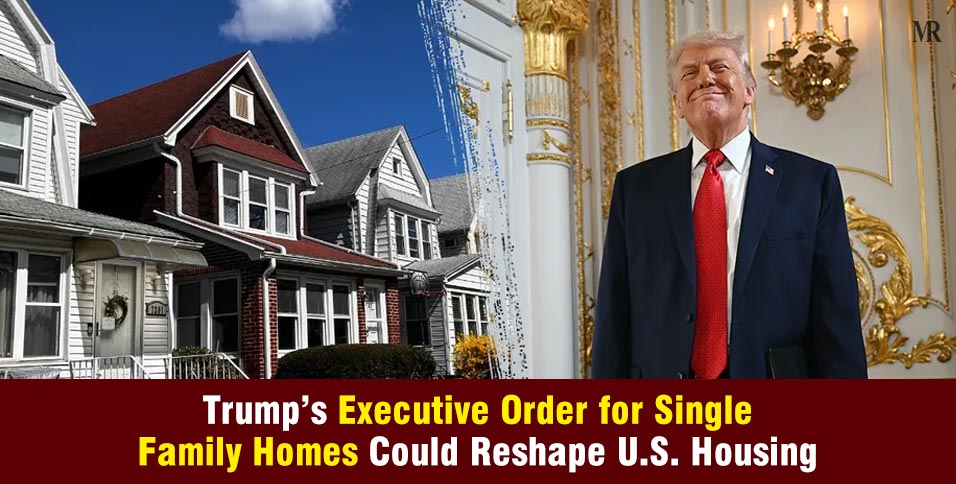
That reality sits at the heart of the Executive Order for single family homes, signed by President Donald Trump on January 20, 2026.
The order targets large institutional investors and limits their ability to purchase single-family homes through federally backed housing programs.
The goal is clear: Put families back at the front of the line.
What the Executive Order for Single-Family Homes Is About
The executive order focuses on a simple idea. Single-family homes should primarily serve people who live in them, not corporations that rent them out at scale.
Over the past decade, institutional investors such as private equity firms and large real estate funds have expanded aggressively into single-family housing. Using deep capital and fast, all-cash offers, these investors often outbid first-time buyers.
The new executive order aims to slow that trend by cutting off federal support that helps these investors acquire homes.
Why This Issue Became Urgent
Housing affordability has weakened sharply in recent years.
Key pressures include:
- High mortgage rates
- Limited housing supply
- Investor-driven competition in entry-level homes
According to housing data frequently cited by policymakers, institutional buyers have concentrated purchases in fast-growing metro areas, reducing inventory for owner-occupants and pushing prices higher.
President Trump framed the issue bluntly, stating, “People live in homes, not corporations.”
What the Order Directs Federal Agencies to Do
The executive order does not ban investors outright. Instead, it reshapes how federal housing programs interact with large institutional buyers.
Key actions include:
- Restricting federal facilitation
Agencies such as HUD, the VA, USDA, and the Federal Housing Finance Agency must stop approving, insuring, guaranteeing, or securitizing single-family home purchases by large institutional investors when families could buy those homes instead.
- Prioritizing individual buyers
Federal programs are directed to promote first-look policies. These policies give owner-occupants a chance to buy foreclosed or government-owned homes before investors enter the market.
- Increasing transparency
Owners of single-family rentals that participate in federal housing assistance programs must disclose who ultimately owns and controls those properties.
- Reviewing anti-competitive behavior
The Department of Justice and the Federal Trade Commission will review large acquisitions for signs of price coordination, artificial vacancies, or other anti-competitive practices.
What Counts as a Large Institutional Investor
The order does not immediately define this term. Instead, it directs the Treasury Department to develop formal definitions within 30 days.
However, policy language suggests the focus will be on:
- Large-scale investors with multiple properties
- Firms using pooled capital or corporate structures
- Entities that operate across multiple markets
Small landlords and individual real estate investors are unlikely to fall under the strictest restrictions.
What the Executive Order for Single Family Does Not Do
Despite strong language, the executive order includes clear limits.
It does not:
- Force investors to sell homes they already own
- Ban all rental housing investment
- Restrict build-to-rent communities that were designed and approved as rentals from the start
This distinction matters. The administration is targeting competition for starter homes, not rental housing as a whole.
How This Could Change the Housing Market
The Executive order for single family homes could influence the market in several ways.
Likely short-term effects:
- Reduced investor bidding on federally linked properties
- More inventory available to owner-occupants
- Slightly less price pressure in investor-heavy neighborhoods
Longer-term outcomes depend on enforcement and legislation. The order instructs the White House to prepare a bill that would codify these policies into law, making them harder to reverse.
If Congress acts, the shift could become structural rather than symbolic.
Political and Economic Context
The housing order fits into a broader economic narrative pushed by the administration.
President Trump has linked housing affordability to:
- Inflation during the previous administration
- Rising interest rates
- Regulatory burdens in housing finance
Alongside the order, Trump has directed Fannie Mae and Freddie Mac to purchase $200 billion in mortgage-backed securities, a move designed to lower borrowing costs.
Supporters argue these combined actions favor first-time buyers. Critics warn that limiting institutional capital could reduce rental supply in some markets.
What Comes Next
Implementation will matter more than headlines.
Agencies have:
- 30 days to define key terms
- 60 days to issue formal guidance
- Ongoing responsibility to monitor compliance
Enforcement by antitrust authorities will also signal how serious the administration is about reshaping investor behavior.
Final Take
The Executive order for single family homes marks one of the strongest federal efforts in years to curb Wall Street’s role in the single-family housing market.
It does not promise instant affordability. But it shifts federal policy toward families, transparency, and owner-occupancy.
Whether it becomes a lasting fix or a political statement will depend on follow-through, enforcement, and Congress. For now, the message is clear. In the fight for America’s starter homes, the federal government is choosing sides.
Maria Isabel Rodrigues