Mirror Review
January 12, 2026
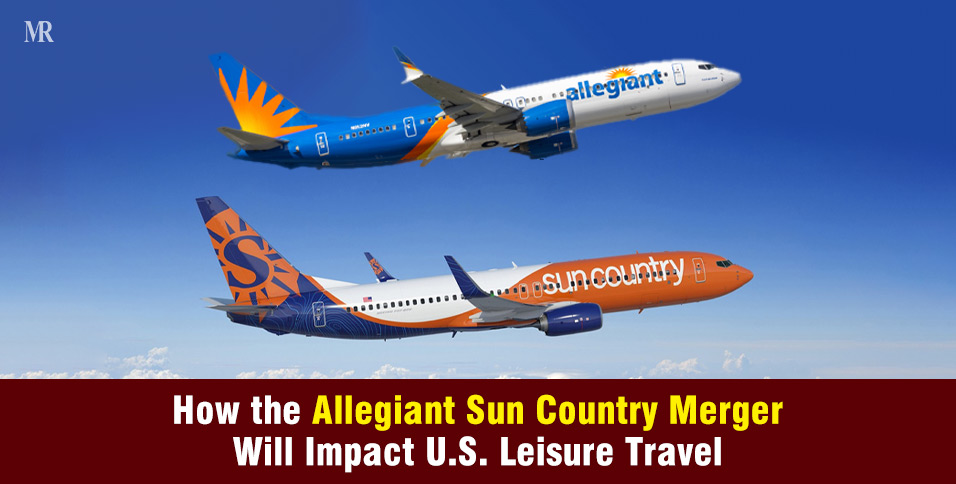
On January 11, 2026, Allegiant Travel Company and Sun Country Airlines announced a definitive merger agreement valued at approximately $1.5 billion. This deal aims to create a premier, leisure-focused U.S. airline by integrating
- Allegiant’s strength in small and mid-sized cities
- Sun Country’s passenger, charter, and cargo operations
The Allegiant Sun Country merger is expected to close in the second half of 2026, pending regulatory and shareholder approvals.
It will ultimately operate under the Allegiant brand with headquarters remaining in Las Vegas.
Why The Allegiant Sun Country Merger Matters
For decades, the U.S. airline industry has been dominated by the “Big Four” airlines: American, Delta, United, and Southwest.
But the Allegiant Sun Country merger signals something different: the rise of a leisure-first airline focused on vacation travelers, not business flyers.
Together, the airlines will offer more than 650 routes across:
- The United States
- Mexico
- Central America
- Canada
- The Caribbean
Their focus is on point-to-point travel, which means flying directly from one city to another without stopping at a major hub like Chicago or Atlanta.
For travelers in smaller cities, this means more opportunities to fly from their local airport straight to a beach or a theme park.
New Direct Routes and Cities
One of the biggest benefits of the Allegiant Sun Country merger is a major expansion of nonstop flights starting in early 2026.
Allegiant airlines has announced entry into four new markets:
| New Market | Major Connection Points | Launch Date |
| Philadelphia, Pennsylvania | Des Moines, Knoxville, Grand Rapids | May 2026 |
| Trenton, New Jersey | Fort Lauderdale, Punta Gorda, St. Pete | Feb 2026 |
| Columbia, Missouri | Orlando-Sanford, Destin–Fort Walton | June 2026 |
| La Crosse, Wisconsin | Mesa (Phoenix), Orlando-Sanford | Feb / May 2026 |
This “underserved” strategy of flying to cities that the bigger airlines often ignore is a cornerstone of the Allegiant Sun Country airlines merger.
By the time the deal is finalized, the combined airline will serve nearly 175 cities, turning once-difficult travel days into simple, two-hour direct hops.
How the Business Model Works
To understand why the Allegiant Sun Country airlines merger is happening, we need to look at how these companies make money
Both airlines follow the Ultra-Low-Cost Carrier (ULCC) model. This means:
- Very low base fares
- Extra charges for add-ons like checked bags, seat selection, and food
What Each Airline Brings
- Allegiant air has perfected the art of “low utilization.” Unlike major airlines that try to keep their planes in the air 12 hours a day, Allegiant often lets its planes sit idle during the middle of the week when demand is low. They only fly when they know they can fill the seats.
- Sun Country adds a unique twist to this: they have a massive cargo contract with Amazon. When people aren’t flying to Florida in the autumn, those same pilots and planes can be used to move packages.
Thus, the Allegiant Sun Country merger combines these two approaches, creating a business that can stay profitable even during economic uncertainties.
What This Means for Ticket Prices
The most common traveler question is simple: Will fares go up?
Short Answer: Probably not.
- The two airlines have almost no overlapping routes, so competition on existing flights is not reduced.
- The companies expect to save about $140 million per year by sharing maintenance, buying fuel in bulk, and streamlining operations.
These savings, often called synergies, can help keep fares low even as costs rise.
Loyalty Programs and Rewards
The merger will also combine loyalty programs:
- Allegiant: 21 million members
- Sun Country: 2 million members
For travelers, this means:
- More ways to earn points
- More destinations to use rewards, including Cancún, Aruba, and other vacation hotspots
Regulatory Approval: What’s Still Pending
Even though both companies have agreed to the deal, the merger must still be approved by the U.S. Department of Justice (DOJ).
Regulators will review the deal to ensure it does not reduce competition or create monopoly power. Industry experts believe approval is likely because:
- Allegiant and Sun Country serve smaller markets
- The merger increases competition against larger airlines
If approved, the airlines expect to receive a single operating certificate by late 2026.
The Future of Leisure Travel
Looking ahead, the Allegiant Sun Country merger represents a bet on the “vacationer.” While business travel has struggled to return to pre-pandemic levels, the desire for “leisure” travel is higher than ever.
Key future highlights:
- A combined fleet of nearly 200 aircraft
- Transition to Boeing 737 MAX planes, which are more fuel-efficient
- Better international access for travelers outside major metro areas
By 2027, this merger could significantly change how Americans plan affordable vacations.
Final Takeaway
The Allegiant Airlines and Sun Country merger promises more nonstop routes, lower fares, and better access to vacation destinations, especially for travelers flying from smaller cities.
For budget-conscious flyers, the future of leisure travel just got more exciting.
Maria Isabel Rodrigues