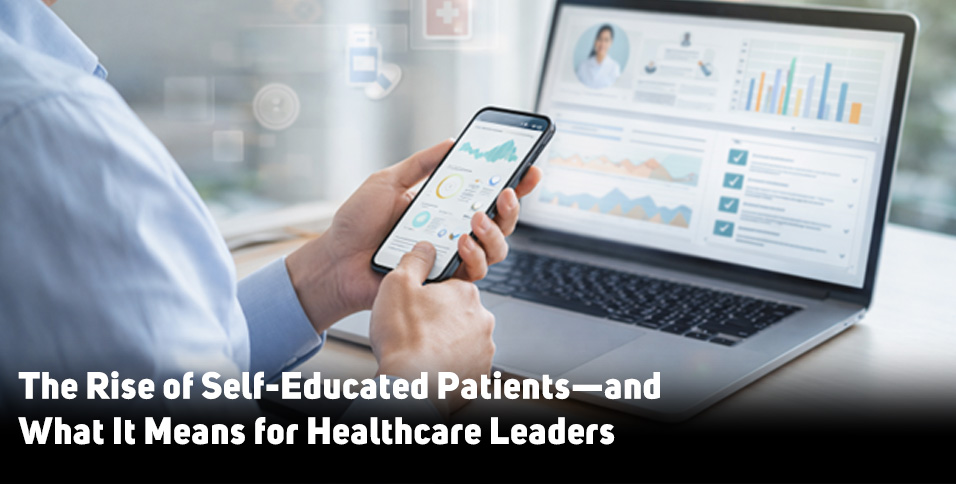
A quiet shift is underway in healthcare, and it’s not being driven by hospitals, insurers, or regulators. It’s being driven by patients.
Not passive patients. Not “Google-it-and-panic” patients. But self-educated patients, people who actively learn, track, question, and manage their health long before they enter a clinic.
For healthcare leaders, this shift is both a warning and an opportunity. Ignore it, and systems will continue to lag behind reality. Embrace it, and healthcare may finally move from reactive sick care to proactive health stewardship.
Patients Are No Longer Waiting to Be Told
Historically, healthcare operated on an information imbalance. Physicians knew. Patients complied. Education was minimal, episodic, and delivered only when something went wrong.
That model is breaking.
Today’s patients:
- Track sleep, diet, activity, stress, and symptoms daily
- Consume long-form health content, not just headlines
- Compare protocols, outcomes, and philosophies
- Expect explanations, not instructions
This isn’t about people trying to replace doctors. It’s about people refusing to remain uninformed participants in their own health.
Technology didn’t create this shift, it accelerated it. Smartphones, wearables, and digital platforms gave individuals access to tools once reserved for institutions. What followed was inevitable: patients started learning faster than systems could adapt
Why Traditional Healthcare Is Struggling to Respond
Healthcare systems are optimized for acute events:
- Diagnosis
- Intervention
- Billing
- Discharge
Education is treated as an afterthought. Prevention is discussed but rarely operationalized. Lifestyle guidance is acknowledged but poorly supported.
Self-educated patients expose this weakness.
They ask better questions:
- “Why is this happening?”
- “What changes before medication becomes necessary?”
- “What can I do daily to influence trajectory?”
Most systems aren’t built to answer those questions, because they exist outside the billing cycle.
For leadership, this creates tension. An informed patient doesn’t fit neatly into a 10-minute visit or a standardized pathway. But ignoring them isn’t an option either.
Health Literacy Is Becoming Infrastructure
The next phase of healthcare won’t be defined by more data alone. It will be defined by who understands and uses that data effectively.
Self-education turns health literacy into infrastructure:
- Knowledge becomes a daily operating system
- Behavior change becomes incremental, not crisis-driven
- Intervention shifts earlier, when it’s cheaper and more effective
This is where modern platforms matter. CureNatural’s ayurveda app, for example, doesn’t just deliver recommendations, it teaches users how to observe patterns, recognize imbalance, and understand cause-and-effect relationships in their own bodies.
Likewise, CureNatural’s structured ayurveda classes transform ancient principles into practical frameworks for modern life, helping users build intuition alongside information, and understand their bodies better.
The point isn’t tradition versus technology. It’s education at scale, delivered continuously rather than episodically.
Why Leaders Should Pay Attention Now
Self-educated patients change the economics of healthcare.
They:
- Delay or avoid preventable conditions
- Reduce unnecessary utilization
- Engage more meaningfully when care is needed
- Expect transparency and partnership
For healthcare leaders, this forces a strategic question: Are we building systems that react to disease, or systems that support informed humans?
Organizations that cling to the old hierarchy, where knowledge flows one way, will face growing friction. Those that invest in education-first models will find patients becoming allies rather than adversaries
The Leadership Shift: From Authority to Stewardship
The rise of self-educated patients requires a mindset shift at the top.
Leadership is no longer about controlling information. It’s about:
- Curating credible frameworks
- Enabling early awareness
- Supporting long-term behavior change
- Integrating human insight with digital tools
This doesn’t weaken clinical authority, it strengthens it. An educated patient who understands context is more likely to comply, persist, and trust.
The future clinician is not just a diagnostician, but a guide within a broader learning ecosystem.
Education Is the Missing Multiplier
Healthcare has spent decades chasing better algorithms, better devices, and better drugs. All matter. But without education, their impact remains limited.
Self-educated patients multiply the effectiveness of every intervention:
- Medications are used more appropriately
- Lifestyle changes stick
- Early signals are acted on
- Outcomes improve upstream
This is why education platforms, especially those that blend systems thinking with daily practicality, are emerging as quiet power players in health innovation.
Looking Ahead
The rise of self-educated patients is not a trend. It’s a structural shift.
Patients are no longer waiting to be fixed. They are learning how to stay well.
For healthcare leaders, the question is no longer whether this shift will continue. It’s whether leadership will evolve fast enough to meet it.
Those who do will help build a system that finally aligns technology, education, and human behavior. Those who don’t will find themselves managing disease in a world that has already moved on.