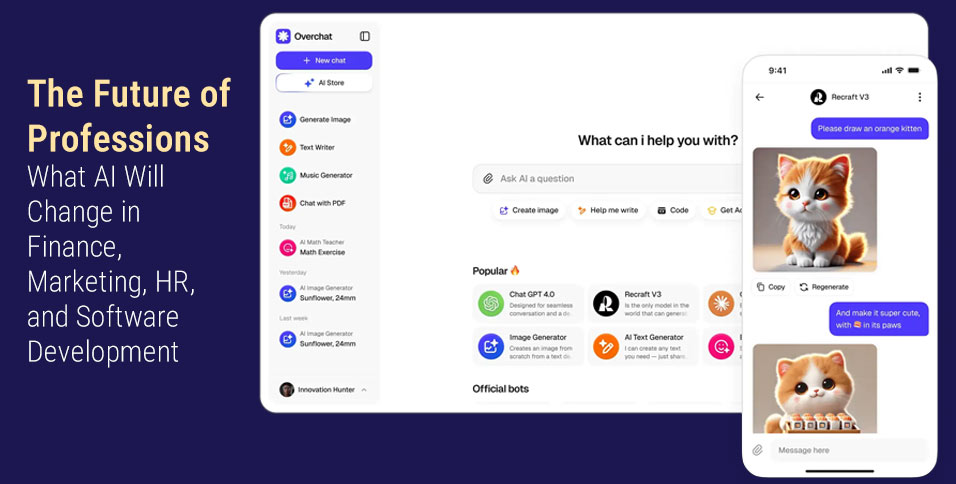
Artificial intelligence is no longer a future concept—it is a practical layer being embedded into everyday work. The real story is not “AI replacing jobs,” but AI reshaping tasks inside jobs: what humans do less of, what they do more of, and what new responsibilities appear. This distinction matters because labor markets rarely collapse in one wave; they evolve through task substitution, task augmentation, and role redesign.
Major institutions now quantify the scope of this shift. The IMF estimates that about 40% of global employment is exposed to AI, with advanced economies seeing closer to 60% exposure because more work involves cognitive tasks. Meanwhile, Goldman Sachs’ analysis suggests generative AI could expose the equivalent of 300 million full-time jobs globally to automation of some tasks, not necessarily full replacement. The World Economic Forum’s “Future of Jobs” research emphasizes simultaneous displacement and creation: roles will be reshaped as technology adoption changes business models and skill needs.
This article focuses on four professional domains—finance, marketing, HR, and software development—because they combine high volumes of digital work, repeatable patterns, and measurable outputs. In each domain, we’ll examine:
- Which tasks AI will automate first
- Which tasks become more valuable
- Which new roles emerge
- How professionals can stay ahead
The Big Shift: From Job Titles to Task Bundles
Historically, professions changed when tools changed the economics of work (spreadsheets, CRMs, cloud computing). AI goes further because it can operate on language, code, images, and structured data. That means it can assist with tasks that were previously “human-only,” such as summarizing complex information, generating first drafts, or proposing options.
How AI Reshapes Finance: From Manual Reporting to Intelligent Decision Support
Finance is an ideal AI use case because it sits on top of structured data, repeated processes, and strict deadlines. AI will reduce time spent on data preparation and narrative reporting, while increasing emphasis on judgment, governance, and scenario thinking.
Tasks AI Will Automate or Accelerate
- Reconciliation and anomaly detection
AI systems excel at pattern recognition across large transaction datasets, flagging outliers faster than manual sampling. - Invoice processing and expense auditing
Document AI can extract fields, categorize spend, and identify policy exceptions. - First-draft management reporting
AI can generate narrative explanations (“What changed and why?”) once the data model is clean. - Forecasting with multiple scenarios
AI can rapidly simulate demand, cost, pricing, and risk assumptions—useful for rolling forecasts.
What Becomes More Valuable for Finance Professionals
- Model governance and accountability (knowing what the AI assumed and where it fails)
- Risk management and compliance (especially in regulated environments)
- Strategic finance (capital allocation, pricing strategy, unit economics)
- Stakeholder communication (explaining uncertainty clearly to leadership)
New Finance Roles Emerging
- AI finance analyst (designing prompts/workflows, validating outputs)
- Model risk and controls specialist (similar to credit model governance, but broader)
- FP&A scenario architect (building scenario libraries tied to business levers)
Expert comment: The finance teams that win will treat AI as a decision intelligence layer—but they’ll keep humans accountable for every number that reaches the board.
How AI Changes Marketing: From Content Volume to Personalization and Experimentation
Marketing is already being disrupted because AI can generate content at scale. But the biggest impact won’t be “more posts.” It will be faster experimentation, better segmentation, and higher-precision creative iteration—while raising the bar for authenticity and brand coherence.
McKinsey estimates generative AI could add $2.6–$4.4 trillion in annual value across industries, and many high-impact use cases sit in marketing and sales: content creation, customer operations, and sales enablement.
Tasks AI Will Automate or Expand
- Content drafting and localization
AI can generate first drafts for ads, landing pages, emails, and translations, reducing cycle time dramatically. - Creative variation at scale
Marketers can test dozens of headlines, offers, and angles quickly—then use performance data to refine. - Audience segmentation and predictive targeting
AI improves the ability to identify micro-segments and predict conversion likelihood. - Marketing analytics and insight synthesis
Instead of manually building reports, teams can ask: “What drove conversion changes last week?” and get structured answers.
What Becomes More Valuable in Marketing
- Brand strategy and creative direction (AI produces options; humans choose what fits the brand)
- Experiment design (knowing what to test and why)
- Data literacy and attribution understanding
- Trust, community, and authenticity (AI content is easy to create; credibility is hard to earn)
New Marketing Roles Emerging
- Prompt-to-performance strategist (turning brand guidelines into repeatable prompt systems)
- AI creative producer (managing generation pipelines + human review)
- Marketing AI governance lead (copyright, disclosure, data use policies)
Expert comment: AI will commoditize “average content.” Competitive advantage shifts to taste, positioning, and iterative learning speed.
The Midpoint Reality: AI Literacy Becomes a Baseline Skill
In every professional domain, AI adoption is accelerating—yet usage quality varies widely. Many companies now expect employees to use AI tools as part of normal work, similar to how spreadsheets became mandatory decades ago.
That’s why professionals increasingly maintain a “tool belt” of assistants for drafting, summarizing, and analysis—sometimes testing different interfaces just to understand strengths and limitations. You might even see people compare solutions like Free Overchat AI Chat alongside other chat-style tools during internal evaluations—not as a replacement for expertise, but as a way to benchmark speed, accuracy, and workflow fit across tasks such as summarization, brainstorming, and first drafts.
How AI Reshapes HR: From Administrative Work to Talent Intelligence
HR work involves high volumes of repetitive processes (screening, scheduling, document handling) and high-stakes decisions (hiring fairness, compliance, culture). AI will automate administrative tasks, but HR will become more strategic—focused on workforce design, skills planning, and retention systems.
Tasks AI Will Automate or Assist
- Resume parsing and candidate shortlisting
AI can match applicants to job requirements, but must be monitored for bias and false negatives. - Employee support and knowledge access
HR chatbots can answer policy questions, explain benefits, and guide employees through processes. - Skills inventory and internal mobility
AI can map skills across the company and recommend training or internal moves. - Performance feedback synthesis
AI can summarize multi-source feedback, highlight patterns, and propose coaching themes.
What Becomes More Valuable in HR
- Workforce planning and talent strategy
- Change management (AI-driven transformation causes role redesign and anxiety)
- Ethics, bias mitigation, and compliance
- Culture building and leadership development
New HR Roles Emerging
- Workforce intelligence analyst (skills mapping, scenario planning)
- AI policy and governance partner (fairness, transparency, audit trails)
- Learning experience architect (AI-personalized training pathways)
Expert comment: HR will become the “operating system” for AI-era work—because reskilling and redeployment determine whether AI boosts productivity or creates disruption.
How AI Transforms Software Development: From Coding to Systems Thinking
Software development is already one of the most AI-augmented professions. AI copilots can generate code snippets, tests, refactorings, and documentation. But as coding becomes faster, the bottleneck shifts to requirements clarity, architecture, security, and integration.
Tasks AI Will Automate or Accelerate
- Boilerplate code and scaffolding
AI can generate standard components, APIs, and configuration quickly. - Unit tests and test data creation
Developers can ask for coverage based on function behavior, saving hours. - Bug triage and log analysis
AI can summarize crash patterns and propose likely root causes. - Documentation and code explanation
AI assists with internal knowledge transfer and reduces onboarding time.
What Becomes More Valuable for Developers
- Architecture and system design (trade-offs and scalability)
- Security engineering (AI can generate insecure code if not guided)
- Product thinking (building the right thing, not just building quickly)
- Code review and governance (quality standards and maintainability)
New Development Roles Emerging
- AI-assisted development lead (workflow and tooling strategy across teams)
- Prompt and policy engineer for codebases (rules, guardrails, style compliance)
- AI QA specialist (testing AI-generated changes at scale)
Expert comment: AI will not eliminate engineers—but it will raise expectations. Teams that once shipped monthly may be expected to ship weekly. The competitive edge moves to system-level competence.
Cross-Industry Facts: Who Is Most Exposed—and Why
The IMF highlights a critical pattern: AI exposure is higher in advanced economies because more work is cognitive and digital, and AI interacts strongly with those tasks. Exposure does not automatically mean displacement; it often means augmentation. But the distribution matters: groups with higher exposure can gain productivity benefits—if they have access, training, and supportive organizational redesign.
Expert Comment: Productivity Gains Require Redeployment
The key variable isn’t “how good AI is.” It’s whether institutions can redeploy people to higher-value tasks. Research and policy commentary repeatedly stress that productivity gains do not automatically translate into broad prosperity without reskilling pathways and organizational change.
The Skills That Will Matter Most (Across Finance, Marketing, HR, Dev)
AI changes skill demand in a consistent pattern: technical execution becomes easier; judgment and accountability become more important.
The “AI-Proof” Skill Stack
- Problem framing: turning vague goals into precise questions
- Verification: checking outputs against data, policy, and reality
- Domain expertise: knowing what “good” looks like
- Ethics and governance: fairness, privacy, security, compliance
- Systems thinking: understanding second-order effects
- Communication: explaining uncertainty and trade-offs
- Experimentation: rapid learning loops and measurement
Expert comment: In the AI era, the premium is on people who can own outcomes, not just produce outputs.
What Leaders Should Do Now: A Practical Playbook
If you manage a team in finance, marketing, HR, or engineering, your job is to make AI adoption productive and safe.
A 90-Day Implementation Framework
- Pick 3 workflows with measurable ROI (e.g., reporting, content testing, screening, test generation)
- Define “human-in-the-loop” checkpoints (where validation is mandatory)
- Create a model usage policy (data sensitivity, prohibited use cases, disclosure rules)
- Train for prompting + verification (prompting alone is not enough)
- Instrument quality metrics (accuracy, cycle time, error rate)
- Redesign roles so time saved becomes value created (not idle capacity)
What Not to Do
- Don’t deploy AI without governance in HR and finance
- Don’t measure adoption by “number of users” only—measure impact and error rates
- Don’t assume employees will self-train; structured learning is required
- Don’t confuse content volume with marketing effectiveness
Conclusion: Professions Will Evolve—But Human Responsibility Remains
AI will reshape finance, marketing, HR, and software development by automating repetitive tasks and amplifying human capability. The net result will be:
- fewer hours on routine production
- more emphasis on decision-making, governance, and strategy
- new roles focused on AI orchestration and accountability
- higher expectations for speed and quality
The future belongs to professionals who treat AI as a collaborator—but remain the final owners of truth, ethics, and outcomes. And for organizations, the winners will be those who redesign work intentionally, invest in skills, and align AI adoption with measurable value.