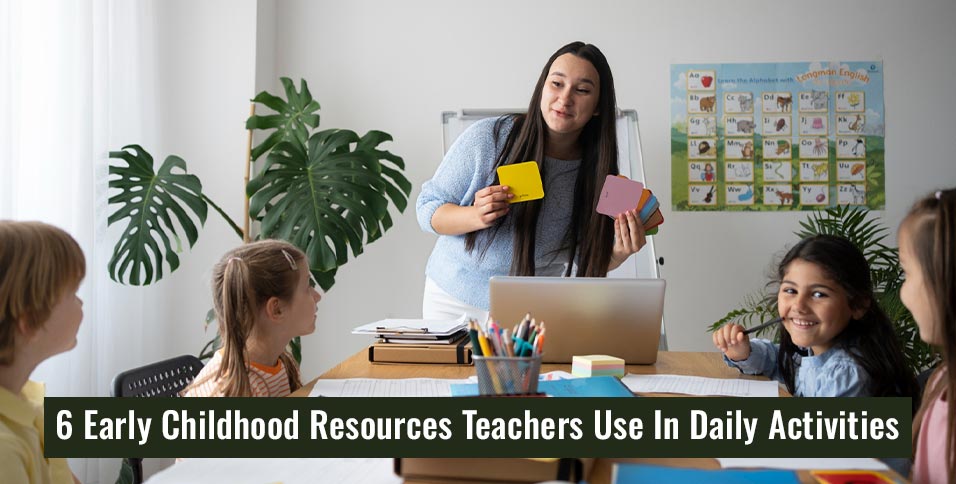
Teachers in preschool use different equipment to create rich, stimulating, appropriate, and varied levels of educational opportunities. These resources are designed to help kids with activities and have fun learning.
To understand what makes a preschool learning environment balanced and complete, take a closer look at six teaching resources preschool educators use every day.
1. Educational Picture Books for Language Development
New and young readers can look at a different and brightly illustrated world of creatures in stories. Simple and repetitive texts build on listening and storytelling. They are great for educators to capture students’ attention and help them learn new ideas.
Books also help kids with social and emotional development. They support kids to recognise and understand different feelings in themselves and other people. It is common for many teachers to use educational books that are connected to the learning of the week.
2. Sensory Play Materials for Hands-On Learning
Such sensory resources as sand trays, water tubs, and texture bins provide opportunities for children to learn by touching and exploring. They are particularly helpful for fine motor skills, attention, and imagination. They also provide an opportunity for children to use their senses in a purposeful manner.
Teachers make simple sensory centres that individual children can independently participate in. They use materials in rotation to keep the experience fresh and captivating. Some teachers search through early childhood resources bins looking for resources that will make a useful sensory bin for the day.
3. Art Supplies for Creative Expression
With crayons, paint, glue sticks, and coloured paper, children can express themselves the way they see fit. Through art activities, children experience colours, shapes, and textures. They also enhance fine motor skills that are vital for early writing.
Art time can also be confidence-building. For kids, there’s nothing like getting praised for something they’ve made and then sharing it with others. Teachers sometimes showcase art in honour of their personal accomplishments.
4. Manipulatives for Early Maths and Problem-Solving
Blocks, puzzles, and pattern tiles are excellent manipulatives to teach early math skills to your child. With these hands-on tools, children are better able to understand abstract concepts, learn pattern recognition, and develop problem-solving skills.
Educators often embed suitable manipulatives in designed activities and opportunities for free play. Such activities help develop spatial awareness and enhance logical reasoning. With so many resources available, there is something that every child will find fascinating.
5. Music and Movement Tools for Active Play
Toys, such as tambourines, maracas, or rhythm sticks, can make music fun in your classroom. Music aids memory, coordination and emotion. Kids may also burn off their energy in a fun, productive way by singing and dancing.
Gross motor skills and movement are critical to the developing child. Scarves, mats or hoops can also be used to impart extra zest for teachers. These play instruments add fun for children and enable each child to exercise easily.
6. Visual Schedules and Learning Charts for Routine Building
Basic pictures and words help a child move through the various parts of the day, including morning gathering time, snack or meal times, and outdoor playtime. Structures like this foster independence and guard against the overwhelm that can plague younger learners at times.
In schools, learning charts are still used as reference materials for the young. Some alphabet posters, counting charts and weather boards expose children to their environment and the world around them. They are a framework for incremental learning.
Build Meaningful Learning With the Right Resources
The right tools allow for richer lessons that are memorable and developmentally appropriate for children. Incorporation of elements such as sense experience, creative expression, movement, and rhythmic structure allows for a thorough early childhood education. Smart, simple, and fun details are the hallmark of learning when you’re little.