Mirror Review
December 22, 2025
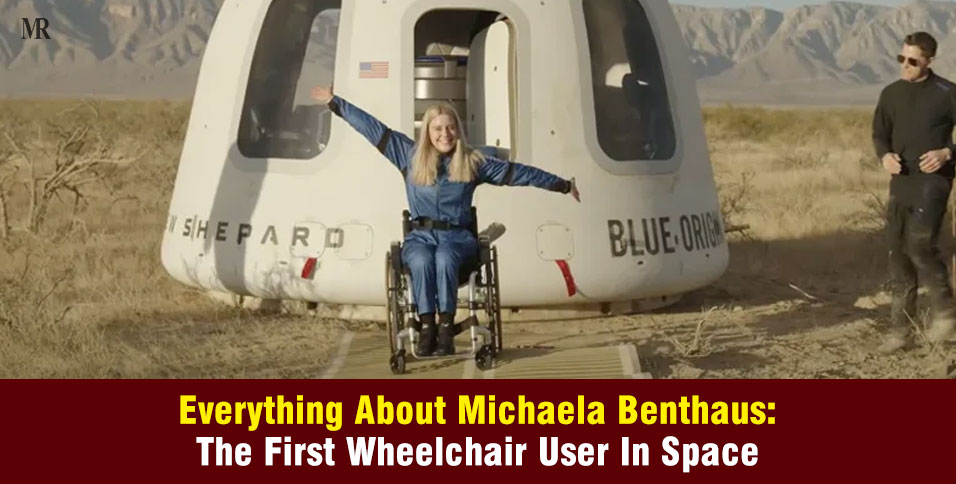
Michaela Benthaus, a 33-year-old German aerospace engineer, became the first wheelchair user to travel beyond the Kármán line, the internationally recognized boundary of space.
This mission was not just a flight for six individuals. It served as a proof of concept that physical disability is no longer an insurmountable barrier to exploring space.
Michaela Benthaus currently works at the European Space Agency as a Young Graduate Trainee, focusing on Mars Radio Occultation. Her journey to space was made possible through a collaboration with retired SpaceX executive Hans Koenigsmann and Jeff Bezos’ space tourism company, Blue Origin.
By reaching an altitude of over 65 miles, she and her crew experienced several minutes of weightlessness, effectively opening a new chapter in the push for global inclusivity.
Michaela Benthaus enjoyed the sensation of weightlessness, even attempting to turn herself upside down.
Here’s everything you need to know about Michaela Benthaus and her milestone as the first wheelchair user in space.
Academic And Professional Background Of Michaela Benthaus
| Organization | Role | Duration | Focus Area |
| European Space Agency (ESA) | Young Graduate Trainee | 2024 to Present | Mars Radio Occultation |
| Max Planck Institute | Working Student | 2023 to 2024 | Extraterrestrial Physics |
| German Aerospace Center (DLR) | Intern | 2022 | Space Flight Dynamics |
| Technical University of Munich | M.Sc. Student | 2020 to 2024 | Aerospace Engineering |
| Linz Center of Mechatronics | Working Student | 2016 to 2021 | Mechatronics |
| Johannes Kepler University | B.Sc. Student | 2016 to 2021 | Robotics and Automation |
Michaela Benthaus Life Changing Injury
The life of Michaela Benthaus took a dramatic turn in September 2018.
At twenty-six years old, she was a very active person who loved parkour, snowboarding, and mountain biking.
Unfortunately, while riding her mountain bike in Austria, she suffered a severe accident that led to a spinal cord injury. The crash resulted in a spinal fracture, which rendered her paraplegic.
Since that day, she has relied on a wheelchair for mobility.
Despite this profound physical challenge, she did not abandon her goals. She noted that while her physical situation changed, her mind and her passions remained the same.
The injury actually strengthened her resolve to work in the aerospace field and advocate for inclusion.
She often mentions that after her accident, she realized how inaccessible the world can be for people with disabilities.
This realization fueled her dedication to ensuring that space, the ultimate frontier, would not remain closed to individuals with mobility limitations.
Her Research On Accessibility In Microgravity
Before her historic spaceflight as the first wheelchair user in space, Michaela Benthaus spent years preparing and conducting research on accessibility in microgravity.
- In December 2022, she participated in a parabolic flight in Houston. These flights follow a path that creates short bursts of weightlessness, often called parabolas. She completed eighteen such parabolas, testing how a wheelchair user can anchor themselves and move safely without gravity. This research was part of the AstroAccess project, which aims to bring people with disabilities into the design phase of space missions.
- In April 2024, she took another step forward by serving as the mission commander for an analog mission in Poland. For two weeks, she lived and worked at the Lunares Research Station, a facility designed to simulate conditions on the Moon or Mars. The station is specifically designed to be wheelchair accessible, allowing her to test operational procedures in a confined, high-stress environment.
These experiences provided the technical foundation that convinced her and others that a suborbital spaceflight can be a viable scientific achievement.
The Collaboration That Launched Michaela Benthaus
The opportunity to fly on a Blue Origin rocket and become the first wheelchair user in space grew from a simple online conversation. Michaela Benthaus contacted Hans Koenigsmann, a former executive at SpaceX, through LinkedIn. She asked him if he thought someone with a spinal cord injury could realistically become an astronaut.
Koenigsmann, who is also a German engineer, was inspired by her drive and her professional background. He decided to help organize the flight and worked closely with Blue Origin to see if their systems could accommodate her needs.
Hans Koenigsmann joined the mission as a crewmate and served as her emergency helper during the flight. Blue Origin responded to the request with enthusiasm, stating that their New Shepard vehicle was already designed with broad accessibility in mind.
This partnership between two experts in the field proved that the commercial space industry can be a powerful engine for social progress. They even used the mission to raise funds for the Wings for Life Foundation, which supports research into curing spinal cord injuries.
Universal Design And Hardware Modifications Of The NS-37 Mission
The NS-37 mission took off from Van Horn, Texas, following a short delay caused by technical checks and high winds.
One of the most impressive feats of the NS-37 mission was that the rocket required very few modifications to accommodate a wheelchair user.
Blue Origin engineers designed the New Shepard with universal design principles from the start.
For example,
- The launch tower already featured an elevator to reach the crew capsule, which is seven stories high. This removes the need for astronauts to climb stairs or ladders to reach the hatch.
- To help Michaela Benthaus move into the capsule, Blue Origin added a simple patient transfer board. This board allowed her to scoot from her wheelchair directly into her seat independently.
- During the flight, her legs were strapped together to prevent them from floating in the way of other passengers.
- After the landing, the recovery team unrolled a carpet on the sand so she could immediately access her wheelchair.
These small changes demonstrate that making space accessible does not require a complete redesign of the vehicle.
The Mission Patch: A Hippo And A Tennis Ball
The NS-37 mission patch was designed to tell the story of the crew and their commitment to accessibility. The patch has a hexagonal shape with several icons representing each member.
For the first wheelchair user in space, Michaela Benthaus, the patch featured a hippo and a tennis ball.
The hippo represents a plush toy that comforted her in the hospital after her accident, and the tennis ball symbolizes her passion for wheelchair tennis.
These symbols highlight the human side of space exploration, reminding us that every mission is driven by personal stories and dreams.
Conclusion
The historic flight of Michaela Benthaus has permanently changed our perception of who can travel to space.
As an aerospace engineer at the European Space Agency and the world’s first wheelchair user in space, she has demonstrated that physical limitations do not define human potential.
Her mission with Blue Origin proved that with minor adjustments and a commitment to universal design, the stars are within reach for everyone.
She often reminds us to never give up on our dreams, no matter how low the probability of success may seem.
Maria Isabel Rodrigues