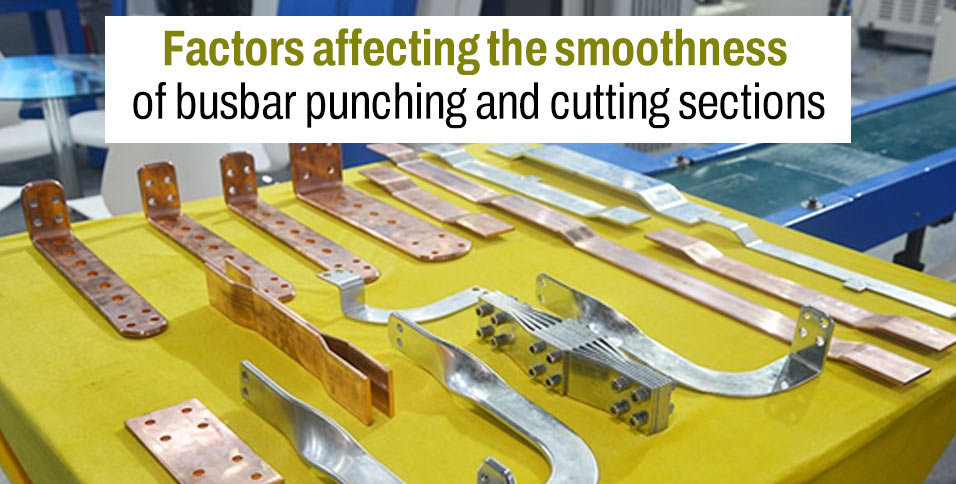
In power system and electrical equipment manufacturing, busbars, as core components for current transmission, directly affect the safe and stable operation of equipment due to their processing quality. Busbar punching and cutting are two critical processing steps, and the smoothness of the cross-section is a core indicator of processing quality—a rough cross-section not only increases current transmission resistance and causes localized heating, but may also damage insulation components during installation and even become a potential source of circuit faults. So, what factors affect the smoothness of the cross-section after busbar punching and cutting?
I. Busbar Intrinsic Characteristics
The material and performance of the busbar are inherent conditions determining the smoothness of the processed cross-section. Differences in the physical properties of different materials directly lead to different processing results. Common busbar materials include copper, aluminum, and copper-aluminum composites. Copper busbars are widely used due to their good conductivity and high strength, but their high hardness also places higher demands on processing tools. When selecting material for an electrical distribution application, understanding the available copper busbar options can also help ensure the chosen material meets the project’s conductivity and dimensional requirements. Pure copper busbars are relatively soft, and uneven force during cutting can easily lead to “burr accumulation”; while alloy copper (such as tin bronze) contains alloying elements that increase hardness, making the cut cross-section more prone to “tearing,” requiring precise control of processing parameters to mitigate this.
The balance between the hardness and toughness of the busbar is equally crucial. Excessively hard busbars (such as cold-worked aluminum busbars) will accelerate wear on cutting tools, leading to “serrated” defects in the cross-section; excessively tough busbars may undergo “plastic deformation” during punching, resulting in irregular protrusions at the hole wall edges. Furthermore, the surface condition of the busbar indirectly affects processing quality. If the raw material surface has an oxide layer, oil stains, or scratches, it may lead to uneven stress during processing, further reducing the smoothness of the cross-section.
II. Busbar Machine and Die
The precision and stability of the busbar processing machine, as well as the performance and condition of the die, are the core factors determining the smoothness of the cross-section. Just as “a skilled cook cannot cook without rice,” high-quality busbar punching machines and dies are prerequisites for achieving high-precision processing.
In the punching process, the precision of the busbar punching machine is crucial. If a conventional busbar punching machine has problems such as excessive guide rail clearance or unstable slider movement, the punch may deviate during its descent, resulting in “tapering” or “burrs” on the hole wall. A CNC busbar punching machine, through precise control of the punch movement via a servo system, can effectively avoid deviation and ensure a vertical and smooth hole wall. The fitting precision between the punch and die is even more critical—the clearance between them must be precisely adjusted according to the busbar thickness and material. Too small a clearance will cause excessive friction between the punch and die, accelerating tool wear and causing “extrusion marks” on the hole wall; too large a clearance will cause “tearing” at the punched part of the busbar, forming numerous burrs.
In the busbar cutting process, the type of busbar cutting machine directly determines the processing effect. Scissor-type cutting and punch-type cutting are two commonly used traditional methods in busbar processing. Busbar punch-scissor machines use two interlaced blades to shear the busbar. The smoothness of the cross-section largely depends on the sharpness and clearance of the blades—dull blades will cause “burrs” at the cut, while excessive blade clearance can easily cause “shearing,” especially when cutting thicker busbars, and uneven force can also lead to cross-section tilting. This cutting method is simple to operate and low in cost, suitable for processing small batches of thin-gauge busbars, but it requires high operator skill in controlling the force applied; unstable force can easily reduce the flatness of the cross-section.
Punch-type cutting, on the other hand, uses the cooperation of a punch and a die to separate the busbar with instantaneous impact force, essentially similar in principle to the punching process. The quality of the cross-section depends primarily on the perpendicularity and surface finish of the punch cutting edge. Wear or uneven chamfering on the punch cutting edge can lead to a “stepped” defect in the cross-section. Simultaneously, controlling the stamping speed is crucial. Excessive stamping speed may cause plastic deformation of the busbar at the moment of separation, while insufficient speed can result in material adhering to the cutting edge. Compared to scissor-type cutting, stamping cutting is more efficient and suitable for batch processing. However, it requires more stringent equipment precision; the gap between the punch and die must be precisely matched according to the busbar material and thickness, otherwise burrs are easily generated.
III. Busbar Processing Machine Parameters
If the busbar machine and mold are the “hardware foundation,” then the machining process parameters are the “software soul.” Reasonable parameter settings maximize equipment performance and ensure a smooth cross-section.
In the punching process, the control of punching speed and pressure is particularly important. For materials with high hardness, such as copper busbars, excessively high punching speeds can cause a huge impact force when the punch contacts the busbar, easily leading to cracks in the hole wall; too low a speed will prolong the contact time, increasing the risk of material adhesion. The punching pressure must match the busbar thickness. Insufficient pressure will result in incomplete punching, leading to a “half-cut” phenomenon; excessive pressure will cause excessive deformation of the busbar, causing the hole wall edges to collapse. Taking a 3mm thick copper busbar as an example, the punching speed of a CNC punching machine is usually controlled at 10-15 times/minute, and the pressure is set at 8-10MPa, which can effectively ensure a smooth hole wall.
Parameter control in the cutting process is equally crucial. Combining the scissor-type and stamping-type cutting mentioned earlier, the core parameters are concentrated in three aspects: cutting gap, punching speed, and mold material. Cutting clearance is fundamental. Taking stamping cutting as an example, the clearance between the punch and the die must be strictly matched to the thickness of the busbar. For 2mm thick aluminum busbars, a clearance of 0.1-0.2mm can prevent material tearing and reduce die friction. Too large a clearance can easily lead to burrs on the cross-section, while too small a clearance can cause extrusion deformation. The punching and shearing speed of the CNC busbar cutting machine needs to be flexibly adjusted according to the cutting method. When cutting thin copper busbars with scissors, too high a speed can easily cause the cutting edge to misalign due to inertia, while too slow a speed can easily cause material adhesion. Usually, 1-2m/min is appropriate. For stamping cutting, the speed can be appropriately increased to 3-5m/min, but it needs to be controlled in conjunction with the punching force to prevent plastic deformation of the busbar. The material of the mold directly affects the durability of the cutting edge and the smoothness of the cross section. Scissors made of high-speed steel wear slowly when cutting aluminum busbars and can maintain a flat cross section for a long time. If the punch of the stamping cutter is made of cemented carbide, it can effectively cope with the high hardness of copper busbars and avoid the “step pattern” on the cross section caused by the dulling of the cutting edge.
IV. Operation and Environment: Unignorable “Detail Variables”
Besides hardware and parameters, the details of human operation and the processing environment can also become “hidden killers” affecting the smoothness of the cross-section. The skill level of the operator directly determines the rationality of parameter settings. Experienced operators can adjust equipment parameters according to subtle differences in busbar material, while novice operators are prone to parameter setting deviations, leading to unstable processing quality. Furthermore, the clamping and fixing of the busbar is also crucial. If the clamping is not secure, the busbar’s movement during processing will cause the cutting or punching trajectory to deviate, resulting in irregular defects in the cross-section.
The temperature, humidity, and cleanliness of the processing environment also have an impact. High temperatures can cause a decrease in the performance of the equipment’s lubricating oil, increasing the frictional resistance of moving parts and affecting processing accuracy; humid environments can easily cause the busbar surface to rust, leading to uneven stress during processing; and metal dust in the workshop, if it enters the equipment guide rails or sliders, will cause wear, indirectly reducing the smoothness of the cross-section.
The smoothness of the busbar punching and cutting cross-section is the result of the combined effects of multiple factors, including the busbar material, processing equipment, process parameters, and operating environment. In actual production, high-quality processing results can only be achieved by starting with raw material selection, accurately matching busbar processing machines and molds, scientifically setting process parameters, and standardizing operating procedures. With the continuous development of CNC technology and laser processing technology, busbar processing is moving towards higher precision and more stable quality. A deep understanding and control of these influencing factors is the foundation for the continuous progress of processing technology.