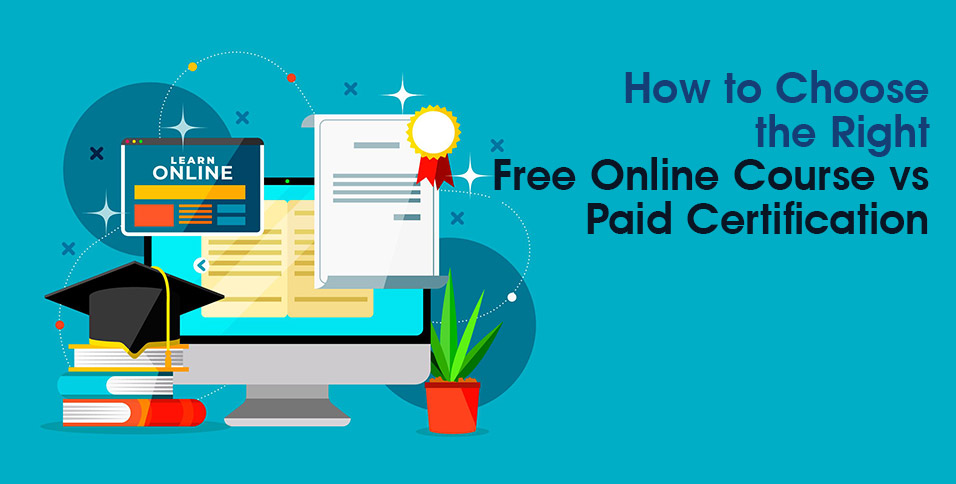
In order to grow in your career nowadays, you need to keep learning new things. There are chances that you are a new professional in a certain field or you are an experienced specialist who needs to learn new things. In both circumstances, you need to learn new things. There are many places on the internet to learn things at your own pace. Among those places are free online courses and paid online courses. It is really up to you to decide, as there are limitless resources, so in order to help you out, we will analyse the positives and negatives of free and paid courses.
How e-Learning is Changing the World
A report by Statista claims that the global eLearning market will be above $400 billion by 2027. Most learners today prefer education that is flexible and on demand. It allows them to balance everything in their life.
There are free online courses that offer educational opportunities that are open and help people get a high-quality education. Over free online courses, there are paid courses that offer a clear-cut learning outline so you can learn the most in the least amount of time, and they validate your education. Knowing the differences between the two can help in deciding your career more closely.
What Are Free Online Courses?
Free online courses are educational programs that cost nothing. Free courses are offered by platforms like SkillUp by Simplilearn, Coursera, edX and Udemy in various fields such as digital marketing, data analytics and AI.
These courses suit:
- Getting an introductory feel of a subject before making a financial commitment.
- Acquiring the basics of a topic to refresh or enhance a foundational skill.
- Learning at your own pace and your own schedule.
Pros of Free Online Courses:
- No financial commitment required.
- They are great for self-learners and complete novices.
- There are expert tutorials in video format and other resources available.
Cons:
- Mentorship and support are limited by an instructor.
- There is no formal certificate or guidance for a career.
- Industry recognition may not exist.
When the goal is to discover interests or learn new skills quickly, free courses are excellent. But if career growth or professional recognition is the main goal, these may not be an adequate choice.
What Are Paid Certification Programs?
Paid certification programs are not just surface-level. There is structured learning with depth that is also available in its level classes. There is also real-world training, mentorship, project work and the added possibility of job assistance.
A great example is Simplilearn’s Professional Certificate in Digital Marketing or Data Analytics, where interactive expert sessions, knowledge earning and credibility with a certifying sponsoring organisation can be gained.
Pros of paid certification programs
- You get a well-rounded and valuable learning experience because of a good structure in the course curriculum.
- You learn with experience because of project-based learning.
- You get course certificates to boost your resume.
- You get access to feedback and help from instructors.
- You get help with networking and guidance.
Cons
- It’s going to cost a lot of money.
- You need to structure your time and get disciplined.
Even with the costs of the certification and courses, you can gain a lot of value in your career from them. You can help level up your career and build a lot more of your employability and your salary with them.
Free Courses vs Paid Certification
| Features | Free Online Courses | Paid Certification |
| Course cost | Free | Paid (varies by provider) |
| Learning depth | Basic to Intermediate | Intermediate to Advanced |
| Certificate Recognition | Usually not recognized | Usually acknowledged in your industry |
| Instructor Support | Limited | Usually active, with much mentoring and guidance |
| Career Support | Minimal | Good help and assistance with finding a job |
| Your experience | Okay for beginners/hobby learners | Better for focused career professionals |
It is clear, from the above comparison, that the best course primarily rests with you. You can explore a new and unfamiliar topic with a free course. Paid certification can be a stepping stone in building new, valuable skills in your field or advancing in your career.
When Should You Choose a Free Online Course?
You should choose a free online course if you are:
- Exploring a new field (e.g. Digital Marketing, Data Science, or Ai).
- Wanting to focus on the foundational level in a new field before investing much.
- On a tight budget or want to complete your learning on your own time.
Example:
Having little to no coding experience, it’s good to start with a free coding Python course to learn the coding basics, and then buy the more expensive course with additional features that focus on more advanced projects.
Pro Tip:
Use free courses as a way to figure out your learning interests before choosing a more expensive and structured certification course.
When Should You Pick a Paid Certification Program?
If you are getting ready for a job promotion or a shift in your career, need a worthwhile credential to support your skills, and prefer learning with more guidance through hands-on projects and mentorship, choose a paid certification.
Example:
If you know the basics of digital marketing, getting a paid certification through recognised platforms like Simplilearn or Google can further enhance your profile and make you a more attractive candidate to employers.
Pro Tip:
Many employers are looking for candidates who don’t just know the subject but are also certified in the skills that go along with the subject and can demonstrate real-world applications for the subject.
How to Make the Right Decision
There are several parameters to consider when choosing between free v/s paid course offerings:
1. Determine the Purpose
Are you learning to satisfy your curiosity or enhance your career?
Will you need a badge because you want to showcase your skills?
When learning is about moving up in your career, paid certifications tend to offer better returns.
2. Understand the Course Provider
Strong partnerships in the industry, credible teaching staff, and neutral success stories from learners are all positive indicators of course offerings. Paid certifications from reputable course providers add value to your resume.
3. Assess the Course Content
Does the course include:
- Real-time classes or mentorship?
- Projects or case studies?
- Assessment or certification?
These are all essential for learning to be practical and the skills to be validated.
4. Consider Available Resources
While free courses allow for flexibility, their structure is not always sound. Conversely, paid courses are usually well designed, so while they require work, they are not a waste of time.
5. Evaluate Potential Opportunities
Take the time to identify job roles and sectors where certifications are in high demand. For example, positions in cloud computing, cybersecurity, or data analytics tend to need formal certifications.
Conclusion: Embracing Blended Learning
If your end goal is to learn effectively, your best bet is probably a mix of paid and free resources. Check out a few free online courses to help you determine your interests and learn a bit. From there, you can invest in a course or program that has a paid certification to help build your skills and to get some recognition for your hard work.
Online education is a great way to upskill, but be sure to tailor your choice to your own interests and career.
If you are intent on building an impressive career, sign up for many of the free courses out there, then try to complete a few paid courses and certifications to help elevate your resume and professional online presence.