In the intricate, high-stakes world of digital business, a professional’s LinkedIn account is no longer just a profile; it is a critical piece of operational infrastructure. This new reality is what makes a technical tool like the Linkedin proxy which is a dedicated, private IP address that acts as a secure, professional gateway for all your account activity, a subject of urgent strategic importance. The conversation around proxies is rapidly moving out of the back alleys of black-hat marketing and into the boardrooms of legitimate, high-growth companies. Why? Because as LinkedIn’s algorithmic security systems become more sophisticated, the risk of a catastrophic, business-halting account restriction due to a simple misunderstanding of digital best practices has never been higher.
To understand the sudden urgency around proxies, you have to appreciate the profound shift in how LinkedIn polices its platform. In its early days, the platform was a relatively passive digital landscape. Today, it is an active, heavily monitored ecosystem, patrolled by an increasingly intelligent AI designed to detect and neutralize any behavior that deviates from a “normal” human pattern. Think of this AI as a digital bouncer at the world’s most exclusive business club. It’s looking for subtle, contextual anomalies.
This is where the very nature of modern business which is global, remote, and agency-driven comes into direct conflict with the platform’s security model. The algorithm’s definition of “normal” is still largely based on an outdated paradigm: one person, in one location, using one computer. The moment a business begins to scale its operations, it almost inevitably begins to generate the kind of digital footprints that this AI is trained to see as suspicious.
The New Red Flags: How Legitimate Businesses Get Mistaken for Bots
The most common and most dangerous red flag is IP address inconsistency. Consider a modern digital marketing agency. A single account manager might be responsible for managing the LinkedIn presence of five to ten different clients. If that manager logs into all ten of those accounts from the same, single IP address in the span of an hour, they have created a data signature that looks almost identical to a malicious actor attempting to take over multiple accounts. It’s a massive, unmissable red flag that can get the agency’s IP address blacklisted and, in a worst-case scenario, all of their clients’ accounts restricted simultaneously.
The second major red flag is geographic volatility. A high-growth tech startup might have its CEO in London, its Head of Sales in New York, and a key marketing team member in Southeast Asia, all of whom need to access the main corporate LinkedIn page or the CEO’s personal account for outreach and brand management. To the algorithm, a login from London at 9 AM, followed by a login from Singapore at 11 AM, looks like a classic account hijacking attempt. This can trigger a security lockout, freezing the company out of its most important social channel at a critical moment.
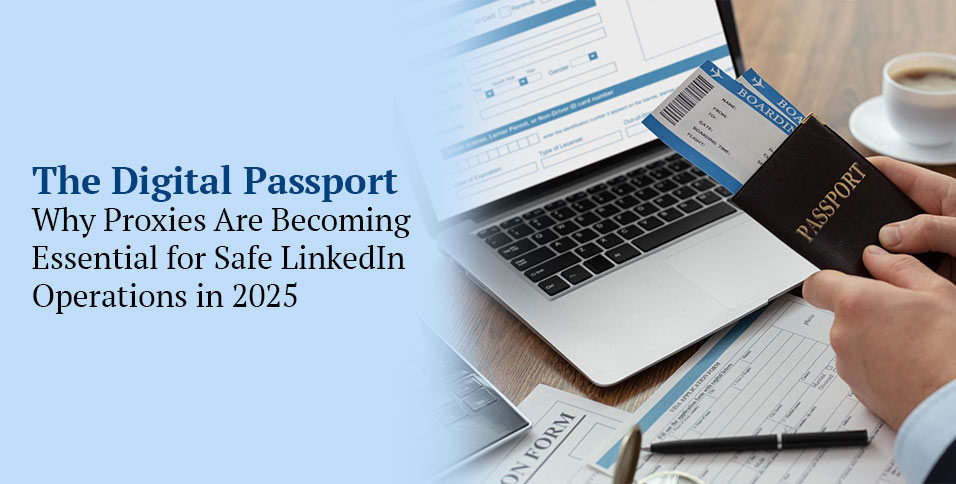
This is the core problem that a proxy is designed to solve. A dedicated, high-quality proxy acts as a stable, professional, and consistent “digital passport” for a LinkedIn account. For the marketing agency, it means assigning a separate, clean, dedicated proxy to each client account. All activity for Client A is now routed through an IP address in Manchester, while all activity for Client B is routed through one in Bristol. For the global startup, it means routing all key account access through a single, secure proxy located in their primary market, ensuring that all activity appears to originate from a consistent, professional location, regardless of where the team member is physically located.
The Dark Side: The Peril of the Cheap, Shared Proxy
This urgent need for proxies has created a booming, but treacherous, market. The temptation for a budget-conscious business is to opt for cheap, “shared” proxies. This is, without a doubt, the single most dangerous mistake a professional can make. A shared proxy is the digital equivalent of trying to build a respectable business out of a known getaway car. You are sharing an IP address with dozens, if not hundreds, of other anonymous users. You have no idea what they are doing. If another user on your shared IP is engaging in spammy or illicit activities, that IP address will get blacklisted by LinkedIn, and your account will be found guilty by association. In this case, a cheap proxy is far more dangerous than no proxy at all.
The Professional’s Stack: Integrating Proxies with Safe, Intelligent Automation
So how does a business navigate these risks and unlock the real opportunities of scalable outreach? The solution is in building a professional-grade technology stack where the proxy is just one part of a broader, safety-first architecture. This is where the choice of automation tool becomes absolutely critical.
A professional-grade platform like Linked Helper is designed for this very scenario. Its most significant advantage is its architecture. It is a downloadable application that runs locally on your computer, which already makes its activity appear far more human than a cloud-based bot that operates from a data center IP. Crucially, it is designed to integrate seamlessly with a dedicated proxy. An agency or a sales team can assign a specific, clean, dedicated proxy to each individual LinkedIn account they manage within the tool.
This combination of a safe tool and a clean IP address is the professional standard for 2025. It allows a business to confidently deploy sophisticated, multi-step message automation campaigns that mimic a human-first cadence. It’s about orchestrating a patient “warm-up” of profile views and post likes before a connection request is ever sent. This intelligent strategy, executed through a secure, professional infrastructure, is how you scale your outreach without raising your risk profile. It signals to the platform’s algorithm that you are a serious, professional entity, not a fly-by-night spammer.
For the modern business leader, a LinkedIn proxy is a strategic investment in stability, security, and scalability. It’s a recognition that in a global, digital-first economy, your IP address is a core part of your professional identity. Choosing the right one, and pairing it with the right tools, is one of the most important, and most overlooked, decisions a growing business can make.