Mirror Review
December 04, 2025
The latest Salesforce Q3 Earnings reflect a new trend inside one of the world’s biggest enterprise software companies.
For years, Salesforce depended on its traditional sales, service, and marketing clouds for most of its growth. But Salesforce Q3 2025 marks a new era. AI products are no longer side offerings. They are now the company’s strongest and fastest-growing revenue engine.
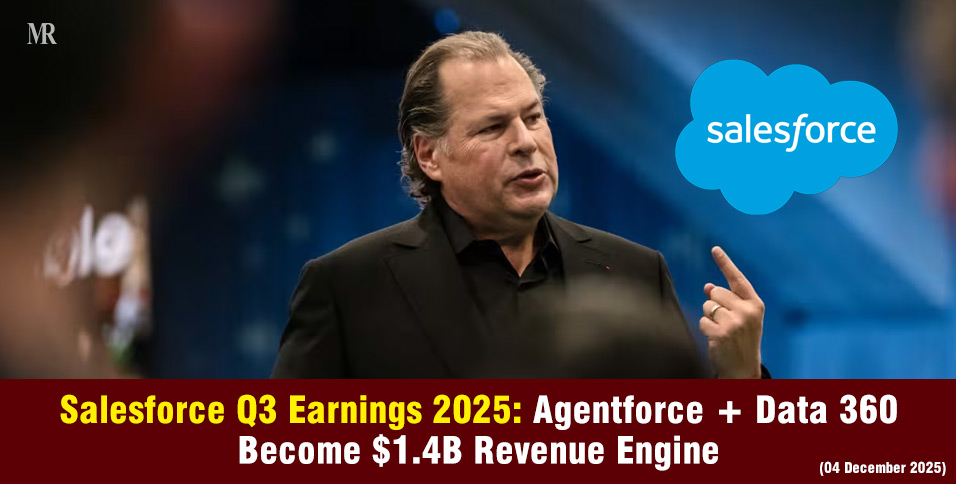
Marc Benioff, Chair and CEO of Salesforce, says the company’s AI momentum is “exceptional,” as Salesforce Q3 Earnings reveal that Agentforce and Data 360 together have reached $1.4 billion in Annual Recurring Revenue (ARR).
This changes Salesforce’s identity to an AI-first enterprise platform.
The New Revenue Powerhouse Inside Salesforce
Salesforce has been through multiple reinvention cycles since its founding in 1999. But the shift from CRM to “AI CRM” may be the company’s most dramatic change yet. The driving force behind this comes from two specific units:
- Agentforce
This includes AI-powered sales and service agents that automate tasks, handle queries, and drive productivity.
- Agentforce ARR passed $500 million, growing 330% year over year
- Salesforce closed more than 9,500 paid Agentforce deals, a 50% jump in one quarter
- Businesses processed 3.2 trillion tokens through Agentforce’s LLM gateway
- Data 360
This is Salesforce’s data unification and governance layer.
- 32 trillion records ingested this quarter
- Zero-copy ingestion up 341% year over year
- Unstructured data processing up 390%
Together, these two pillars reached $1.4 billion in ARR, making them the fastest-growing product line in Salesforce history.
Benioff said the surge in demand signals the rise of “the agentic enterprise,” where companies automate meaningful work across departments, not just small tasks.
Why Agentforce and Data 360 Are Growing This Fast
From an industry perspective, the reason is simple. Businesses are done experimenting with AI. They now want:
- Automated workflows that reduce labor costs
- Reliable data pipelines that make AI outputs useful
- Scalable platforms that integrate with existing systems
Agentforce delivers the automation.
Data 360 delivers the clean, structured, connected data.
For enterprise buyers, the combination is attractive because it does not require rebuilding their tech stack from scratch. Salesforce already lives at the center of sales, service, and marketing operations, so plugging AI into existing workflows is far easier.
This explains why half of all AI bookings came from existing customers, not new ones. Companies are upgrading instead of migrating.
Understanding the Shift in Salesforce’s Business Model
Historically, Salesforce’s growth depended on its core clouds:
| Segment | Q3 FY26 Revenue |
| Agentforce Service (Service Cloud) | $2.495B |
| Agentforce Sales (Sales Cloud) | $2.297B |
| Platform, Slack & Other | $2.180B |
| Integration & Analytics | $1.393B |
| Marketing & Commerce | $1.361B |
As seen in the 2025 Salesforce Q3 Earnings, Service Cloud remains the largest contributor. But Platform, Slack, and AI layers posted the strongest acceleration with 19% constant-currency growth.
In short, the money still comes from Salesforce being a CRM giant, but the growth now comes from AI.
That distinction matters because it suggests where enterprises are headed.
Companies no longer want only CRM tools. They want CRM systems that act rather than report. They want automation, predictions, and intelligent support.
The Informatica Acquisition Signals a Bigger Strategy
Salesforce also completed its acquisition of Informatica this quarter. This move is strategic since AI is only as good as the data behind it, and Informatica brings:
- Data catalogs
- Integration
- Governance
- Data quality tools
- Master data management
- Metadata and privacy layers
This expands Salesforce’s ability to handle enterprise-grade AI deployments. It is also why Data 360’s adoption numbers spiked so rapidly this quarter.
The logic is clear. To sell AI successfully, Salesforce must sell data readiness too.
Financial Strength Reflects Customer Confidence
Several financial metrics signal strong customer commitment:
- Current remaining performance obligation (cRPO): $29.4B, up 11%
- Total RPO: $59.5B, up 12%
- Operating cash flow: $2.3B, up 17%
- Free cash flow: $2.2B, up 22%
These numbers show that customers are locking in long-term contracts and that Salesforce continues to generate strong cash despite heavy AI investments.
Why Salesforce’s AI Strategy Is Working
A few factors explain the momentum:
- AI built for the enterprise, not consumers
Salesforce focuses on workloads that directly affect revenue and customer service.
- Deep integration with existing systems
Companies do not switch CRM easily. They expand what they already have.
- AI that is governed and safe
Data governance is now a mandatory requirement for regulated industries.
- Clear ROI
Automating support tickets, enriching customer profiles, and removing manual work produce tangible financial benefits quickly.
Salesforce’s advantage is not that it builds the most powerful models. Its advantage is that it builds AI that integrates into the systems that businesses already use every day.
The Larger Story Behind Salesforce Q3 Earnings
The bigger picture is that Salesforce has entered its next chapter
The company is no longer simply the world’s number one CRM platform. It is positioning itself as the operating system for enterprise AI.
If the company continues to grow AI ARR at this pace, it will reach Benioff’s long-term goal of exceeding $60 billion in organic revenue within the decade.
Salesforce’s Profitable Growth Framework also targets a combined operating margin and revenue growth rate of 50 by FY30. And Salesforce Q3 results show real progress toward that target.
Conclusion
The Salesforce Q3 Earnings report makes one thing clear. The company has crossed a threshold. Agentforce and Data 360 are no longer emerging products.
They have become a central revenue engine, and their $1.4 billion ARR signals the beginning of Salesforce’s AI-first era.
As more enterprises shift from AI experimentation to operational deployment, Salesforce is positioned to become one of the most influential AI platforms in the business world.