Mirror Review
November 24, 2025
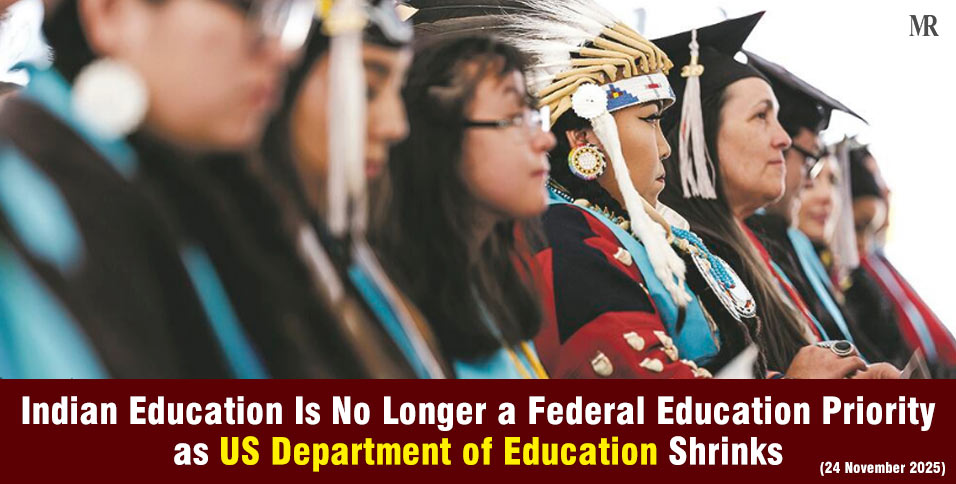
Native American Indian Education programs are no longer part of the US Department of Education after the agency signed new agreements that transfer all administrative responsibilities to the Department of the Interior.
This comes as the US is reducing the Education Department’s role while redistributing long-standing federal programs to agencies considered “a better administrative fit.”
As these changes are implemented, they show a restructuring of federal education priorities, not just an administrative reorganization.
To understand the impact, it helps to look at how this restructuring affects the department’s core responsibilities. But first, it is important to understand what the US Department of Education actually does.
What does the US Department of Education do?
The US Department of Education oversees federal education policy, distributes funding to schools and colleges, enforces civil rights protections for students, and ensures equal access to education across the country.
It does not run schools directly, but it sets national standards, manages grants, and supports states with resources, research, and regulations.
A Federal Restructuring Begins in the US
On November 18, 2025, the US government announced a broad federal restructuring that moves core education programs out of the Department of Education.
The federal restructuring decision is made through six interagency agreements with the Departments of the Interior, Labor, Health and Human Services, and State.
These agreements collectively transfer dozens of programs affecting millions of students nationwide.
- The US Department of Education says the move is intended to “break up the federal education bureaucracy” and return more control to states.
- Education Secretary Linda McMahon framed the reorganization as a long-promised step. She said the agency is “taking bold action to return education to the states and empower local leaders.”
However, this restructuring also redirects federal oversight away from a centralized education body. It raises concern that the fragmentation may slow services for communities that depend on specialized support.
Why Native Indian Education Was Moved
The most consequential transfer sends Indian Education (serving Native American students) programs to the Department of the Interior, which already oversees the Bureau of Indian Affairs and the Bureau of Indian Education.
According to officials, this will “solidify Interior as the key point of contact for Tribes and Native students.”
Interior Secretary Doug Burgum said the partnership will make Indian Education “stronger, more accountable, and fully dedicated to ensuring Native students are prepared for success.” He added that it marks “the beginning of a brighter future where Native students and their communities are empowered with the tools they need to thrive.”
Even so, tribal leaders across the country have raised concerns about limited consultation and the risk of disruptions during the transition.
They argue that Interior already faces operational pressure and that shifting education duties may strain programs serving Native youth.
Inside the Strategy to Shrink the US Department of Education
This year, the US Department of Education has faced layoffs, court battles, and internal disruptions as the administration continues to pursue its long-stated goal of reducing the department’s footprint.
The new agreements enable the government to transfer programs without congressional approval, thereby accelerating the restructuring.
In an internal meeting, Secretary McMahon described the changes as “a piecemeal way to move toward the ultimate goal” of reducing the department’s size.
In contrast, a staff member who attended said “not one person applauded,” describing morale as “completely lost.”
Several employees told reporters that the sudden transfers “make no sense” and create more confusion, not less.
The department once had more than 4,000 employees, but now has about 2,700, following mass layoffs, a reduction-in-force order, and continued workforce uncertainty.
What Other Programs Are Moving
The agreement affecting Indian Education (serving Native American students) is only one part of a broader decentralization effort.
Major transfers as the US Department of Education dismantles include:
- K-12 programs to the Department of Labor
- Postsecondary grants to the Department of Labor
- Child care grants for student parents to HHS
- Foreign medical school accreditation oversight to HHS
- Fulbright-Hays international education programs to the State Department
Labor Secretary Lori Chavez-DeRemer said the shift will create “a cohesive, unified strategy for talent development” across education and job training.
The State Department officials also emphasized efficiency.
Secretary Sarah Rogers said moving language and international study programs “will strengthen and streamline funding while advancing national security interests.”
These changes expand the administrative load for other federal agencies while shrinking the Education Department’s operational role.
Why the Transfer Matters for Tribal Communities
Indian Education programs include funding for
- Native language development
- Academic support
- Tribal education agencies
- Adult learning
- Career pathways
These services operate across rural, reservation, and urban Native communities.
The Department of the Interior says the move will coordinate support more effectively. But many education leaders caution that the transition could slow services, especially during grant cycles and technical assistance periods.
Rachel Gittleman, president of AFGE Local 252, which represents many Education Department employees, said the shift “weakens the national mission to support students” and risks scattering essential services across departments not equipped for them.
As more responsibilities shift away from a centralized agency, states and tribes will need clearer guidance to ensure students do not face interruptions in essential services.
Political Reactions Show Sharp Divides
There are mixed reactions to the Department of Education restructuring.
- Republican lawmakers applauded the move as overdue government reform.
- Democrats, including Senator Elizabeth Warren, called it “an assault on public education.”
- Teacher unions warned of “abandonment” of students.
- Education experts said shifting programs does not simplify the system, but rather “unleashes chaos.”
Critics argue that the transition bypasses congressional oversight and sets a precedent for future federal restructuring without public accountability.
What This Signals for Federal Education Policy
The transfer of Native American Indian Education out of the US Department of Education highlights huge changes in federal education strategy:
- A smaller central education authority
Programs shift to specialized agencies while ED retains oversight but loses capacity.
- Greater emphasis on workforce alignment
Labor’s expanded role suggests a federal shift toward job-centered education models.
- Fragmented service delivery
With programs split among Interior, Labor, HHS, and State, coordination may become more complex.
- Long-term structural change
If Congress later authorizes a full department closure, these moves will serve as the foundation.
This shows that the future of federal education will rely less on a single agency and more on a distributed network of departments.
Conclusion
The relocation of Native American Indian Education programs to the Department of the Interior marks a significant change in how the federal government organizes education responsibilities.
As the US Department of Education continues to shrink, essential programs are now spread across multiple agencies, creating both opportunities for improved alignment and risks of service gaps.
- Supporters argue that the restructuring reduces bureaucracy.
- Critics fear it weakens federal oversight and leaves vulnerable communities in uncertain territory.
Yet, the long-term impact will depend on how effectively the Interior Department manages its expanded role and whether federal coordination remains strong enough to support students nationwide.