1. Talk First, Regret Later
Let’s be honest — I talk way more than I type. Half my best ideas are mumbled somewhere in a voice memo called “final_v4_really_final.” You’ve got them too, right? Those late-night recordings where you sound like you’ve swallowed your phone and a bad idea? For a long time, I just let them sit there. Hours of audio. Zero text. Zero progress.
Then one day, after spending thirty minutes trying to remember what I said in a recording from last week, I snapped. I thought, “There’s got to be a smarter way to convert audio to text online.” Turns out, there was — and it didn’t involve typing till my fingers begged for mercy.
2. Stop Typing Like It’s 1999
Typing feels ancient now. We talk to our phones, shout at smart speakers, and argue with our GPS — but we still type meeting notes like it’s Y2K. It’s madness. When I discovered I could upload an audio file and watch it transform into readable, searchable text, it felt like magic.
And not the card-trick kind — the “I just saved two hours of my life” kind. With online tools, I can drag, drop, hit ‘Start Transcribing’, and walk away. Suddenly, I’m free to focus on ideas instead of finger cramps. You don’t need to be a tech guru either; it’s literally click, upload, done.
3. Let the Machines Do the Heavy Listening
The beauty of these tools isn’t just speed — it’s sanity. I used to listen to the same interview five times, trying to catch every word. Now? I let the AI handle it. It doesn’t yawn, it doesn’t get distracted, and it doesn’t accidentally write “cat video” when I meant “cash value.”
Sure, AI isn’t perfect — once it thought I said “pigeon strategy” instead of “vision strategy” — but it’s getting close. Some tools are even smart enough to detect speakers and format the dialogue automatically. That means no more guessing who said what in that chaotic group discussion that sounded like everyone was talking underwater.
This is where platforms like DeVoice.io come in handy. I use it when I want my audio cleaned up before transcription — no background chaos, just crisp words ready to become text. It’s not real-time, but it sure feels like a professional sound editor living in my laptop.
4. How to Convert Audio to Text with Devoice?
Step 1: Upload Your Audio File
Click the Upload Audio button and choose your file. Devoice supports multiple formats including MP3, WAV, M4A, AAC, and more.
Step 2: Let AI Transcribe Automatically
Once uploaded, Devoice’s AI speech recognition engine instantly begins converting your audio into text. You can track progress in real time.
Step 3: Export or Copy Your Text
Download the text in your preferred format — TXT, DOCX, or PDF — or simply copy it for use in blogs, captions, or research notes.
That’s it! In under a minute, your spoken content becomes polished written material.
5. Speak Up, Don’t Type Down
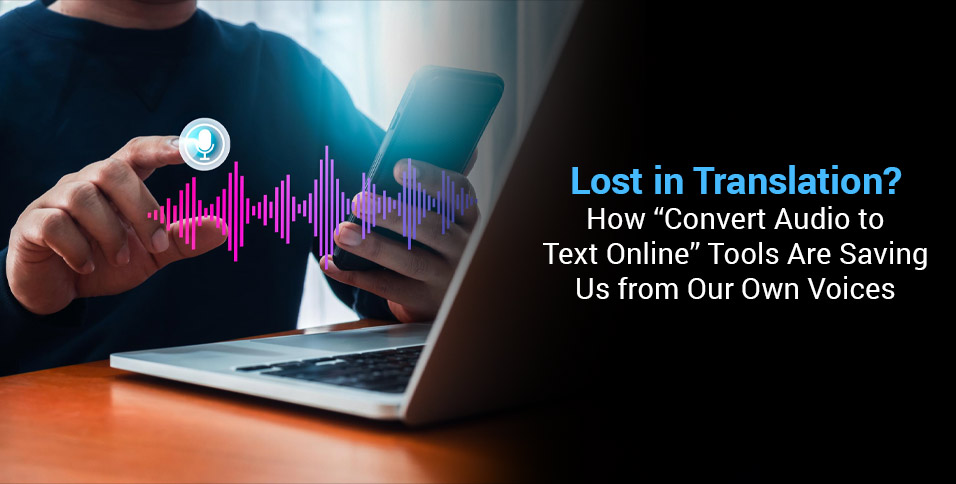
Here’s the thing: people think faster than they type. You’ve probably noticed it too — you hit ‘Record’, start talking, and ideas just flow. That’s why I swear by audio-first thinking. I’ll record a messy voice note, toss it through a convert audio to text online tool, and boom — instant draft.
This workflow changed how I create. It’s faster, freer, and way more human. I don’t filter myself mid-sentence anymore. I just speak, convert, edit, and share. And when I want the audio to sound extra clean before transcribing, I run it through DeVoice.io to smooth out the noise. Two clicks, and it sounds like I recorded it in a studio instead of beside my washing machine.
So, next time you’ve got a killer idea, don’t let it die in your voice memos. Just hit ‘Start Recording’, ramble your genius thoughts, and convert audio to text online before they fade into the digital abyss. Trust me — your fingers, your brain, and your cat will thank you.
✨ Final Thoughts
Talking is easy. Writing is work. But with a little AI help, the gap between those two is shrinking fast. We’re entering an age where our voices aren’t just noise — they’re content. And honestly, that’s pretty exciting.
So go ahead, talk it out. You might sound weird, you might mess up, but who cares? Somewhere out there, an algorithm is patiently waiting to turn your rambling brilliance into the next viral masterpiece.